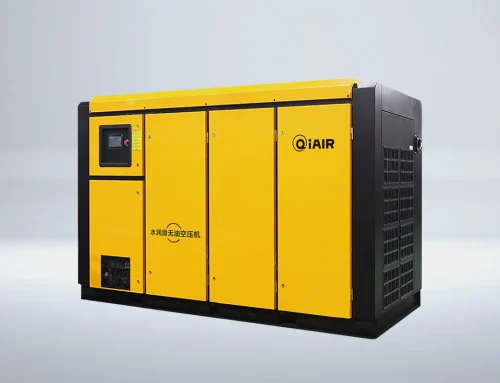
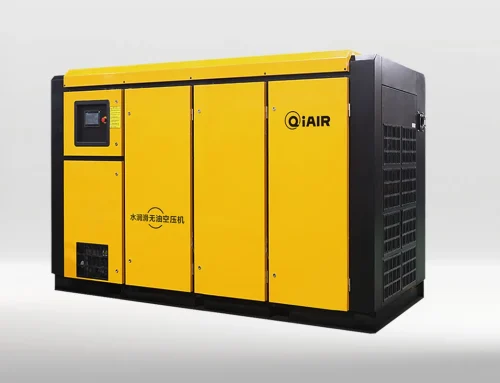
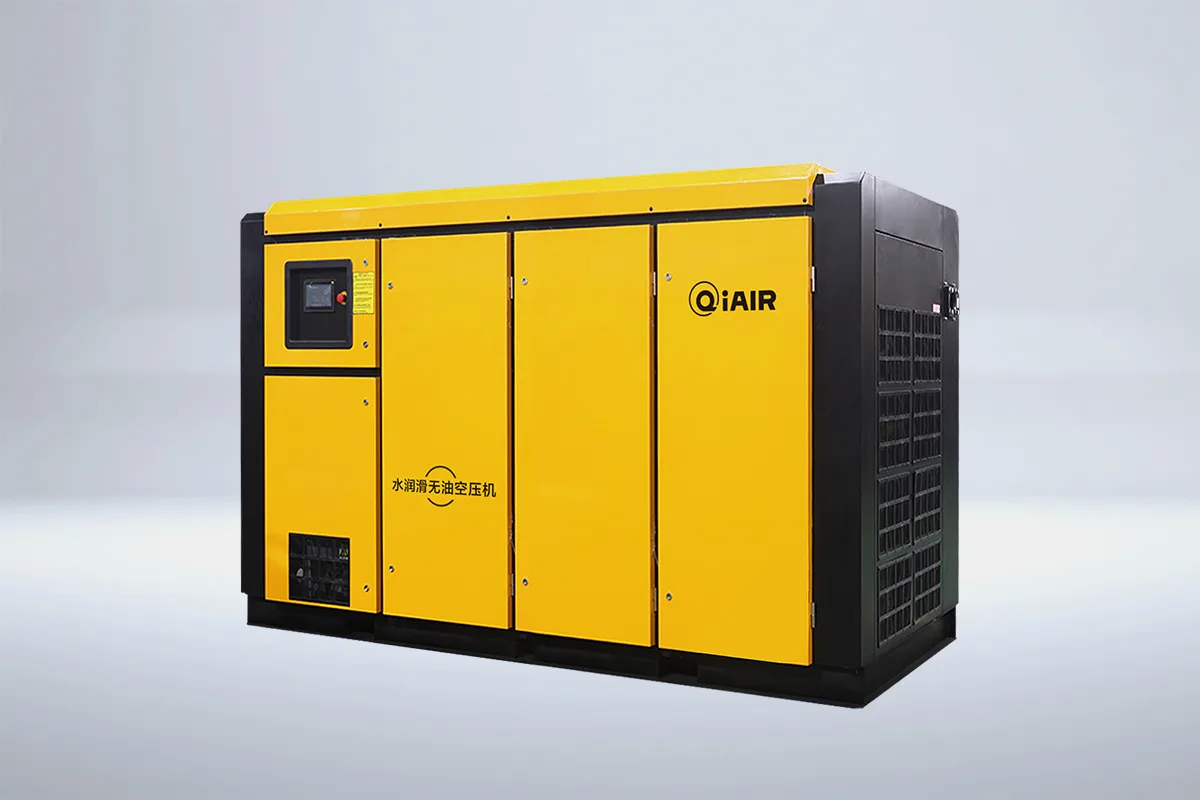
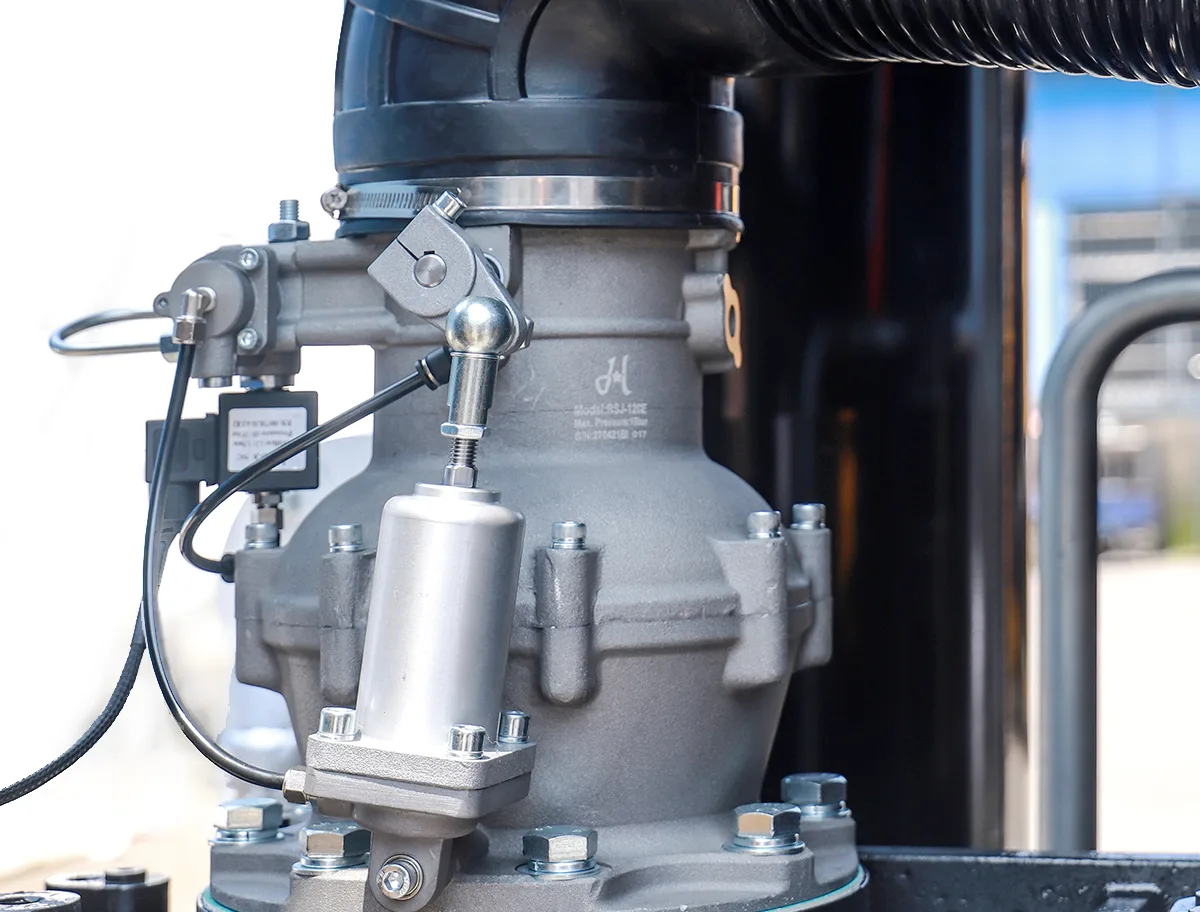
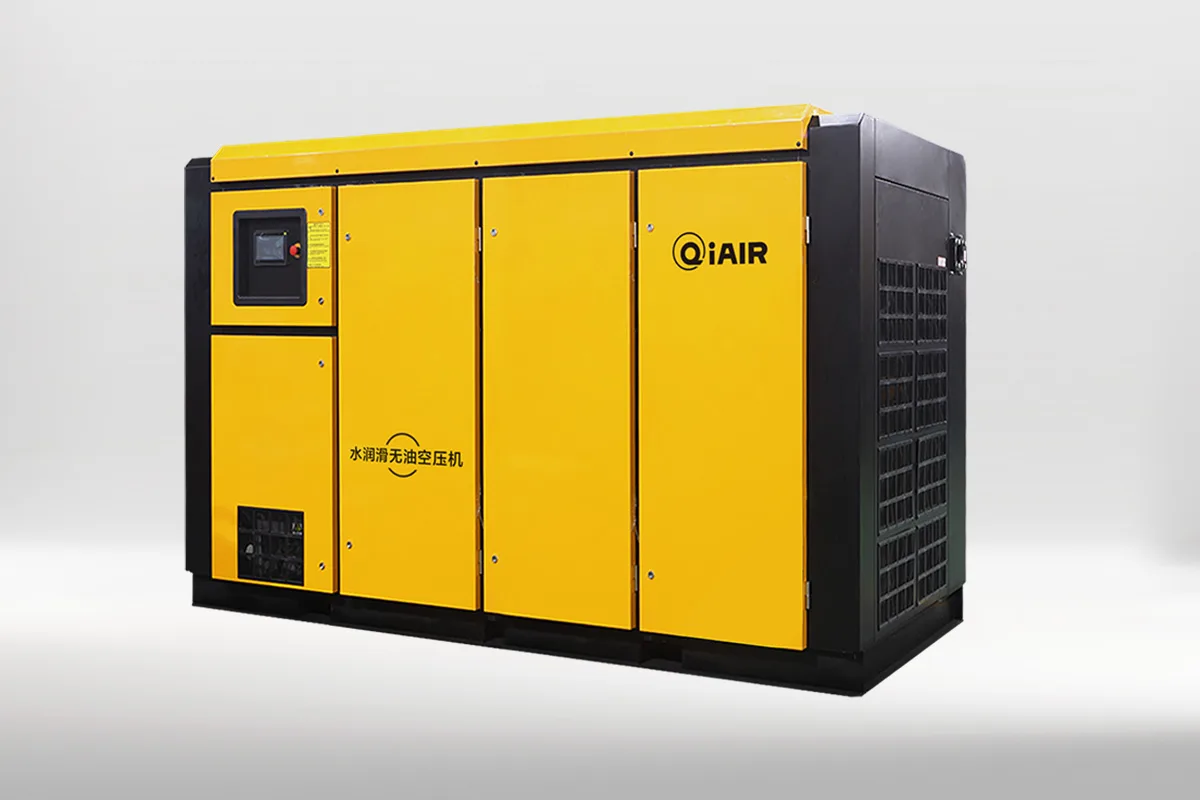
TL;DR — Direct answer: A transformer manufacturing plant typically runs 7 to 8 bar, 8 to 18 m3/min, on 75 to 132 kW rotary screw compressors, with a 3°C pressure dew point dryer and 0.01 micron filtration protecting core cutting, coil winding and vacuum drying from moisture and oil. QiAir, a Chinese screw compressor manufacturer and supplier, sizes systems with dry, stable air so dielectric tests pass first time.
A transformer factory builds the heavy steel and copper machines that step power up and down across the grid, and its work is closer to shipbuilding than to appliance assembly. Silicon steel cores are cut and stacked, copper coils are wound and dried, tanks are fabricated, and every finished unit is oil-filled and tested. Compressed air touches each step, from the slitting line that cuts core steel to the rig that checks insulation.
The product must carry full load for thirty years on a substation, so moisture trapped in a winding or oil in a tank becomes a failure years later rather than a passing unit. Air quality at the cutting, winding and drying stations is therefore a production issue, and utility buyers who audit the factory will ask about it directly.
Core Cutting, Slitting and Stacking
Transformer cores start as grain-oriented silicon steel, slit and cut on lines that use air for clamping, feeding and handling. A cut that drifts because its clamping air sagged leaves a core limb that is out of tolerance, and an out-of-tolerance core hums louder and runs hotter in service. Stable 7 bar air keeps every cut true.
Core stacking is the most air-sensitive job in the steel shop. Laminations are stacked by hand and with air-assisted fixtures, and a lamination shifted by a fixture that moved leaves a gap that raises losses. Regulate the stacking benches to a steady 7 bar and check stack tightness against a standard every shift. A loose stack also raises audible noise, which utility buyers measure during factory acceptance tests.
Steel dust and cutting oil mist drift through the core shop, and dust drawn into the compressor intake scores the airend over time. Duct the intake to clean air outside, fit a heavy-duty pre-filter, and blow out the oil cooler weekly so summer heat does not push discharge temperatures up.
- Hold 7 bar steady at the core cutting line
- Regulate core stacking benches to a steady 7 bar
- Duct the intake away from steel dust and cutting mist
Coil Winding, Insulation and Tank Fabrication
Transformer coils are wound from copper strip and wire on machines that use air for tensioning, clamping and handling. A winding tension that drifts because its air supply sagged leaves a coil that is loose, and a loose coil moves under short-circuit forces. Regulate the winding machines to a steady 7 bar.
Insulation work is the most air-sensitive job in the winding shop. Paper and pressboard are wrapped around coils, and moisture in the wrapping air settles into the insulation and lowers its dielectric strength. Keep the winding branch dried to a 3°C pressure dew point and filtered to 0.01 micron. Wet insulation paper is scrapped, not dried and reused, because its strength never fully returns.
Tank fabrication runs beside the winding shop, and its pneumatic needs are heavy. Steel tanks are welded, blasted and painted with air tools, and a weld that shifts because its fixture moved leaves a tank that leaks oil. Regulate the tank bay to a steady 7 bar and keep its air branch separate from the winding hall.
- Regulate coil winding machines to a steady 7 bar
- Dry winding air to a 3°C dew point
- Regulate the tank fabrication bay to a steady 7 bar
Vacuum Drying, Oil Filling and Dielectric Testing
Vacuum drying is the gate every transformer winding must pass before oil filling. The active part is heated under vacuum for days, and the air used to drive the drying plant valves must be dry, because wet air leaking into the chamber undoes hours of drying. Use desiccant-dried air to minus 20°C dew point on the drying branch.
Oil filling uses air in quieter ways that still matter. Oil is filtered and degassed before it enters the tank, and the air tools used around the filling bay must not carry moisture into an open tank. Keep the filling branch dried and filtered, and never blow oil mist or wet air across an open tank.
Dielectric testing is the final gate before shipping. The transformer is run through impulse, applied voltage and partial discharge tests, and the air used to drive the test rigs must be stable, because a pressure dip can look like a test fault. Keep the test branch filtered and regulated, and log the dew point during every session.
- Dry vacuum-drying air to minus 20°C dew point
- Keep filling-bay air dry and filtered
- Log the dew point during every dielectric test session
Buying from China: Sizing Sheet for Transformer Plants
Before requesting a quotation, gather four numbers: the core cutting and stacking peak flow, the coil winding air demand and its dew point target, the vacuum drying and oil filling air quality specification, and the distance from the compressor room to the furthest winding machine. A supplier that quotes from the transformer output alone will miss the drying specification that actually decides the system.
For most transformer plants the practical range is a 75 to 110 kW variable-speed drive screw compressor at 7.5 or 8 bar, with a refrigerated dryer, a desiccant dryer for the drying branch, 0.01 micron filtration and a 5,000 litre receiver. Larger plants with several winding lines usually run a duty-plus-standby pair so maintenance never stops a drying cycle.
When comparing Chinese suppliers, ask for the full package price including both dryers, filters, receiver and commissioning spares, and confirm the export packing, voltage and documentation for your country. Check the desiccant dryer running cost, the service interval and the availability of filters and airends through the supplier's export channel. QiAir, a Chinese screw compressor manufacturer and supplier, quotes the complete package so buyers compare real installed cost.
- Collect cutting, winding and drying loads before quoting
- Budget 75 to 110 kW VSD plus two-stage drying
- Confirm desiccant running cost, spares and export packing in writing
Frequently asked questions
What pressure does a transformer plant normally run?
Most run 7 to 8 bar at the header, with cutting and winding at 7 bar, tank fabrication at 7 bar, and test rigs held at a steady 6 to 7 bar.
Why does vacuum drying need a desiccant dryer?
A refrigerated dryer at a 3°C pressure dew point leaves enough moisture to undo hours of winding drying. Desiccant drying to minus 20°C keeps the chamber dry.
Can moisture cause a false dielectric test result?
Yes. Moisture in the winding lowers insulation strength and can make a sound transformer look faulty, while oil coats test equipment. Test only with dry, oil-free air.
Should winding air share a line with tank fabrication?
No. Give coil winding and drying their own dryer and filtration branch, so welding dust and blasting grit can never reach insulation paper.
Related reading
- Screw Compressor Heat Recovery: Turning Waste Heat into Factory Savings
- IoT Monitoring for Screw Compressor Rooms: A China Supplier's Practical Setup
QiAir is a Chinese manufacturer and supplier of screw air compressors. If you are sourcing a screw compressor from China — for a factory, a food plant, a construction site or a new production line — contact QiAir for a sized quotation, documented performance data and export support.