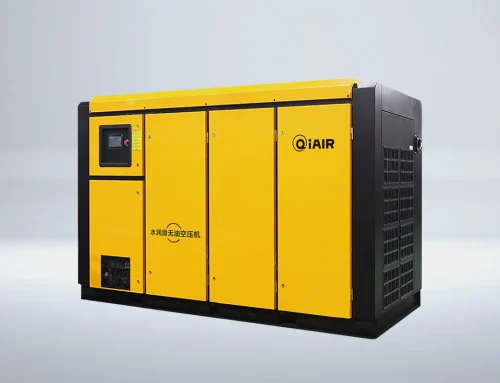
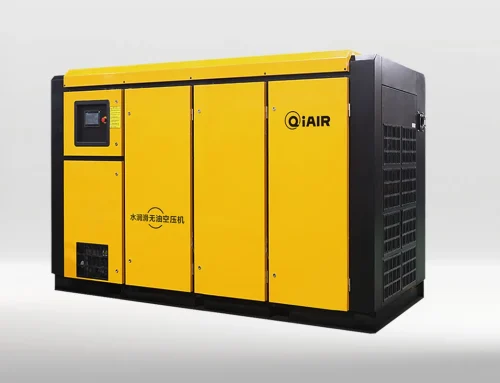
TL;DR — Direct answer: An industrial laundry equipment plant typically runs 7 to 8 bar, 5 to 12 m3/min, on 37 to 90 kW rotary screw compressors, with a 3°C pressure dew point dryer and 0.01 micron filtration protecting drum assembly, valve testing and paint lines from moisture and oil. QiAir, a Chinese screw compressor manufacturer and supplier, sizes systems with clean, stable air so every washer leaves the factory leak-free.
Industrial laundry machines are big steel boxes full of water, steam and moving drums, and their factory has to test every one of those systems before shipping. Washer-extractors are assembled and water-tested, dryers are fitted with gas or steam heating, and ironers are calibrated to press linen flat at high temperature. Compressed air drives the tools and the tests throughout.

The machines will work in hotels and hospitals where a leak or a failed valve is a service call, so the factory test has to be honest. Wet or oily test air can hide a leak during the factory test and then let the machine fail in the customer's laundry, which is why air treatment is a quality issue here.
Drum Assembly, Welding and Sheet Metal Work
Drum assembly is the heaviest job in a laundry equipment plant. Stainless drums are rolled, welded and balanced, with pneumatic clamps holding the shell while the welder works around the circumference. A pressure sag during a weld changes the gap, and the drum then runs out of balance, vibrating the whole machine at spin speed.
Sheet metal work fills the rest of the fabrication hall. Punch presses, brakes and shears form the cabinets and panels, and their air demand is steady but large, with clamping and ejection cycling all day. Metal fines from punching drift into the compressor intake if it sits in the same hall, so duct the intake to clean air outside.
Balancing and alignment need air that is stable as well as strong. The drum is spun on a balancing rig driven by air motors, and a fluctuating supply changes the spin speed enough to hide an imbalance that later shows up as vibration in the hotel laundry.
- Hold 7 bar steady at drum welding stations
- Duct the intake away from sheet metal dust
- Regulate balancing-rig air to a steady 7 bar
Valves, Water Testing and Steam Systems
Water testing is the gate every washer must pass. The machine is filled, run through a full cycle and watched for leaks at every valve, hose and seal, while the test rig uses compressed air to actuate valves and blow water out afterwards. A wet air line can leave moisture in a valve that later corrodes, so the test branch needs its own dryer and filtration.
Pneumatic valves control water, steam and detergent dosing in the finished machine, and the factory tests each valve on air before the machine ships. A valve that sticks because its test air carried oil will stick again in the customer's laundry, so test the valves on clean, dry air at the same pressure they will see in service.
Steam systems add a heat problem to the air system. Dryers and ironers run hot, and the compressor room beside them breathes warm air all day, losing output and running its oil hotter than designed. Ventilate the compressor room separately, keep the oil cooler clean, and never site the intake above a steam line.
- Give water testing its own dryer and filtration branch
- Test valves on clean, dry air at service pressure
- Ventilate the compressor room away from steam heat
Painting, Controls and Final Inspection
Laundry machines are painted to survive a wet, chemical environment, so the paint shop needs air as clean as any coating line. Spray guns need air filtered to 0.01 micron with carbon adsorption, dried to a low dew point and regulated to a steady 6 bar, because a fisheye in the paint becomes a rust point in a laundry within a year.
Control panels are wired and programmed beside the assembly line, and their pneumatic needs are small but exacting. Relay testing, sensor calibration and door interlock checks all need clean air at a regulated 6 bar, and a sticky valve caused by wet air can make a door interlock test fail for no electrical reason. Filter the controls branch separately.
Final inspection runs the machine through a complete laundry cycle, and the air system must keep up with every valve, cylinder and door actuator firing in sequence. A header that sags during the inspection cycle slows the test and can mask a slow valve
- Dry paint-shop air with carbon filtration to 0.01 micron
- Filter control-panel air on a separate 6 bar branch
- Fit a 3,000 litre receiver near final inspection bays
Buying from China: Sizing Sheet for Laundry Equipment Plants
Before requesting a quotation, gather four numbers: the drum welding and sheet metal peak flow, the water-test bay demand and its air quality specification, the paint-shop coating requirement, and the distance from the compressor room to the furthest inspection bay. A supplier that quotes from the machine output alone will miss the test-air specification entirely.
For most industrial laundry equipment plants the practical range is a 37 to 75 kW variable-speed drive screw compressor at 7.5 or 8 bar, with a refrigerated dryer, 0.01 micron filtration, carbon adsorption and a 2,000 to 3,000 litre receiver. Larger plants with several test bays usually run a duty-plus-standby pair so maintenance never stops a machine build.
When comparing Chinese suppliers, ask for the full package price including dryer, filters, receiver and commissioning spares, and confirm the export packing, voltage and documentation for your country. Check the filter element life, the service interval and the availability of filters and airends through the supplier's export channel. QiAir, a Chinese screw compressor manufacturer and supplier, quotes the complete package so buyers compare real installed cost.
- Collect welding, test and paint loads before quoting
- Budget 37 to 75 kW VSD plus dryer and carbon filtration
- Confirm spares, voltage and export packing in writing
Frequently asked questions
What pressure does an industrial laundry equipment plant normally run?
Most run 7 to 8 bar at the header, with drum welding at 7 bar, paint-shop air regulated to 6 bar, and controls on a separate 6 bar branch.
Why does water testing need dry air?
Wet test air leaves moisture in valves that later corrodes, and can hide a leak during the factory test. A dedicated dryer on the test branch keeps results honest.
Does the paint shop need special air treatment?
Yes. Laundry machines live in a wet, chemical environment, so paint-shop air needs 0.01 micron filtration with carbon adsorption and a low dew point to prevent fisheyes and rust points.
Should steam heat affect compressor placement?
Yes. Dryers and ironers run hot, so ventilate the compressor room separately and never site the intake above a steam line, or output and oil life will suffer.
Related reading
- Screw Air Compressor Maintenance Checklist from a China Manufacturer
- How to Size a Screw Compressor: Air Demand Calculation Before You Buy from China
QiAir is a Chinese manufacturer and supplier of screw air compressors. If you are sourcing a screw compressor from China — for a factory, a food plant, a construction site or a new production line — contact QiAir for a sized quotation, documented performance data and export support.