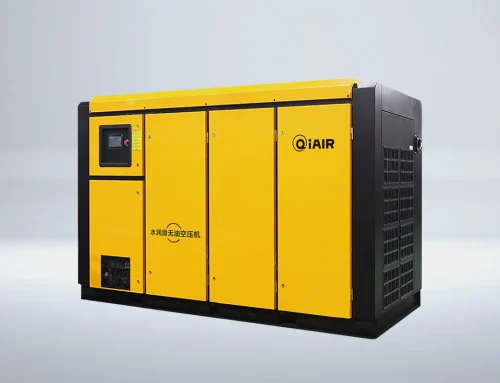
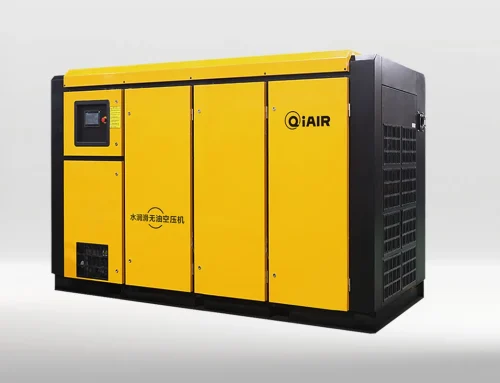
TL;DR — Direct answer: A vacuum pump plant typically runs 7 to 8 bar, 4 to 12 m3/min, on 30 to 90 kW rotary screw compressors, with a 3°C pressure dew point dryer and 0.01 micron filtration protecting precision machining, rotor assembly and leak test benches from moisture and oil. QiAir, a Chinese screw compressor manufacturer and supplier, sizes systems with stable, clean air so vacuum test results stay trustworthy.
Vacuum pump manufacturing is precision work with an ironic twist: the factory that builds vacuum equipment runs on compressed air. Rotors are machined to micron tolerances, housings are ground and honed, and every pump is tested for ultimate vacuum and leak rate before it ships.

The irony goes deeper, because the product itself punishes dirty air. A vacuum pump that leaves the factory with oil or moisture inside will never reach its rated vacuum, and the customer will blame the pump, not the air that built it. Air quality is therefore a product quality issue here, not just a maintenance concern.
Precision Machining and Grinding Air Demand
A vacuum pump plant with eight machining centres and two grinding lines will usually draw 3 to 6 m3/min during steady cutting, rising when several machines change tools at once. Spindle air purge, workpiece clamping and chip blow-off all need clean, dry air, and a purge that carries oil vapour will eventually show up as surface defects on rotors and housings.
Grinding and honing are the least forgiving steps. Coolant mist, fine metal dust and heat all work against air quality, and a honed bore that is blown clean with wet air will corrode before assembly. A refrigerated dryer holding a 3°C pressure dew point, followed by 0.01 micron coalescing filtration, keeps purge and blow-off air dry and clean.
Rotor balancing deserves special attention. Balancing machines spin rotors at high speed and measure vibration to fractions of a gram, and their pneumatic bearings and clamps need perfectly stable pressure. A header that sags during a tool change elsewhere in the plant will corrupt a balance reading. Give the balancing cell its own regulator and a small local receiver.
- Size for simultaneous tool changes, not average cutting load
- Fit 0.01 micron filtration close to grinding and honing cells
- Give the balancing cell its own regulator and receiver
Rotor Assembly and Clean Assembly Rooms
Rotor assembly happens in clean, temperature-controlled rooms where clearances are measured in microns. Pneumatic presses fit bearings, air tools drive fasteners, and lift assists move heavy rotors without damage. Every one of these tools needs dry, oil-free air, because a single oil spot on a bearing race shortens pump life dramatically.
Seals and gaskets are fitted by hand with pneumatic assistance, and the assembly room air must be free of dust as well as oil. Use point-of-use filtration at each assembly station, and keep the assembly room on its own air branch with a dedicated dryer. General workshop air, with its grinding dust and moisture, must never share the assembly header.
Temperature stability matters as much as air quality. Rotors and housings are measured at 20°C, and a hot compressor room next door can drift the assembly room temperature enough to change clearances. Keep the compressor room ventilated and separate, and use insulated pipework where the air line passes through warm areas of the plant.
- Filter assembly air to 0.01 micron at each station
- Keep the assembly room on its own dryer branch
- Separate the compressor room from temperature-controlled assembly
Vacuum Testing and Leak Detection
Every vacuum pump is tested before it ships, and the test itself uses compressed air. Pneumatic valves sequence the test cycle, clamps seal the pump to the test rig, and control air drives the gauges and recorders. A test that fails because supply air dipped looks exactly like a defective pump, so size the system from the test bench demand, not the average plant load.
Leak detection is the most sensitive test in the plant. Helium mass spectrometers and pressure decay rigs measure leaks far smaller than any workshop tool could notice, and moisture or oil in the test air contaminates seals and skews results. Test benches need their own fine filtration and a small dedicated dryer if the main plant dryer sits far away.
Endurance testing runs pumps for hours or days, and the test rig air must stay stable for the whole run. A variable-speed drive compressor holds pressure steady through the long, even load of endurance testing, while a fixed-speed machine cycling on and off introduces small pressure waves that show up as noise in the test data.
- Size the system from test bench demand, not average load
- Give leak test benches their own fine filtration
- Use variable-speed drive for stable endurance test air
Buying from China: Sizing Sheet for Vacuum Pump Plants
Before requesting a quotation, gather four numbers: the count of machining centres and their simultaneous tool-change demand, the assembly room air quality specification, the test-bench flow at maximum throughput, and the distance from the compressor room to the furthest test rig. A supplier that quotes from total installed power alone will miss the test specification entirely.
For most vacuum pump plants the practical range is a 30 to 75 kW variable-speed drive screw compressor at 7.5 or 8 bar, with a refrigerated dryer, 0.01 micron filtration and a 2,000 to 3,000 litre receiver. Larger plants with in-house casting or coating often step up to 90 kW or a duty-plus-standby pair.
When comparing Chinese suppliers, ask for the full package price including dryer, filters, receiver and commissioning spares, and confirm the export packing, voltage and documentation for your country. Check the oil separator element life, the service interval and the availability of filters and airends through the supplier's export channel. QiAir, a Chinese screw compressor manufacturer and supplier, quotes the complete package so buyers compare real installed cost.
- Collect a 15 minute peak load profile before quoting
- Budget 30 to 75 kW VSD plus dryer, filters and receiver
- Confirm spares, voltage and export packing in writing
Frequently asked questions
What pressure do vacuum pump plants normally run?
Most run 7 to 8 bar at the header, regulated down to 6 bar at machining cells and 5 to 6 bar at test benches, so tools and test rigs see stable pressure all shift.
Why is air quality a product issue for vacuum pumps?
Oil or moisture inside a finished pump prevents it reaching rated vacuum, and the customer blames the pump. Clean, dry assembly and test air protects the product itself.
Do leak test benches need their own dryer?
Yes, if the main dryer sits far away. A small dedicated dryer and fine filtration at the test bench keep moisture and oil out of seals and stop false leak readings.
Should balancing machines share the main header?
They can, but give the balancing cell its own regulator and a small local receiver, so a tool change elsewhere in the plant never corrupts a balance reading.
Related reading
- Single-Stage vs Two-Stage Screw Compressors: Which One a China Manufacturer Recommends
- Buying Screw Compressors from China: A Ranking Checklist for Choosing a Supplier
QiAir is a Chinese manufacturer and supplier of screw air compressors. If you are sourcing a screw compressor from China — for a factory, a food plant, a construction site or a new production line — contact QiAir for a sized quotation, documented performance data and export support.