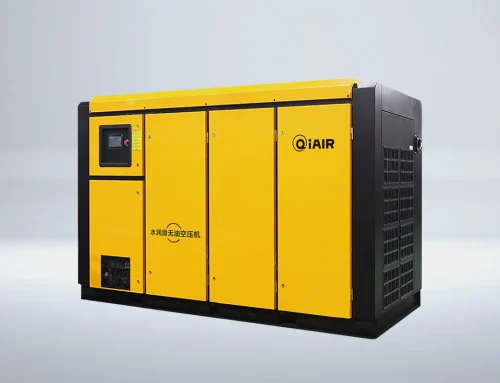
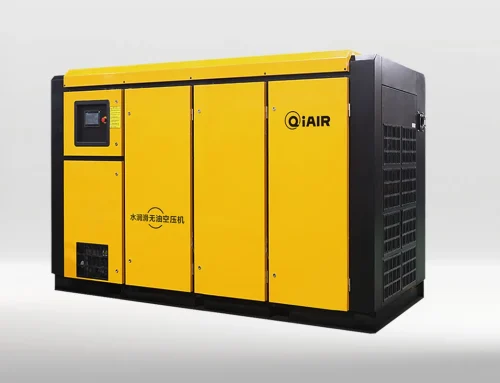
TL;DR — Direct answer: A telecom equipment plant typically runs 6.5 to 7.5 bar, 5 to 14 m3/min, on 45 to 110 kW rotary screw compressors, with a 3°C pressure dew point dryer and 0.01 micron filtration protecting SMT lines, conformal coating and RF test benches. QiAir, a Chinese screw compressor manufacturer and supplier, sizes clean, oil-free air systems so a single moisture event never scraps a batch of boards.
Telecom equipment factories are clean, quiet and deceptively demanding on compressed air. Surface-mount lines place thousands of components per hour, reflow ovens run continuously, and test benches check every board before it ships. The air system rarely makes noise, which is exactly why it gets ignored until a moisture event ruins a production run and the failure is blamed on solder paste or a faulty component.

The difference from heavy industry is the cost of a single failure. A scrapped telecom board carries expensive chips, a tight delivery schedule and a customer who tests every unit on arrival. Air quality is therefore a yield issue, not a utility issue.
SMT Lines, Pick-and-Place and Reflow Ovens
Pick-and-place machines use vacuum and compressed air together, and the air side drives component feeders, nozzle changers and board conveyors. A pressure dip during a feeder index causes a missed pick, and a missed pick on a high-speed line becomes a board that needs rework or scrap.
Reflow ovens and wave soldering add a thermal load that affects air quality downstream. Warm air carries more moisture, and a dryer that is sized for a cool compressor room will underperform when the oven hall heats up in summer.
Screen printing and solder paste handling are sensitive to humidity in the surrounding air as well as in the supply lines. Pneumatic stencil cleaners and board handling arms that blow moist air across a printed board change paste behaviour before reflow. A point-of-use filter and a short, dedicated drop to each SMT line reduce the length of pipe where condensate can form, and daily drain checks on those drops catch problems early.
- Hold header pressure within 0.2 bar for pick-and-place lines
- Size dryers for the hottest inlet temperature, not catalogue rating
- Use short dedicated drops with point-of-use filters per SMT line
Conformal Coating, Potting and Enclosure Assembly
Conformal coating booths spray thin protective layers over finished boards, and the atomising air must be oil-free and dry. Oil carryover shows up as coating dewetting, where the film pulls away from the board in patches, and the defect is often discovered only at final inspection. A coalescing filter pair plus an activated carbon stage on the coating branch, changed on schedule, is cheap insurance against a batch of rework.
Potting and encapsulation stations use air to drive dispensing guns and to hold moulds closed while resin cures. Air bubbles in a potting compound come from wet or pulsating supply air, and a bubble over a high-voltage section is a field failure waiting to happen. A stable regulated supply at 6 to 6.5 bar, with a small accumulator at each dispensing station, smooths the pulses from neighbouring equipment and keeps dispensing consistent.
Enclosure assembly for base stations, routers and outdoor cabinets uses air tools, riveting and sealing. Outdoor enclosures are leak-tested after assembly, and the test air must be dry enough not to leave moisture inside a sealed unit that will later sit in the rain. A dedicated test-bench dryer, even a small one, is a sensible spend when the product warranty covers outdoor exposure for years.
- Fit carbon filtration on the conformal coating branch
- Add accumulators at potting and dispensing stations
- Dry test-bench air for sealed outdoor enclosures
RF Testing, Burn-In and Cleanroom Support
RF test benches are the most sensitive air users in a telecom plant. Pneumatic test fixtures clamp boards, switch RF paths and drive thermal chambers, and any oil mist in the fixture air contaminates contacts and changes test results.
Burn-in racks run boards at elevated temperature for hours, and the air that drives their handling and cooling dampers must stay dry even as the room heats up. A dryer that cycles on temperature rather than on measured dew point will let moisture through on a hot afternoon.
Cleanroom support air, for air showers, garment handling and material transfer, needs the same quality as the process air. The volume is modest but the consequence of a failure is a contamination event across a whole clean zone. Keep the cleanroom supply on its own filtered branch with a differential pressure gauge across the final filter, so a clogged element is spotted during a routine walk rather than during a yield review.
- Monitor test-bench air quality as a process parameter
- Alarm dew point at the burn-in area, not only at the dryer
- Gauge final filters on the cleanroom branch during routine walks
Buying from China: Sizing Sheet for Telecom Plants
A telecom quotation should start with the SMT line count, the number of test benches and the coating booth demand, because those three set both the flow and the quality specification. Add the enclosure assembly tools and the cleanroom support air, and state the required dew point and oil class explicitly rather than writing clean air and hoping the supplier interprets it the same way.
Most telecom plants use a 55 to 90 kW variable-speed drive screw compressor at 7.5 bar, with a refrigerated dryer, 0.01 micron filtration, an activated carbon stage for coating and test areas, and a 2,000 to 3,000 litre receiver. Larger plants with multiple SMT lines often run a duty-plus-standby pair so a service visit never stops a line.
When sourcing from China, ask for the dryer dew point performance curve, the filter element grades and the oil carryover figure in writing, and confirm the compressor ships with English documentation and a service manual. Check the lead time for filter elements and dryer spares, and confirm the export voltage and plug standard.
- State ISO 8573-1 class and dew point in the enquiry
- Budget 55 to 90 kW VSD with carbon filtration for coating areas
- Confirm dew point curves and spares lead times in writing
Frequently asked questions
What air quality does a telecom plant need?
Typically ISO 8573-1 Class 2 or better for moisture and oil, meaning a 3°C pressure dew point and 0.01 micron filtration, with carbon filtration for coating and RF test areas.
Why do SMT lines need such stable pressure?
Pick-and-place feeders miss components when pressure dips, so holding the header within 0.2 bar of setpoint protects yield on high-speed lines.
Is an oil-free compressor needed for telecom?
Not always, but it is worth considering where coating and RF testing dominate, since oil carryover causes coating defects and contaminates test fixtures.
Related reading
- Screw Air Compressor Maintenance Checklist from a China Manufacturer
- How to Size a Screw Compressor: Air Demand Calculation Before You Buy from China
QiAir is a Chinese manufacturer and supplier of screw air compressors. If you are sourcing a screw compressor from China — for a factory, a food plant, a construction site or a new production line — contact QiAir for a sized quotation, documented performance data and export support.