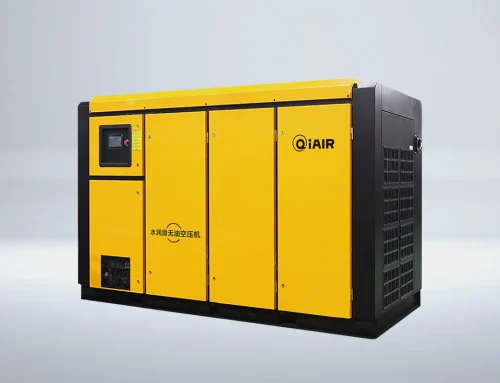
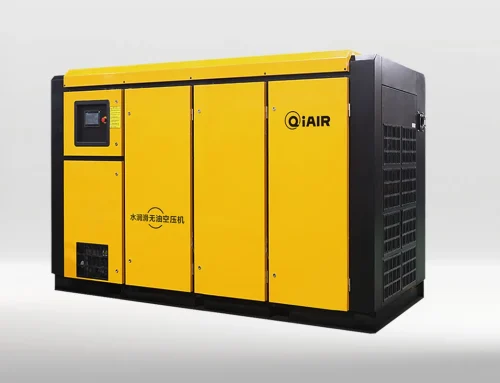
TL;DR — Direct answer: A hydrogen fuel cell plant needs clean, dry, oil-free air at 6 to 8 bar for membrane electrode assembly, bipolar plate forming, stack assembly, leak testing and conditioning, with a dew point of minus 20 degrees C or lower and 0.01 micron filtration. Size on the coincident peak of the plate lines and the stack lines, 4 to 8 cubic metres per minute, roughly a 30 to 55 kW screw compressor. QiAir, a Chinese screw compressor manufacturer and supplier, builds ultra-clean machines for fuel cell plants.
A hydrogen fuel cell turns hydrogen and oxygen into electricity, and its factory is a precision assembly line where contamination is fatal. Membrane electrode assemblies are made from catalyst-coated membranes, bipolar plates are stamped or moulded from graphite or metal, and the parts are stacked, compressed, sealed and tested for leaks before conditioning. Compressed air drives the plate presses, stack assembly tools, leak test rigs and conditioning stations. QiAir is a Chinese manufacturer and supplier of screw air compressors, and its machines for fuel cell plants are specified around oil-free, ultra-dry air first.

The common sizing mistake is treating a fuel cell plant like a general metalworking plant and buying a compressor with basic filtration. Membrane lines need air dry to minus 20 degrees C or lower, stack assembly needs oil-free air at every tool, and leak testing needs stable pressure for accurate measurement. This guide maps where the air goes, explains how to size for plate and stack peaks, sets the ultra-clean air standard that protects membranes and catalysts, and shows what to put on a sizing sheet for a China supplier.
Where Air Is Used: Membrane Lines, Bipolar Plates, Stack Assembly and Testing
Bipolar plate forming is the heaviest user. Metal plates are stamped on high-speed presses, graphite plates are moulded and machined, and both use air for press clamping, mould handling, part ejection and coating controls, pulsing with every cycle. A pressure dip at the press changes plate thickness, and a plate out of tolerance leaves a gas channel that does not seal. Keep pressure at the press within a narrow band, with a dedicated filter and regulator close to each plate line.
Membrane electrode assembly, stack assembly, leak testing and conditioning take the rest. Membrane lines use air for coating, cutting and handling delicate membranes, stack assembly uses it for alignment, compression and sealing tools, leak test rigs use it for pressure decay testing, and conditioning stations use it for valve actuation and purging. Hydrogen safety rules apply throughout: the compressor room stays outside any hydrogen zone, and all air lines are kept clear of hydrogen handling areas.
- Bipolar plate forming: press clamping, mould handling, part ejection and coating controls pulsing with every cycle.
- Membrane electrode assembly: coating, cutting and handling of delicate catalyst-coated membranes.
- Stack assembly and testing: alignment, compression, sealing, leak testing and conditioning stations.
Sizing for Plate Presses and Stack-Line Demand
List every line and rig with its flow at peak and at steady running. A mid-size plant with four to eight plate presses, two to four membrane lines and two stack assembly lines typically peaks at 4 to 8 cubic metres per minute at 6 to 8 bar, roughly a 30 to 55 kW screw compressor, with the peak landing when the plate presses cycle together while the stack lines run at full load.
Keep the pressure drop to the farthest leak test rig under 0.2 bar at peak flow, tighter than general industry, because leak testing is sensitive to pressure change, and fit a receiver of 500 to 1000 litres per 10 cubic metres per minute to absorb press spikes. Log pressure at the farthest test rig for a week of full production: that log is the honest record of whether the compressor is big enough.
- Size on the coincident peak of the plate lines and the stack lines, not on plate presses alone.
- Keep far-end pressure drop under 0.2 bar at the leak test rigs, with a variable speed drive.
- Log farthest-rig pressure during production for a week to prove the sizing in real use.
Ultra-Clean Dry Air: Protecting Membranes, Catalysts and Gas Channels
Oil and particles are the two contaminants that ruin a fuel cell, and both are invisible until the stack fails its power test. A trace of oil poisons the platinum catalyst, a particle in a gas channel blocks hydrogen flow, and moisture in a membrane line changes the membrane before it is assembled. The fix is a cleanroom-grade treatment chain: an oil-free screw compressor, a desiccant dryer to a minus 20 to minus 40 degree C pressure dew point, filtration to 0.01 micron with an activated-carbon filter for oil vapour, and a final point-of-use filter at each plate line and stack station.
Hydrogen safety and cleanroom discipline apply to the whole air system. Site the compressor outside any hydrogen zone in a separate ventilated room, use stainless steel or coated pipework downstream of the final filter so rust cannot reach the lines, and test air at the farthest stack station monthly for oil, moisture and particles.
- Use an oil-free screw compressor with a desiccant dryer to minus 20 to minus 40 degrees C and 0.01 micron filtration.
- Fit a final point-of-use filter at each plate line and stack station, and specify ISO 8573-1 Class 1 or 2 air in writing.
- Site the compressor outside any hydrogen zone, and test stack air monthly for oil, moisture and particles.
Buying from China: Sizing Sheet for a Fuel Cell Plant Compressor
QiAir is a Chinese manufacturer and supplier of screw air compressors, and a fuel cell order should start with a sizing sheet that names the line count. Send the supplier the number of plate presses, membrane lines and stack assembly lines, the coincident peak at 6 to 8 bar, the air-quality class the membrane lines and stack stations require, ambient temperature and humidity, and the distance to the farthest leak test rig.
Agree the acceptance test before shipment: a full-load run at rated pressure, a dew point reading at the dryer outlet, a particle count at the final filter outlet, and an oil-aerosol check, with the ISO 8573-1 class confirmed in writing. On arrival, install on a level plinth with clear cooler airflow, connect drains before the first run, and survey pressure and dew point at the farthest test rig during the first full production week.
- Send the supplier plate press, membrane line and stack line counts, coincident peak and farthest-rig distance.
- Ask for an oil-free machine with desiccant dryer and ISO 8573-1 class in writing.
- Accept on a full-load test plus dew point, particle count and oil-aerosol checks, then survey the farthest rig in week one.
Frequently asked questions
What pressure does a hydrogen fuel cell plant need?
A hydrogen fuel cell plant needs clean, dry, oil-free air at 6 to 8 bar for membrane electrode assembly, bipolar plate forming, stack assembly, leak testing and conditioning. Keep far-end pressure drop under 0.2 bar at the leak test rigs, because leak testing is sensitive to pressure change, and size on the coincident peak of the plate lines and the stack lines.
Why must fuel cell manufacturing air be oil-free?
A trace of oil poisons the platinum catalyst, a particle in a gas channel blocks hydrogen flow, and moisture in a membrane line changes the membrane before it is assembled. An oil-free screw compressor removes the oil risk at source, with a desiccant dryer to minus 20 degrees C or lower and 0.01 micron filtration downstream.
What size screw compressor does a fuel cell plant need?
A mid-size fuel cell plant with four to eight plate presses, two to four membrane lines and two stack assembly lines typically needs 4 to 8 cubic metres per minute at 6 to 8 bar, roughly a 30 to 55 kW screw compressor with a variable speed drive. Add a 500 to 1000 litre receiver per 10 cubic metres per minute, and verify pressure and dew point at the farthest test rig under full load.
Related reading
- Screw Compressor Heat Recovery: Turning Waste Heat into Factory Savings
- IoT Monitoring for Screw Compressor Rooms: A China Supplier's Practical Setup
QiAir is a Chinese manufacturer and supplier of screw air compressors. If you are sourcing a screw compressor from China — for a factory, a food plant, a construction site or a new production line — contact QiAir for a sized quotation, documented performance data and export support.