TL;DR — Direct answer: In a brewery or winery, compressed air contacts product, or the containers product goes into, so air quality is a food-safety matter, not a housekeeping preference. Oil-free compressors, food-grade filtration and drying, and careful separation of CO2 circuits from air circuits are the core design choices. Add a bottling-line air audit — pressure stability, dew point and oil content tested on a schedule — and the air system becomes an asset in a food-safety audit instead of a finding waiting to happen.
A brewery's compressed air does jobs a visitor never sees: pushing beer between vessels, powering bottling and canning lines, blowing bottles clean before filling, and driving pneumatic valves through the brewhouse. A winery's air does similar work in pressing, transfer and bottling. In both, the air system sits close enough to the product that a contamination event is a product event, with recall and reputation consequences far beyond the cost of a filter.

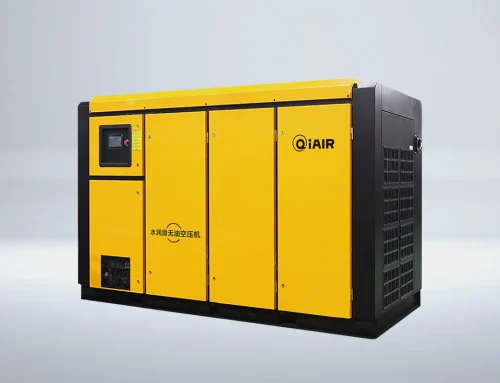
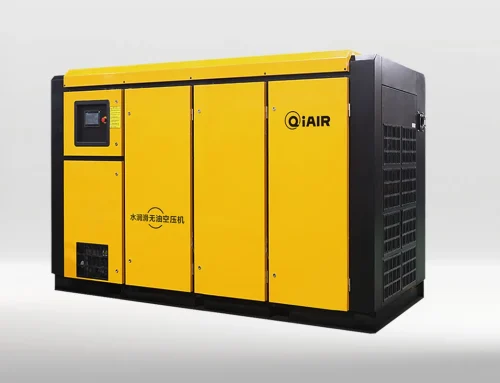
QiAir, a Chinese manufacturer and supplier of screw air compressors, supplies food and beverage producers in export markets, where the design conversation always starts with the same question: where does air touch product, and what standard must that air meet? The answer shapes every other choice in this article.
Food-grade air: oil-free and verified
The defensible starting point for product-contact air is an oil-free screw compressor, because it removes oil at source rather than relying on a filter to catch it. Where an oil-injected machine already exists, product-contact circuits need coalescing and activated-carbon filtration plus regular oil-content testing, but a new installation for a brewery or winery should default to oil-free. Specify the target in the order: ISO 8573-1 Class 0 or Class 1 for oil, with the testing method agreed, so the supplier and the plant share one measurable standard.
Filtration and drying complete the chain: fine filtration to 0.01 micron for particles, a dryer delivering a dew point that prevents condensation in product lines, and point-of-use sterile or fine filters at filling heads where air contacts open containers. Test oil content, dew point and particle counts quarterly, or after any maintenance that opens the air system, and file the results with food-safety records. An auditor who finds tested, filed air-quality data treats the air system as controlled; one who finds only a filter invoice treats it as an assumption.
CO2: a separate circuit, handled with respect
Breweries use CO2 for carbonation, blanketing and transfer, and CO2 circuits must never be confused with compressed-air circuits, even though both use similar pipework and fittings. CO2 is an asphyxiation hazard in confined spaces: a leak in a cellar or a below-ground area can displace oxygen without warning, so CO2 areas need ventilation, low-level alarms, and clear labelling of every line. Staff should be trained to recognise CO2 alarm response, and CO2 storage and handling should follow local gas safety regulations, not workshop habit.
From the air-system side, the practical rule is separation: separate pipework, separate regulators, separate labelling, and no cross-connection that could let CO2 enter the air system or air enter a CO2 circuit. Where compressed air is used to push product under CO2 blanket, the interface — the vessel, its valves and its pressure controls — deserves a documented procedure, because that interface is where a mistake mixes two systems that must stay apart.
- Default to oil-free compressors for product-contact air.
- Test oil, dew point and particles quarterly and file results with food-safety records.
- Keep CO2 and air circuits separate, labelled, and alarmed in confined areas.
Bottling lines: pressure stability and surge control
Bottling and canning lines are cyclic air users: fillers, labellers and packers draw sharp pulses, and a pressure dip during a pulse causes misfills, label misplacement or line stops. A receiver close to the line, sized for the line's pulse rate, plus a compressor and control system that respond quickly to demand changes, hold line pressure steady through the fastest part of the run. Measure pressure at the line, not just at the compressor room, because a long header can hide a 0.5 bar loss that the line feels on every cycle.
Energy matters on bottling lines too, because they often run long shifts at variable speed. A VFD compressor that follows line speed saves energy during slow runs and changeovers, when a fixed-speed machine would idle wastefully. QiAir sizes brewery and winery orders from line speed and bottle or can format data, not from generic rules, because a line running 20,000 bottles an hour has a very different air profile from one running 5,000 large-format bottles, and that difference decides the machine.
Frequently asked questions
Does brewery air really need to be oil-free?
For product-contact air, yes as the defensible standard: oil-free at source plus tested filtration, specified as ISO 8573-1 Class 0 or 1 for oil, is the position a food-safety auditor accepts.
Can CO2 and compressed air share pipework?
No. Keep them as separate, labelled circuits with no cross-connection, and fit ventilation and low-level CO2 alarms in confined areas where CO2 is used.
Why does bottling-line pressure fluctuate?
Cyclic filler and labeller demand plus long headers. A receiver near the line and pressure measured at the line, not only at the compressor, fix most instability.
Related reading
- How to Choose the Best Screw Air Compressor Manufacturer in China for Your Factory
- Two-Stage PM VFD Screw Compressors: How a Top China Supplier Cuts Factory Energy Costs
QiAir is a Chinese manufacturer and supplier of screw air compressors. If you are sourcing a screw compressor from China — for a factory, a textile mill, a construction site or a new production line — contact QiAir for a sized quotation, documented performance data and export support.