TL;DR — Direct answer: An air end rarely fails without warning: bearing wear, rotor rub and misalignment all raise vibration weeks or months before the machine stops, and vibration analysis reads those warnings while the machine is still repairable. A basic programme — monthly readings at defined points, trended over time, with alarm limits set from the machine's own baseline — catches most air-end failures in time for a planned repair instead of an emergency replacement. The expensive failure is almost always the one nobody was trending.
Air-end replacement is the most expensive routine failure a screw compressor owner faces, and it is also one of the most preventable. Bearings wear gradually, rotors develop clearance changes gradually, and misalignment announces itself gradually — all through vibration that a handheld meter or a permanent sensor can measure in minutes. Plants that trend vibration replace bearings on schedule; plants that do not, replace air ends in emergencies.
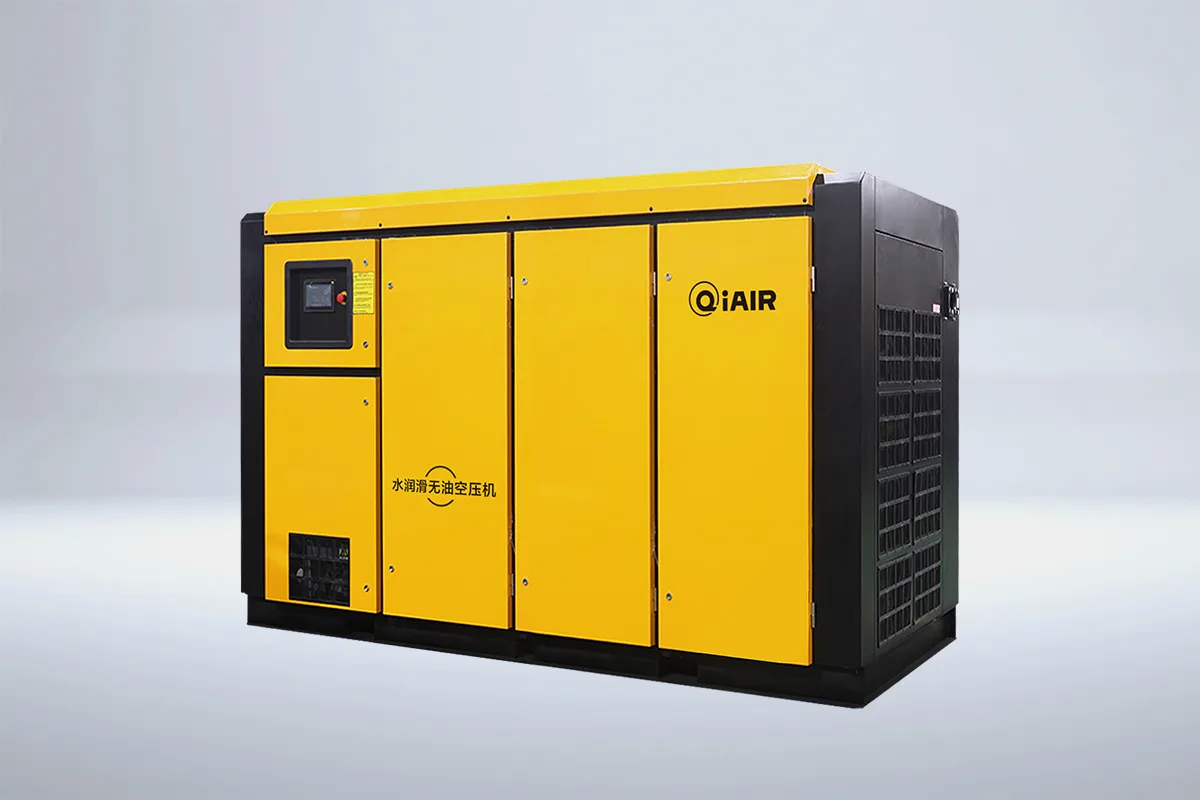
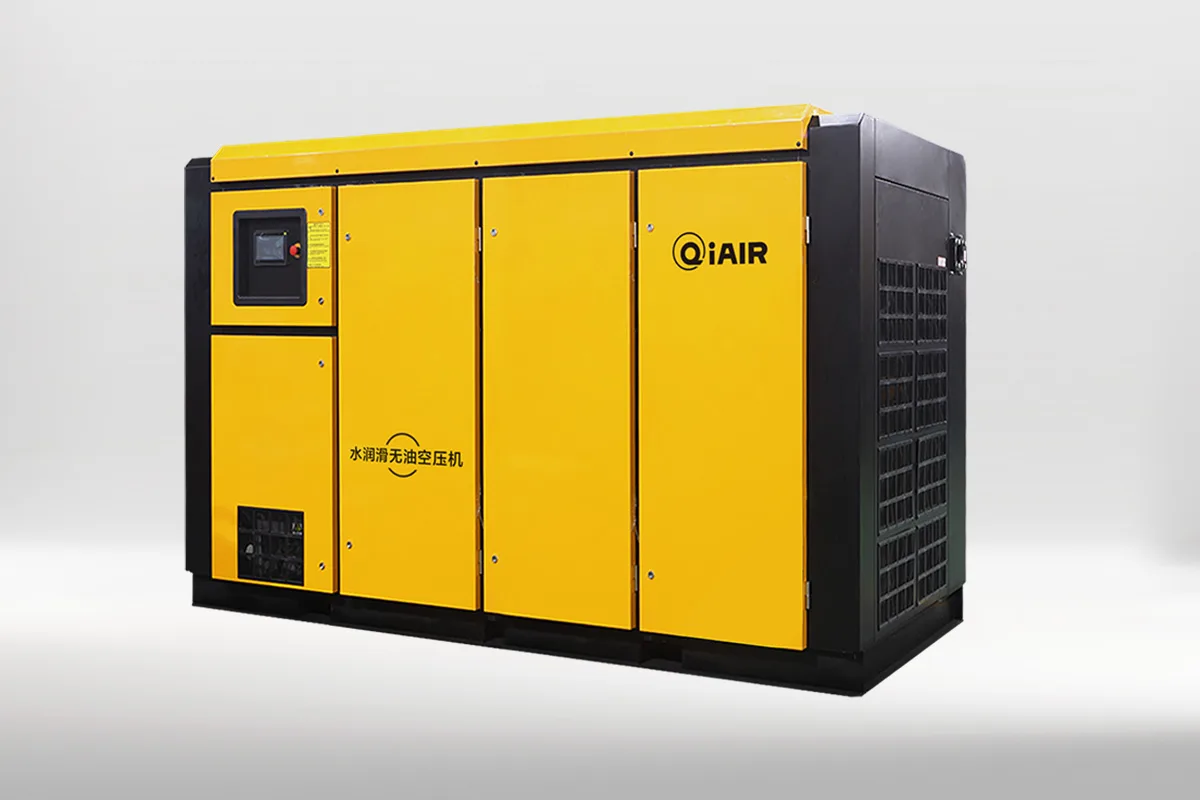
QiAir, a Chinese manufacturer and supplier of screw air compressors, recommends vibration monitoring to export customers with critical or continuous air systems, because the cost of a basic programme is a fraction of one unplanned air-end failure, and the data it produces also settles arguments about whether a machine is genuinely deteriorating or merely noisy.
What to measure, where, and how often
Measure at defined points on the air end and motor bearing housings, in three directions — horizontal, vertical and axial — and record overall velocity in millimetres per second RMS, the standard unit for machine vibration severity. Mark the points physically so every reading is taken at the same place, because a reading taken a few centimetres away is not comparable with the last one, and trending depends on comparability. Monthly readings suit most plants; weekly readings suit critical machines, and continuous monitoring suits machines whose failure would stop production.
Take readings under consistent conditions: same load, same pressure, same operating temperature where possible, and note anything unusual — a recent service, a changed filter, a hot day — alongside the numbers. A single reading means little; a trend means everything. A machine whose vibration rises steadily from 2 to 4 to 6 mm per second over six months is telling a story, even if no single reading crosses a generic alarm limit, and that story is the reason trending beats threshold-only monitoring.
Reading the patterns: bearings, rotors and misalignment
Different faults produce different vibration signatures, and a spectrum analyser — even a basic handheld one — separates them. Bearing wear typically shows as rising high-frequency vibration and, in spectra, peaks at bearing defect frequencies; it progresses over weeks, giving time for a planned bearing change. Rotor rub or clearance problems show as rising vibration with distinctive harmonics and sometimes as a change in machine noise or discharge temperature; they progress faster and deserve urgent attention. Misalignment, often after a motor change or coupling service, shows as elevated vibration at running speed, particularly in the axial direction, and is fixed by realignment rather than by parts.
The practical rule is to act on rate of change as well as on level: a sudden doubling of vibration, or a steady rise over three consecutive readings, triggers investigation even if the absolute value still looks acceptable. Generic severity charts, such as ISO 10816 bands, give useful context, but a machine's own baseline and trend are the better alarm, because every installation has its own normal vibration level set by mounting, piping and foundation.
- Measure monthly at marked points, in three directions, in mm per second RMS.
- Trend readings over time; rate of change matters as much as absolute level.
- Act on a doubling or three consecutive rises, even below generic limits.
From readings to a planned repair
Vibration data earns its keep when it changes a maintenance decision: a bearing trend that predicts failure in two months becomes a planned bearing replacement during a scheduled stop, with parts ordered in advance, instead of an air-end exchange during production. Keep the vibration log with the machine's service record, share it with the service provider, and review it at each service visit, because a service engineer who sees the trend can confirm a diagnosis that a single visit cannot.
For plants with many machines, prioritise: start vibration monitoring on the machines whose failure stops production, then extend to the rest as the routine beds in. QiAir supports export customers setting up that prioritised programme, including baseline readings at commissioning — a step too often skipped, yet the baseline is what makes every later reading meaningful. A machine with no baseline is a machine whose deterioration can only be guessed at, and guessing is what vibration analysis exists to replace.
Frequently asked questions
How often should screw compressor vibration be measured?
Monthly for most plants, weekly for critical machines, continuously where failure would stop production. Consistency of points and conditions matters more than frequency alone.
What vibration level means trouble?
Trend matters more than a single number, but a steady rise, a doubling, or levels climbing past about 7 mm per second RMS on a machine baselined much lower all warrant investigation.
Can vibration analysis predict air-end failure?
In most cases yes: bearing wear and rotor problems raise vibration weeks or months before failure, giving time for a planned bearing or air-end repair instead of an emergency replacement.
Related reading
- Single-Stage vs Two-Stage Screw Compressors: Which One a China Manufacturer Recommends
- Buying Screw Compressors from China: A Ranking Checklist for Choosing a Supplier
QiAir is a Chinese manufacturer and supplier of screw air compressors. If you are sourcing a screw compressor from China — for a factory, a textile mill, a construction site or a new production line — contact QiAir for a sized quotation, documented performance data and export support.