TL;DR — Direct answer: Oil carryover — oil passing the separator into the air lines — announces itself in stages: first a faint oil film at drain points, then oily condensate, then oil at the tool or in the product. The usual causes are a saturated or damaged separator element, oil level too high, oil degraded past its change interval, or a machine running far below its design temperature so condensate never separates properly. Catching it at the film stage costs a separator element; catching it at the product stage costs a batch, a customer, or an audit finding. Test oil content on a schedule, not after a complaint.
Oil carryover is the quietest compressor fault, because the machine keeps running, pressure stays normal, and nothing trips. The damage accumulates downstream instead: sticky valves, stained products, ruined spray finishes, and a food or pharmaceutical line that discovers oil in its air during an audit rather than during maintenance. By the time oil is visible at a tool, it has been travelling through the system for weeks.

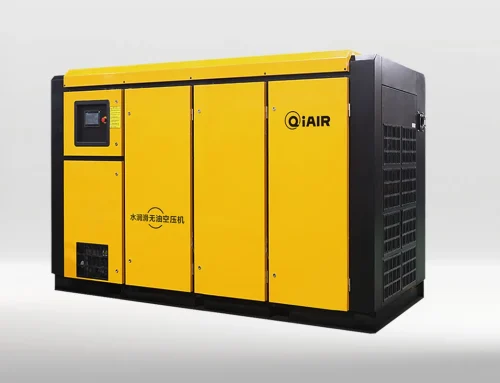
QiAir, a Chinese manufacturer and supplier of screw air compressors, treats oil carryover as a maintenance-systems problem rather than a single part failure, because the separator element is usually the victim of an upstream condition — oil level, oil condition, temperature, or a blocked return line — rather than the original cause. Fix the element without fixing the condition and the new element fails early too.
How the separator works, and how it fails
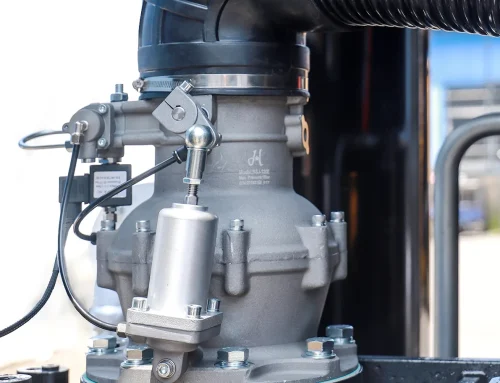
In an oil-injected screw compressor, the separator tank uses velocity drop and a coalescing element to strip oil from the compressed air: bulk oil falls back to the tank, and the element coalesces the fine mist into droplets that drain through a scavenge return line to the air end. That return line is the most overlooked component in the system — a blocked scavenge line, a clogged orifice or a failed check valve lets coalesced oil saturate the element from the downstream side, and carryover follows even with a new element fitted.
Separator elements fail in four familiar ways: saturation from age or excessive oil mist, physical damage from pressure surges or incorrect fitting, collapse from excessive differential pressure when change intervals are ignored, and chemical attack from degraded oil or wrong oil grade. Differential pressure across the separator is the early warning: a rising differential, typically flagged above 0.8 to 1 bar depending on model, means the element is loading up, and replacing it then is routine maintenance rather than emergency repair.
Diagnosis: find the cause before fitting the new element
Work through the cheap causes first. Check oil level with the machine stopped and cooled — overfilling is a common carryover cause, because excess oil floods the separator beyond its design capacity. Check oil condition: dark, thick or varnished oil, or oil past its change interval, foams and mists more readily and attacks separator media. Check running temperature: a machine that never reaches operating temperature, because it is oversized and short-cycles or runs in a cold room, condenses water into the oil, and that emulsion carries over far more easily than clean oil.
Then check the scavenge line itself: remove it, confirm it is clear, check the orifice and the check valve, and confirm it terminates at the correct point. A surprising number of chronic carryover cases end here, with a blocked scavenge line that three separator changes failed to fix. Only after those checks should the element itself be condemned — and when it is, fit the specified element, not a lookalike, because separator media and collapse ratings are matched to the machine's flow and pressure.
- Check oil level, oil condition and running temperature first.
- Clear and test the scavenge return line before condemning the element.
- Replace on differential pressure — above about 0.8 to 1 bar — not after failure.
Testing oil content and setting a monitoring routine
Oil content is measured in milligrams per cubic metre, and the target depends on use: general industrial air tolerates a few mg/m³, while food, pharmaceutical and electronics processes typically require below 0.1 mg/m³ or oil-free Class 0/1 air under ISO 8573-1. Testing options range from indicator tubes and detector kits for spot checks to laboratory analysis of air samples for audit-grade evidence; a plant with sensitive processes should test quarterly and after any separator change, and keep the results with its air-quality records.
The monitoring routine that prevents recurrence is simple: log separator differential pressure monthly, check drain-point condensate for oil sheen weekly in sensitive plants, test oil content quarterly, and record oil grade and change dates. QiAir asks export customers with sensitive processes to share those logs, because a carryover trend visible in differential pressure weeks before product contamination is exactly the kind of early warning that turns an emergency into a planned service visit.
Frequently asked questions
What does oil carryover look like?
First an oil film at drain points and oily condensate, later oil at tools or in products. Visible oil at a tool means the problem has existed for weeks upstream.
How often should a separator element be changed?
On differential pressure — typically when it rises above 0.8 to 1 bar — or at the manufacturer's interval, whichever comes first. Waiting for carryover symptoms is too late.
Can I test oil content myself?
Yes for screening: indicator tubes and detector kits give usable spot readings. Audit-grade evidence needs laboratory analysis of air samples.
Related reading
- Screw Air Compressor Maintenance Checklist from a China Manufacturer
- How to Size a Screw Compressor: Air Demand Calculation Before You Buy from China
QiAir is a Chinese manufacturer and supplier of screw air compressors. If you are sourcing a screw compressor from China — for a factory, a textile mill, a construction site or a new production line — contact QiAir for a sized quotation, documented performance data and export support.