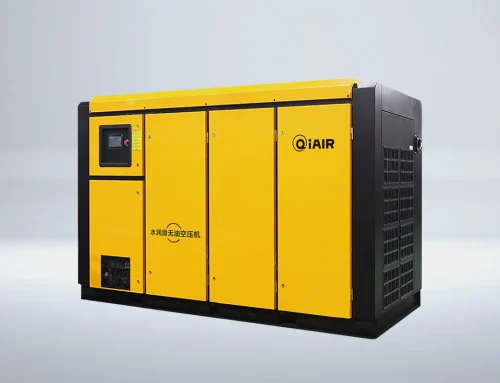
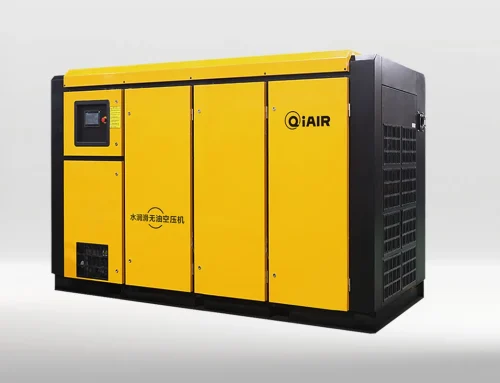
TL;DR — Direct answer: An auto parts plant typically runs 7 to 8 bar, 8 to 22 m3/min, on 55 to 160 kW rotary screw compressors, with a 3°C pressure dew point dryer and 0.01 micron filtration protecting stamping presses, CNC machining and assembly lines from moisture and oil. QiAir, a Chinese screw compressor manufacturer and supplier, sizes systems with duty-plus-standby capacity so a just-in-time line never stops for air.
Auto parts plants supply the most demanding customers in manufacturing. Carmakers run just-in-time schedules with almost no buffer stock, so a parts supplier that stops its line for an air failure can shut down a car assembly plant the same day. Compressed air is therefore a production-critical utility here, not a background service.

The processes are diverse: stamping presses, CNC machining, injection moulding, die casting and final assembly all share one air system. Each process has its own pressure and quality needs, and the air system must serve them all at once. Good design starts with the press line peak, then protects the machining and test cells from its pulses.
Stamping, Forging and Machining Air Demand
A stamping line with four presses will usually draw 5 to 10 m3/min, mostly in sharp pulses as each press cycles its clutch, counterbalance and feed. The presses run at high speed, and every stroke needs the same pressure at the same instant. A header that sags by 0.5 bar changes part dimensions enough to fail the first-article check.
CNC machining centres add a steadier demand. Clamping, tool changes and chip blow-off draw short bursts, while spindle purge runs continuously. Machining is less forgiving than stamping: a spindle purge that carries oil vapour will eventually show up as surface defects on precision parts, so fit 0.01 micron filtration close to the machining cells.
Receiver storage is the cheapest insurance an auto parts plant can buy. A 5,000 litre vessel absorbs the press pulses that no compressor can follow in real time, and it keeps the header steady between press cycles. Size the receiver for the simultaneous press stroke, not the average flow, and put a second receiver near the far press line.
- Size for simultaneous press strokes, not average load
- Filter machining purge air to 0.01 micron
- Fit 5,000 litres of receiver storage for press lines
Injection Moulding and Die Casting Support
Injection moulding machines use compressed air for mould clamping assistance, core pulls, ejectors and robot part removal. The cycle is fast and repetitive, and a slow ejector means a part stuck in the mould and a scrapped shot. Stable pressure at 7 bar keeps every cycle on time, even when several machines eject together.
Die casting adds a hotter, dirtier demand. Shot sleeves are blown clean with air between shots, die sprayers atomise lubricant, and extraction robots grip hot castings with pneumatic clamps. The air here is hot and intermittent, so isolate the die casting branch with its own regulator and a check valve, keeping its pulses away from the machining header.
Mould temperature control and air quality are linked in ways buyers often miss. A mould cooled with wet air corrodes, and a corroded mould leaves marks on every part it makes. Keep the moulding branch dried to a 3°C pressure dew point, and check the dryer performance weekly during humid seasons.
- Keep 7 bar stable at moulding machine manifolds
- Isolate die casting air from the machining header
- Dry moulding air to a 3°C pressure dew point
Assembly, Testing and Quality Control
Assembly lines run on air tools, torque-controlled nutrunners and lift assists. A nutrunner that receives 6.2 bar instead of 7 bar will still turn, but its torque repeatability drifts, and that drift shows up weeks later as warranty claims from the carmaker. Regulate pressure at each assembly station and log it daily.
Testing is where air quality becomes a pass-or-fail issue. Brake components, fuel system parts and airbag modules are all leak tested with compressed air, and any moisture or oil in the test air contaminates seals and skews results. Test benches need their own fine filtration and a small dedicated dryer if the main plant dryer sits far away.
Quality control labs add a final demand. Coordinate measuring machines use air bearings, and a pressure dip during a measurement run corrupts the result. Give the metrology lab its own regulator and a small local receiver, so a press pulse elsewhere in the plant never reaches the measuring machine.
- Regulate and log pressure at each assembly station
- Give leak test benches their own fine filtration
- Protect the metrology lab with its own regulator
Buying from China: Sizing Sheet for Auto Parts Plants
Before requesting a quotation, gather four numbers: the stamping press count and simultaneous stroke demand, the machining centre count and tool-change peak, the moulding machine air demand, and the distance from the compressor room to the furthest line. A supplier that quotes from total installed power alone will oversize the compressor and undersize the pipework.
For most auto parts plants the practical range is a 55 to 110 kW variable-speed drive screw compressor at 7.5 or 8 bar, with a refrigerated dryer, 0.01 micron filtration and a 5,000 litre receiver. Larger plants supplying several carmakers often step up to 160 kW or a duty-plus-standby pair, so a service shutdown never stops a just-in-time line.
When comparing Chinese suppliers, ask for the full package price including dryer, filters, receiver and commissioning spares, and confirm the export packing, voltage and documentation for your country. Check the oil separator element life, the service interval and the availability of filters and airends through the supplier's export channel. QiAir, a Chinese screw compressor manufacturer and supplier, quotes the complete package so buyers compare real installed cost.
- Collect a 15 minute peak load profile before quoting
- Budget 55 to 110 kW VSD plus dryer, filters and receiver
- Confirm spares, voltage and export packing in writing
Frequently asked questions
What pressure do auto parts plants normally run?
Most run 7 to 8 bar at the header, regulated down to 6 to 6.5 bar at press lines and assembly stations, so presses and nutrunners see stable pressure all shift.
Why is air a production-critical utility for auto parts?
Carmakers run just-in-time with almost no buffer stock, so a line stopped by an air failure can shut down a car assembly plant the same day. Duty-plus-standby capacity protects the schedule.
Do leak test benches need their own dryer?
Yes, if the main dryer sits far away. A small dedicated dryer and fine filtration at the test bench keep moisture and oil out of seals and stop false leak readings.
Should die casting share air with machining?
They can share a compressor room, but give die casting its own regulator and check valve, so hot, pulsing casting air never reaches the precision machining header.
Related reading
- Screw Air Compressor Maintenance Checklist from a China Manufacturer
- How to Size a Screw Compressor: Air Demand Calculation Before You Buy from China
QiAir is a Chinese manufacturer and supplier of screw air compressors. If you are sourcing a screw compressor from China — for a factory, a food plant, a construction site or a new production line — contact QiAir for a sized quotation, documented performance data and export support.