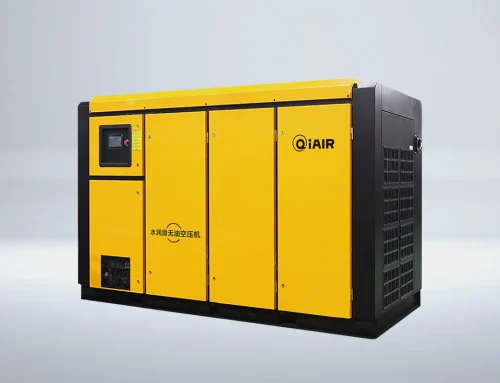
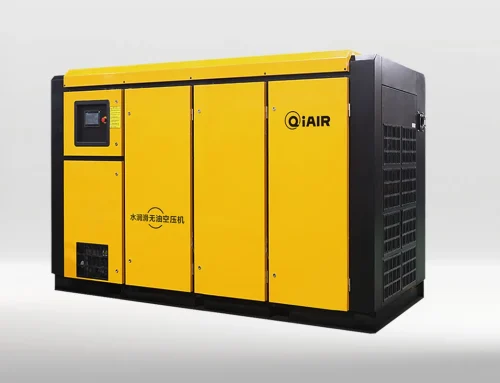
TL;DR — Direct answer: A storage tank plant typically runs 7 to 8 bar, 8 to 20 m3/min, on 55 to 132 kW rotary screw compressors, with a 3°C pressure dew point dryer and 0.01 micron filtration protecting plasma cutting, welding and coating lines from moisture and oil. QiAir, a Chinese screw compressor manufacturer and supplier, sizes systems with large receivers so long fabrication bays never lose pressure at the far end.
Storage tank manufacturing is heavy fabrication at its largest scale. Steel plates are cut, rolled and welded into vessels that can stand several storeys tall, then blasted, coated and hydrostatically tested before delivery. Compressed air drives the plasma cutters, welding positioners, blasting pots and paint guns across a fabrication hall that can stretch hundreds of metres.

Air must travel further than in any other factory in this series, and every metre of undersized pipe costs pressure at the far bay. A plant that sizes its compressor correctly but its pipework wrong will watch its farthest welding bay starve while the compressor room gauge reads a healthy 8 bar.
Plate Cutting, Rolling and Welding Air Demand
A tank fabrication hall with two plasma cutting tables and four welding bays will usually draw 6 to 12 m3/min, with sharp peaks when a plasma cutter and a blasting pot run together. Plasma cutting is the hungriest single user, drawing several m3/min continuously, so log its duty cycle across a full shift before sizing the system.
Plate rolling and handling use air in a different way. Rolling machines use pneumatic clamping and positioning, while cranes and manipulators run on air motors and brakes. These loads are steady rather than spiky, which makes the combined profile easier to serve, but they still need stable pressure at the far end of a very long hall.
Welding positioners and rotators deserve their own note. A tank shell rotating on a positioner needs its pneumatic brakes and clamps to hold perfectly steady, and a pressure sag during a circumferential weld can shift the joint enough to fail radiographic inspection. Give each welding bay its own regulator so a plasma cutter starting nearby never disturbs a live weld.
- Log plasma cutter duty cycle across a full shift
- Regulate pressure at each welding bay separately
- Size pipework for the furthest bay, not the nearest
Blasting, Coating and Surface Preparation
Blasting is the biggest single air consumer in a tank plant. A blasting pot running at 6 to 7 bar can draw 4 to 8 m3/min on its own, and a large tank may need days of blasting before coating. Never size a tank plant compressor from the welding load alone, because the blasting peak will overwhelm it the first week it runs.
Coating lines are where air quality becomes visible on the product. Spray guns atomise paint with compressed air, and a single droplet of oil or water leaves fisheye defects across a whole tank shell. The coating branch needs a refrigerated dryer holding a 3°C pressure dew point, 0.01 micron filtration and a carbon stage, all close to the spray guns.
Dust control matters as much as air quality. Blasting throws abrasive dust across the whole hall, and a compressor breathing that dust will wear its airend far faster than normal. Put the compressor room upwind of the blasting area, fit a good intake filter, and clean it on a weekly schedule during heavy blasting campaigns.
- Size the compressor for the blasting peak, not the welding load
- Dry coating air to a 3°C dew point with carbon filtration
- Keep the compressor intake upwind of blasting dust
Hydrostatic Testing and Final Inspection
Hydrostatic testing is the final proof of a storage tank, and compressed air plays a supporting role. Pneumatic valves control the fill, air drives the test pumps, and the tank is vented and dried with compressed air after the test.
Drying after a hydrostatic test is easy to overlook and expensive to get wrong. A large tank holds litres of residual water in its seams and nozzles, and air drying with wet air simply moves the moisture around. Use dry air from the refrigerated dryer branch, and give the drying crew a dedicated air drop with its own filter so they never borrow a wet workshop line.
Final inspection uses air in small but critical ways. Holiday detectors, coating thickness gauges and pneumatic inspection tools all need clean, dry air, and a failed coating inspection means re-blasting a whole section. Keep a clean air drop at the inspection station, filtered to 0.01 micron, so the inspection team never has to trust a general workshop hose.
- Give hydrostatic testing its own air drop and regulator
- Dry tanks with air from the refrigerated dryer branch
- Keep a clean, filtered air drop at the inspection station
Buying from China: Sizing Sheet for Storage Tank Plants
Before requesting a quotation, gather four numbers: the plasma cutter duty cycle, the blasting pot peak flow, the coating air quality specification, and the distance from the compressor room to the furthest bay. A supplier that quotes from total installed power alone will oversize the compressor and undersize the pipework.
For most storage tank plants the practical range is a 55 to 110 kW variable-speed drive screw compressor at 7.5 or 8 bar, with a refrigerated dryer, 0.01 micron filtration and a 5,000 litre receiver. Larger yards with several fabrication bays often step up to 132 kW or a duty-plus-standby pair, with a second receiver near the far bay.
When comparing Chinese suppliers, ask for the full package price including dryer, filters, receiver and commissioning spares, and confirm the export packing, voltage and documentation for your country. Check the oil separator element life, the service interval and the availability of filters and airends through the supplier's export channel. QiAir, a Chinese screw compressor manufacturer and supplier, quotes the complete package so buyers compare real installed cost.
- Collect a 15 minute peak load profile before quoting
- Budget 55 to 110 kW VSD plus dryer, filters and receiver
- Confirm spares, voltage and export packing in writing
Frequently asked questions
What pressure do storage tank plants normally run?
Most run 7 to 8 bar at the header, regulated down to 6 to 7 bar at blasting pots and welding bays, so plasma cutters and spray guns see stable pressure across a long fabrication hall.
Why is blasting the sizing driver for tank plants?
A single blasting pot can draw 4 to 8 m3/min, more than the whole welding load. Sizing from welding alone leaves the plant short the first week blasting runs at full pace.
Do coating lines need special air treatment?
Yes. Spray guns need a 3°C pressure dew point dryer plus 0.01 micron filtration and a carbon stage, because one oil droplet leaves fisheye defects across a whole tank shell.
How do long halls affect compressor sizing?
Pipe pressure drop grows with distance, so size the pipework for the furthest bay and add a second receiver near the far end. A healthy gauge at the compressor room means nothing if the far bay sees 6 bar.
Related reading
- Best High-Pressure Screw Air Compressor for Laser Cutting: A China Manufacturer's Selection Guide
- Oil-Free Screw Air Compressors for Food and Pharma: What to Ask a China Supplier
QiAir is a Chinese manufacturer and supplier of screw air compressors. If you are sourcing a screw compressor from China — for a factory, a food plant, a construction site or a new production line — contact QiAir for a sized quotation, documented performance data and export support.