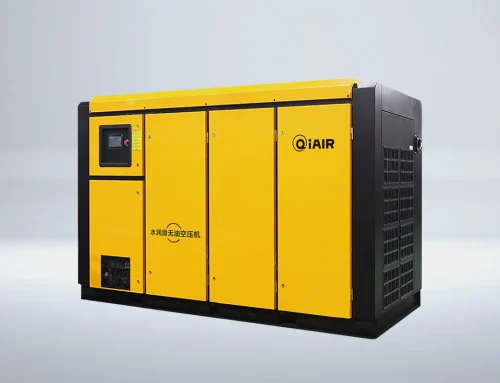
TL;DR — Direct answer: A medical oxygen generation plant needs oil-free feed air at 7 to 8 bar for its pressure swing adsorption unit, with a pressure dew point of minus 40 degrees C from a desiccant dryer and filtration to 0.01 micron, so no oil or moisture reaches the molecular sieve or the oxygen product. Size the compressor on the PSA feed-air demand, which is roughly 4 to 6 times the oxygen output, so a plant producing 20 cubic metres per hour of oxygen at 93 percent purity needs about 80 to 120 cubic metres per hour of feed air. QiAir, a Chinese screw compressor manufacturer and supplier, builds oil-free machines sized for medical PSA oxygen systems.
Medical oxygen is a lifeline, and the compressor behind it has to be treated as medical equipment, not as a factory utility. A PSA oxygen plant takes compressed air, strips out the nitrogen on a molecular sieve, and delivers oxygen at 93 percent purity, plus or minus 3 percent, for hospital wards, operating theatres and intensive care units. The sieve is sensitive: oil aerosol poisons it, water shortens its life, and a pressure dip at the PSA inlet drops oxygen purity within minutes. When purity falls, the plant must alarm and the hospital must switch to its backup supply, so the air system is designed around continuity first and cost second. QiAir is a Chinese manufacturer and supplier of screw air compressors, and its oil-free machines for medical oxygen plants are specified around purity, dryness and redundancy first and flow second.

The sizing mistake buyers make most often is matching the compressor to the oxygen output instead of the feed-air demand. A PSA oxygen unit consumes far more air than the oxygen it delivers, because the air it takes in is only about 21 percent oxygen and the sieve needs extra air for purging and regeneration. The ratio of feed air to oxygen output is typically 4 to 6, and it rises as the required purity rises. This guide explains how PSA oxygen generation uses compressed air, how to size the compressor for it, why oil-free air is not optional, and what to put on a sizing sheet for a China supplier.
How PSA Medical Oxygen Generation Uses Compressed Air
A PSA oxygen unit works in cycles. Compressed feed air enters one sieve bed, where the molecular sieve adsorbs nitrogen and lets oxygen pass through to the product tank, while the other bed regenerates by venting its trapped nitrogen to atmosphere. The beds switch every minute or so, and each switch draws a pulse of feed air, so the compressor sees a pulsing load rather than a smooth one. A feed-air receiver between the compressor and the PSA smooths those pulses, and a product receiver after the PSA steadies the oxygen delivery to the hospital pipeline. Without enough receiver volume, the PSA inlet pressure swings with every bed switch, and purity swings with it.
Oxygen demand in a hospital is uneven and hard to predict. Wards use a steady flow, operating theatres peak during surgery lists, and intensive care units draw heavily when ventilators are in use, so the plant must cover a peak that can be twice the night-time average. The compressor must also keep running through a machine service, which is why medical oxygen plants are built with N+1 redundancy: one more compressor than the load requires, with automatic changeover. A plant that maps every oxygen user, including the small ward outlets that run all day, usually finds 15 to 20 percent more demand than the original estimate.
- PSA beds switch every minute, drawing feed air in pulses that a receiver must smooth.
- Feed air to oxygen ratio is typically 4 to 6, because air is only about 21 percent oxygen.
- Hospital oxygen demand peaks during surgery lists and intensive care use, so build in N+1 redundancy.
Sizing the Compressor for PSA Oxygen Feed Air
Start from the oxygen output and work backwards. A plant producing 20 cubic metres per hour of oxygen at 93 percent purity needs about 80 to 120 cubic metres per hour of feed air at 7 to 8 bar, which is roughly 1.3 to 2 cubic metres per minute, and a 15 to 22 kW oil-free screw compressor covers it, with a second machine in standby for N+1 redundancy. A plant producing 100 cubic metres per hour of oxygen needs roughly 7 to 10 cubic metres per minute of feed air, about a 45 to 75 kW machine, again with a standby unit. Always ask the PSA supplier for the feed-air consumption at the exact purity and pressure the hospital needs, because the air factor changes with purity and with the sieve type.
Keep the pressure at the PSA inlet within a narrow band, because purity falls when inlet pressure falls. Fit a feed-air receiver of at least 1000 litres per 5 cubic metres per minute of feed air, and a product receiver sized to carry the oxygen load through a bed switch and a short compressor stop. Keep the pressure drop from the compressor room to the PSA under 0.3 bar at peak flow, and log PSA inlet pressure and oxygen purity daily for the first month, because that log shows whether the compressor is big enough before purity alarms do.
- Size feed air at 4 to 6 times the oxygen output, and confirm the exact air factor with the PSA supplier.
- Install N+1 compressors with automatic changeover, so one machine can be serviced without losing oxygen.
- Fit a large feed-air receiver to smooth bed-switch pulses, and log PSA inlet pressure and purity daily in month one.
Why Oil-Free Air Is Not Optional for Medical Oxygen
Oil in a medical oxygen plant is a patient-safety issue, not just an equipment issue. Oil aerosol poisons the molecular sieve and cuts oxygen capacity permanently, and oil in an oxygen-rich environment is a fire hazard, so the feed air must be oil-free at source. That means an oil-free screw compressor, not a filtered oil-injected machine, for any PSA oxygen plant. The treatment chain is a pre-filter, a desiccant dryer to minus 40 degrees C pressure dew point, a coalescing filter to 0.01 micron and an after-filter, with a dew point monitor and alarm on the dryer outlet and an oxygen purity analyser with an alarm on the product line.
Maintenance is what keeps that chain honest. Regenerate desiccant on schedule, change coalescing elements on pressure drop, and test the air at the PSA inlet quarterly for oil, moisture and particles. Drain condensate with automatic zero-loss drains, slope lines to drain legs, and keep the compressor room clean, ventilated and cool. Watch the PSA outlet purity trend as well as the air quality: a slow fall in purity at constant pressure is the earliest sign that the sieve is degrading, and catching it early is far cheaper than replacing a bed or losing oxygen supply to a hospital.
- Use an oil-free screw compressor for medical oxygen, because oil in an oxygen-rich system is a fire hazard.
- Fit pre-filter, desiccant dryer to minus 40 degrees C, 0.01 micron coalescing filter and after-filter.
- Monitor dew point and oxygen purity continuously with alarms, and test feed air quarterly.
Buying from China: Sizing Sheet for a Medical Oxygen Plant Compressor
QiAir is a Chinese manufacturer and supplier of screw air compressors, and a medical oxygen order should start with a sizing sheet that names the PSA requirement and the redundancy arrangement. Send the supplier the oxygen output and purity required, the PSA feed-air consumption at that purity, the feed-air pressure, ambient temperature and humidity, and the distance to the PSA unit. Ask for a quotation that states the oil-free machine, dryer duty and filtration grades explicitly, and ask what documentation, test records and spare-parts lists ship with the system, because a hospital buyer will need them for its own quality file.
Agree the acceptance test before shipment: a full-load run at rated pressure, a dew point reading at the dryer outlet, an oil-aerosol check at the final filter outlet, and a changeover test from duty to standby. On arrival, install on a level plinth with clear cooler airflow, full maintenance access around each machine, and drains connected before the first run, then survey pressure at the PSA inlet during the first full operating week. Keep a log of pressure, dew point, purity and filter changes, and review it monthly, because a slow fall in purity is the earliest sign that the feed air needs attention before patients are affected.
- Send the supplier oxygen output, required purity, PSA feed-air consumption and redundancy arrangement.
- Ask for the oil-free machine, dryer duty and filtration grades in writing, with documentation listed.
- Accept on a full-load test plus dew point, oil-aerosol and changeover checks, then survey PSA inlet pressure in week one.
Frequently asked questions
How much feed air does a PSA medical oxygen plant need?
A PSA oxygen unit typically needs 4 to 6 times as much feed air as the oxygen it delivers, so 20 cubic metres per hour of oxygen at 93 percent purity needs about 80 to 120 cubic metres per hour of feed air at 7 to 8 bar. Confirm the exact air factor with the PSA supplier, because it changes with purity and with the sieve type used.
Why must medical oxygen plants use oil-free compressors?
Oil aerosol poisons the molecular sieve and cuts oxygen capacity permanently, and oil in an oxygen-rich environment is a fire hazard. An oil-free screw compressor removes the risk at source, and the treatment chain adds a desiccant dryer to minus 40 degrees C, a 0.01 micron coalescing filter and a purity analyser with an alarm on the product line.
What size screw compressor does a medical oxygen plant need?
A plant producing 20 cubic metres per hour of oxygen typically needs a 15 to 22 kW oil-free screw compressor delivering 1.3 to 2 cubic metres per minute of feed air at 7 to 8 bar, plus a standby machine for N+1 redundancy. A 100 cubic metre per hour plant needs roughly a 45 to 75 kW machine, again with a standby unit.
Related reading
- Screw Air Compressor Maintenance Checklist from a China Manufacturer
- How to Size a Screw Compressor: Air Demand Calculation Before You Buy from China
QiAir is a Chinese manufacturer and supplier of screw air compressors. If you are sourcing a screw compressor from China — for a factory, a food plant, a construction site or a new production line — contact QiAir for a sized quotation, documented performance data and export support.