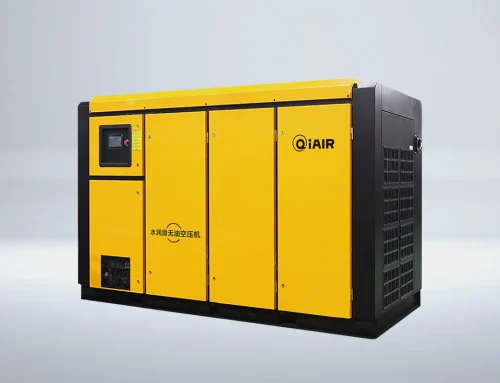
TL;DR — Direct answer: A battery recycling plant needs dust-tolerant air at 6 to 7 bar for dismantling, crushing, sorting and pneumatic conveying, with a pressure dew point of 3 degrees C and filtration to 0.01 micron so no oil or water reaches a sorting valve or a pneumatic tool. Size on the coincident peak of dismantling and sorting, commonly 5 to 12 cubic metres per minute for a mid-size plant, and use a variable speed drive because dismantling runs in batches. QiAir, a Chinese screw compressor manufacturer and supplier, builds fixed and variable speed machines with heavy-duty intake filtration for battery recycling plants.
Battery recycling is a dusty, abrasive, safety-sensitive business. Spent lithium-ion and lead-acid batteries are dismantled, crushed, sorted and separated into metals, plastics and black mass, and compressed air sits behind most of it: it drives pneumatic tools for dismantling, powers sorting valves and air jets, feeds pneumatic conveying lines, and operates dust-extraction dampers and cleaning lances. A pressure dip at the wrong moment can stall a sorting valve mid-cycle and send valuable material to the wrong bin, and a dusty intake can choke a compressor in weeks if it is not protected. Battery dust is also a fire risk, so the air system must be designed with dust control and fire safety in mind from the start. QiAir is a Chinese manufacturer and supplier of screw air compressors, and its machines for recycling plants are specified around dust tolerance and intake protection first and flow second.

The trap in battery recycling is sizing air like a clean factory utility. Dismantling is batchy, sorting is continuous, and pneumatic conveying peaks when a new batch of crushed material moves through the line. The compressor must cover the coincident peak without sagging below 6 bar at the farthest sorting valve, and the intake must survive fine, abrasive dust that would clog a standard filter in days. This guide maps the air users on a recycling line, explains how to size for dismantling and sorting peaks, sets the dust standard that protects the compressor, and shows what to put on a sizing sheet for a China supplier.
Where Air Is Used: Dismantling, Crushing, Sorting and Conveying
Dismantling is the most hands-on user. Pneumatic wrenches, cutters and screwdrivers open battery packs and remove modules, and a pressure swing shows up directly as a stalled tool or a stripped fastener. A dismantling hall with eight to sixteen benches can pull its peak when several operators start a new pack together, and a compressor sized on average flow will sag exactly then. Keep the pressure at the bench within a narrow band, and fit a dedicated receiver near the dismantling hall if the header run is long, because a local receiver is cheaper than upsizing the whole system.
Crushing, sorting and conveying take the most air and the most dust. Crushers use air for damper control and cleaning, sorting lines use high-speed air jets and valves to separate metals, plastics and black mass, and pneumatic conveying moves crushed material between process stages. Battery dust is fine, abrasive and everywhere, so any air tool or valve there needs filtration that survives it, and any open blow-off nozzle wastes air fast if operators leave it running. A plant that maps every user, including the small air tools used for cleaning, usually finds 15 to 25 percent more demand than the original estimate.
- Dismantling: pneumatic tools for opening packs and removing modules, where a pressure dip stalls a tool.
- Crushing and sorting: damper control, high-speed air jets and sorting valves that separate materials.
- Conveying and cleaning: pneumatic transport of crushed material and cleaning lances across the plant.
Sizing for Dismantling and Sorting Peaks
List every line with its flow at peak and at steady running, because the two differ sharply in recycling work. A mid-size plant processing 2,000 to 5,000 tonnes of batteries per year typically peaks at 5 to 12 cubic metres per minute at 6 to 7 bar, which is roughly a 37 to 75 kW screw compressor, and the peak usually lands when dismantling and sorting run together in the middle of the shift. A variable speed drive earns its keep here: it follows the batch pattern instead of loading and unloading a fixed-speed machine dozens of times a shift, and it holds pressure within the narrow band that sorting valves prefer.
Keep the pressure drop to the farthest sorting valve under 0.3 bar at peak flow, and fit a receiver of 500 to 1000 litres per 10 cubic metres per minute to absorb dismantling and sorting spikes. A ring main helps when the dismantling hall, sorting line and conveying system sit in different wings of the building. Log pressure at the sorting line during a full production run for a week, because that log is the honest record of whether the compressor is big enough, and it settles arguments faster than any catalogue figure. Never raise the set point to mask a sag: every extra bar adds roughly 7 percent to power use and hides the real fault, which is usually a clogged filter or an undersized pipe.
- Size on the coincident peak of dismantling and sorting, not on steady-state average flow.
- Use a variable speed drive for batch dismantling loads, and keep far-end pressure drop under 0.3 bar.
- Log sorting-line pressure during production for a week to prove the sizing in real use.
Dust, Fire Risk and Compressor Protection
Battery dust is the defining problem of this industry. It is fine, abrasive and conductive in some fractions, and lithium battery dust can be a fire risk, so the compressor intake must sit on the clean side of the building, away from the dismantling hall and the crusher, and ducted if necessary so the machine breathes relatively clean air. A standard intake filter clogs fast in a recycling plant; fit a heavy-duty pre-filter or a cyclone separator upstream of the intake, check it weekly, keep a spare on the shelf, and watch the pressure drop across it, because a choked intake raises discharge temperature and power draw at the same time.
Fire safety shapes the whole air system. Keep the compressor room separate from the dismantling and crushing areas, keep it clean and free of dust build-up, and never store battery material or black mass in the compressor room. Fit automatic zero-loss drains, slope lines to drain legs, and use a refrigerated dryer to a 3 degree C pressure dew point with a coalescing filter to 0.01 micron, so no moisture reaches a sorting valve or a pneumatic tool. Test the air at the sorting line quarterly, and review the plant's fire and dust-explosion assessment with the air system in mind, because a compressor that breathes battery dust is a maintenance problem and a safety problem at once.
- Put the compressor intake on the clean side of the building, with a heavy-duty pre-filter or cyclone separator.
- Check the intake filter weekly, keep a spare in stock, and watch pressure drop across it.
- Keep the compressor room separate from dismantling and crushing, and review fire safety with the air system in mind.
Buying from China: Sizing Sheet for a Battery Recycling Plant Compressor
QiAir is a Chinese manufacturer and supplier of screw air compressors, and a battery recycling order should start with a sizing sheet that names the dust level. Send the supplier the number of dismantling benches and sorting lines, the coincident peak at 6 to 7 bar, the dust level and ambient temperature in the compressor room, and the distance to the farthest sorting valve. Ask for a quotation that states the intake filtration, dryer type and filter grades explicitly, and ask whether a heavy-duty intake pre-filter or a cyclone separator fits the dust load better, with the cost and maintenance difference spelled out.
Agree the acceptance test before shipment: a full-load run at rated pressure, a dew point reading at the dryer outlet, and a pressure reading at a simulated far-end load. On arrival, install on a level plinth with clear airflow around the cooler, connect the drains before the first run, and run a pressure survey at the farthest sorting valve during the first full production week. Keep a simple log of pressure, temperature and filter changes, and it will tell you months ahead when a service is due.
- Send the supplier dismantling bench and sorting line counts, coincident peak, dust level and farthest-valve distance.
- Ask for intake filtration, dryer type and filter grades in writing, and compare pre-filter against cyclone on total cost.
- Accept on a full-load test plus dew point and far-end pressure readings, then survey pressure again in week one.
Frequently asked questions
What size screw compressor does a battery recycling plant need?
A mid-size battery recycling plant processing 2,000 to 5,000 tonnes of batteries per year typically needs 5 to 12 cubic metres per minute at 6 to 7 bar, roughly a 37 to 75 kW screw compressor. Size on the coincident peak of dismantling and sorting, add a 500 to 1000 litre receiver per 10 cubic metres per minute, and verify pressure at the farthest sorting valve under full load.
Why does battery dust damage compressors?
Battery dust is fine, abrasive and can be a fire risk, so a standard intake filter clogs fast and a choked intake raises discharge temperature and power draw. Put the intake on the clean side of the building, fit a heavy-duty pre-filter or cyclone separator, check it weekly, and keep the compressor room separate from dismantling and crushing areas.
How do I keep sorting valves working in a battery recycling plant?
Sorting valves need dry air at stable pressure, so fit a pre-filter, refrigerated dryer to a 3 degree C pressure dew point and coalescing filter to 0.01 micron in series, keep far-end pressure drop under 0.3 bar, and log sorting-line pressure weekly. A pressure dip or a drop of moisture can stall a valve mid-cycle and send material to the wrong bin.
Related reading
- Screw Compressor Heat Recovery: Turning Waste Heat into Factory Savings
- IoT Monitoring for Screw Compressor Rooms: A China Supplier's Practical Setup
QiAir is a Chinese manufacturer and supplier of screw air compressors. If you are sourcing a screw compressor from China — for a factory, a food plant, a construction site or a new production line — contact QiAir for a sized quotation, documented performance data and export support.