TL;DR — Direct answer: Wastewater aeration needs large volumes of air at low pressure — typically 0.3 to 1.0 bar above atmospheric — and that pressure range decides the machine. A screw blower is built for exactly this duty and beats a screw compressor on efficiency there, because a compressor is designed for 7 bar and throttled down to aeration pressure wastes most of its energy. A screw compressor earns its place only where the plant also needs higher-pressure air, or where diffuser depth pushes pressure beyond a blower's efficient range. Size on diffuser depth and oxygen demand, not on plant size.
Aeration is usually the largest energy user in a wastewater treatment plant, often half or more of total electricity, so the choice of aeration machine is the plant's most consequential energy decision. Yet buyers sometimes specify a familiar screw compressor for aeration duty, because it is the machine they know, and then pay for that familiarity on every electricity bill for a decade.

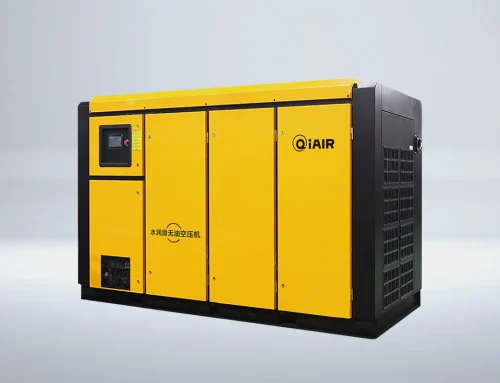
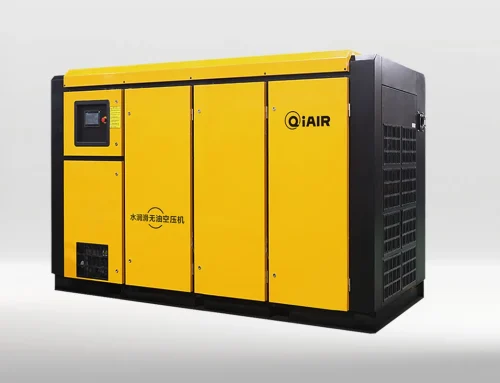
QiAir, a Chinese manufacturer and supplier of screw air compressors and blowers, supplies aeration equipment to municipal and industrial treatment plants in export markets, and the advice below is deliberately blunt: for most aeration duty, the blower wins, and the compressor should have to justify itself. The numbers explain why.
Pressure decides the machine
Aeration pressure is set mainly by diffuser submergence: roughly 0.1 bar per metre of water depth, plus diffuser and piping losses, so a basin with diffusers 5 metres deep needs about 0.5 to 0.7 bar, and even deep basins rarely exceed 1.0 bar. A screw blower delivers air efficiently across that 0.3 to 1.0 bar band, with a compression ratio matched to the duty. A screw compressor, designed to reach 7 to 13 bar, running at 0.7 bar is operating far outside its efficient band: it still consumes much of its full-load power while delivering air at a fraction of its design pressure, and its controls cannot recover that waste.
The crossover point is where diffuser depth or process pressure rises beyond blower range, or where the plant needs a single machine to serve both aeration and a higher-pressure duty such as filter backwashing or pneumatic conveying. In those cases a screw compressor, or a hybrid arrangement with blowers for aeration and a compressor for high-pressure duties, is the rational answer. The test is simple: if no duty on the machine exceeds about 1.5 bar, a blower is almost certainly the efficient choice.
Efficiency, turndown and the energy bill
Aeration demand varies through the day with influent load and dissolved-oxygen targets, so turndown matters as much as full-load efficiency. Modern screw blowers with VFD control turn down smoothly to 40 percent or less of rated flow while holding efficiency far better than a throttled compressor, and they do so without the unload losses that punish fixed-speed machines at part load. On a plant running aeration 24 hours a day, a 10 to 20 percent efficiency gap compounds into tens of thousands of kilowatt-hours a year, which is why aeration equipment should be compared on specific power at the aeration pressure, not on motor size or catalogue claims at unrelated pressures.
Maintenance follows the same comparison. Blowers for aeration duty run at lower temperatures and pressures than compressors, with simpler oil systems and no high-pressure separator to maintain, and their service intervals reflect that easier life. In the humid, corrosive atmosphere of a treatment plant, however, both machines need protected intakes, corrosion-resistant coatings where specified, and a service regime that accounts for hydrogen sulphide exposure in covered areas. The blower's simpler maintenance is an advantage only if the plant actually performs it.
- Size aeration pressure from diffuser depth: about 0.1 bar per metre plus losses.
- Compare machines on specific power at aeration pressure, not motor size.
- Value VFD turndown: aeration demand varies with influent load all day.
Sizing: oxygen demand, not plant footprint
Size aeration air from oxygen demand: the biological process needs a mass of oxygen per day, determined by influent load and treatment targets, and the air system must deliver that oxygen through diffusers at their efficiency. A common sizing error is to size on basin volume or on the previous blower's nameplate, both of which ignore diffuser condition: fouled or aged diffusers need more air pressure and flow for the same oxygen transfer, so a sizing exercise should include a diffuser inspection and, where possible, an oxygen-transfer test.
Provide redundancy for a process that cannot stop: aeration failure quickly leads to permit breaches and process upset, so plants typically install duty plus standby capacity, or multiple smaller blowers that can cover essential demand if one unit is down. QiAir sizes aeration orders with that redundancy in the calculation, because an aeration system sized exactly to average demand, with no standby, is a system that fails on the first peak-load day or the first service visit.
Frequently asked questions
Can a screw compressor do wastewater aeration?
It can, but inefficiently: a compressor designed for 7 bar running at 0.7 bar wastes most of its energy. Use a blower unless the plant also needs higher-pressure air.
What pressure does aeration need?
Typically 0.3 to 1.0 bar, set by diffuser depth at about 0.1 bar per metre plus diffuser and piping losses.
How should aeration air be sized?
From oxygen demand and diffuser condition, with duty plus standby capacity, not from basin volume or the old machine's nameplate.
Related reading
- Screw Air Compressor Maintenance Checklist from a China Manufacturer
- How to Size a Screw Compressor: Air Demand Calculation Before You Buy from China
QiAir is a Chinese manufacturer and supplier of screw air compressors. If you are sourcing a screw compressor from China — for a factory, a textile mill, a construction site or a new production line — contact QiAir for a sized quotation, documented performance data and export support.