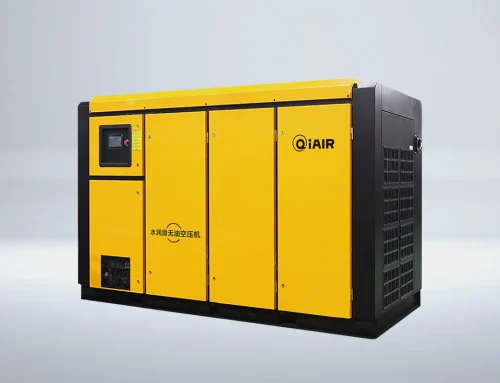
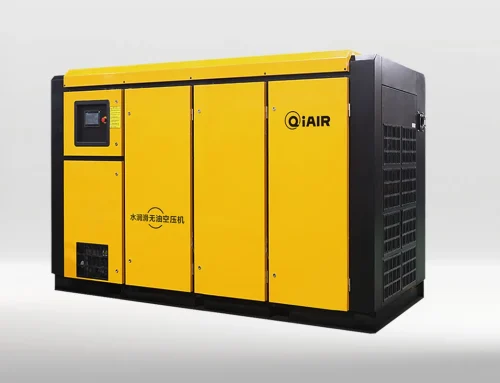
TL;DR — Direct answer: A woodworking machinery plant needs clean, dry air at 6 to 8 bar for machining centres, spindle assembly, welding, painting, machine assembly and testing, with a 3 degree C pressure dew point and 0.01 micron filtration. Size on the coincident peak of the machining centres and the test bays, 5 to 10 cubic metres per minute, roughly a 37 to 75 kW screw compressor. QiAir, a Chinese screw compressor manufacturer and supplier, builds dry-air machines for woodworking machinery plants.
A woodworking machine is a heavy steel frame carrying a fast-spinning cutter, and its factory builds that precision into every spindle, table and fence. Castings are machined on machining centres, spindles are assembled and balanced, frames are welded and painted, and every finished saw, planer or CNC router is run through cutting tests before delivery. Compressed air drives machining centres, spindle air, welding clamps, spray guns and assembly tools. QiAir is a Chinese manufacturer and supplier of screw air compressors, and its machines for woodworking machinery plants are specified around clean, dry air first.

The common sizing mistake is counting the machining centres alone and forgetting spindle testing and machine assembly. Machining centres draw air steadily, spindle test rigs need a long clean flow, assembly bays use air for fitting and torqueing, and sawdust is everywhere, clogging any intake placed near the cutting lines. This guide maps where the air goes, explains how to size for machining and test peaks, sets the dry-air standard that protects spindles and painted frames, and shows what to put on a sizing sheet for a China supplier.
Where Air Is Used: Machining Centres, Spindles, Welding and Testing
Machining centres are the heaviest users. Cast iron frames and steel tables are milled, drilled and tapped, spindles are assembled and balanced, and fences and guards are formed, using air for tool changes, workpiece clamping, chip blowing and spindle purging, continuously while the centres run. A pressure dip at a tool changer slows the change and adds seconds to every cycle, and a slow tool change on a three-shift line costs hours of cutting time every week.
Welding, painting, machine assembly and testing take the rest. Frames are welded and ground, machine covers are spray painted, finished machines are assembled with air tools, and every saw, planer and router is run through cutting and accuracy tests. Spindle air must stay free of oil and moisture, because a contaminated spindle bearing fails early and takes the machine down with it.
- Machining centres: tool changes, workpiece clamping, chip blowing and spindle purging running continuously.
- Spindle assembly: bearing fitting, balancing, runout checks and clean-air purging.
- Welding, painting and testing: frame welding, spray booths, assembly tools and cutting tests.
Sizing for Machining Centres and Spindle Test Peaks
List every centre, rig and bay with its flow at peak and at steady running. A mid-size plant with six to twelve machining centres, two to four spindle lines and a machine test area typically peaks at 5 to 10 cubic metres per minute at 6 to 8 bar, roughly a 37 to 75 kW screw compressor, with the peak landing when the machining centres run at full load while spindle test rigs purge together.
Keep the pressure drop to the farthest machining centre under 0.3 bar at peak flow, and fit a receiver of 500 to 1000 litres per 10 cubic metres per minute to absorb tool change and chip blowing spikes. Log pressure at the farthest machining centre for a week of full production: that log is the honest record of whether the compressor is big enough.
Sawdust control starts at the compressor room, not at the filter. Place the intake high on a clean wall away from the cutting lines, fit a pre-filter rated for wood dust, and check it every week during full production, because a clogged intake filter is the most common cause of a slow pressure sag in a woodworking plant. Keep a spare set of intake and coalescing elements on site, so a filter change takes minutes instead of waiting for a delivery while the machining centres stand idle.
- Size on the coincident peak of the machining centres and the test bays, not on machining alone.
- Use a variable speed drive for mixed steady and pulsing loads, and keep far-end pressure drop under 0.3 bar.
- Log farthest-centre pressure during production for a week to prove the sizing in real use.
Dry Air and Sawdust Control for Spindles and Painted Frames
Moisture is the main enemy in woodworking machinery manufacturing. A spindle assembled with damp air corrodes at the bearings before the machine is sold, moisture in a tool changer causes slow or sticking changes, and damp air in a spray gun leaves orange peel on a machine cover. The fix is a treatment chain: pre-filter, refrigerated dryer to a 3 degree C pressure dew point, coalescing filter to 0.01 micron, and activated-carbon filter for oil vapour, with a final point-of-use filter at each machining group and spindle line.
Sawdust is the second risk: fine wood dust drawn into a compressor intake clogs filters and wears valves, and dust in a paint gun ruins a finished surface. Site the compressor intake away from cutting saws and sanding lines, fit a heavy-duty intake filter and check it weekly, drain condensate with automatic zero-loss drains, and test air at the farthest machining centre quarterly. Change coalescing elements on pressure drop, not on a calendar guess.
- Fit pre-filter, refrigerated dryer, 0.01 micron coalescing filter and carbon filter, with a final filter at each machining group and booth.
- Keep the compressor intake away from sawdust and sanding dust, with a heavy-duty pre-filter checked weekly.
- Drain condensate automatically, and test air at the farthest machining centre quarterly for oil and moisture.
Buying from China: Sizing Sheet for a Woodworking Machinery Plant Compressor
QiAir is a Chinese manufacturer and supplier of screw air compressors, and a woodworking machinery order should start with a sizing sheet that names the centre count. Send the supplier the number of machining centres, spindle lines, welding stations and test bays, the coincident peak at 6 to 8 bar, the air-quality standard the spindle lines and machining centres require, ambient temperature and humidity, and the distance to the farthest machining centre.
Agree the acceptance test before shipment: a full-load run at rated pressure, a dew point reading at the dryer outlet, and an oil-aerosol check at the final filter outlet. On arrival, install on a level plinth with clear cooler airflow, connect drains before the first run, and survey pressure at the farthest machining centre during the first full production week.
- Send the supplier machining centre, spindle line and bay counts, coincident peak and farthest-centre distance.
- Ask for dryer type and filtration grades in writing, and compare oil-free against filtered oil-injected on total cost.
- Accept on a full-load test plus dew point and oil-aerosol checks, then survey pressure at the farthest centre in week one.
Frequently asked questions
What pressure does a woodworking machinery plant need?
A woodworking machinery plant needs clean, dry air at 6 to 8 bar for machining centres, spindle air, welding, painting, machine assembly and testing. Keep far-end pressure drop under 0.3 bar, because a pressure dip slows tool changes, and size on the coincident peak of the machining centres and the test bays.
Why must woodworking machinery air be dry?
A spindle assembled with damp air corrodes at the bearings before the machine is sold, moisture in a tool changer causes slow or sticking changes, and damp air in a spray gun leaves orange peel on a machine cover. A pre-filter, refrigerated dryer to a 3 degree C pressure dew point, 0.01 micron coalescing filter and carbon filter in series protect the spindles and finishes.
What size screw compressor does a woodworking machinery plant need?
A mid-size woodworking machinery plant with six to twelve machining centres, two to four spindle lines and a machine test area typically needs 5 to 10 cubic metres per minute at 6 to 8 bar, roughly a 37 to 75 kW screw compressor with a variable speed drive. Add a 500 to 1000 litre receiver per 10 cubic metres per minute, and verify pressure at the farthest machining centre under full load.
Related reading
- Screw Compressor Heat Recovery: Turning Waste Heat into Factory Savings
- IoT Monitoring for Screw Compressor Rooms: A China Supplier's Practical Setup
QiAir is a Chinese manufacturer and supplier of screw air compressors. If you are sourcing a screw compressor from China — for a factory, a food plant, a construction site or a new production line — contact QiAir for a sized quotation, documented performance data and export support.