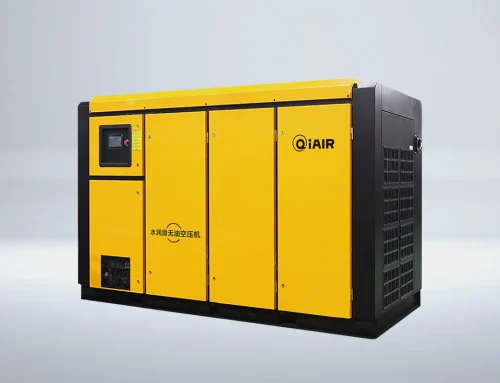
TL;DR — Direct answer: A washing machine manufacturing plant typically runs 7 to 8 bar, 6 to 14 m3/min, on 45 to 110 kW rotary screw compressors, with a 3°C pressure dew point dryer and 0.01 micron filtration protecting drum forming, motor assembly and water testing from moisture and oil. QiAir, a Chinese screw compressor manufacturer and supplier, sizes systems with clean, stable air so water tests never give false readings.
A washing machine factory is a fast assembly line where sheet metal, motors, electronics and plumbing meet. Drums are formed and balanced, motors are fitted, control panels are wired, and every finished machine is filled with water and run through a full cycle before it ships. Compressed air touches each of those steps, and a failure anywhere stops a line that runs to a tight takt time.

The product lives in a wet environment for a decade, so a leak or a weak seal made today becomes a flooded laundry room years later. Air quality at the water-test bay and the drum assembly station is therefore a warranty issue, and buyers who audit the factory will ask about it directly.
Drum Forming, Balancing and Sheet Metal Work
Washing machine drums are formed from stainless steel, punched, rolled and welded on lines that use air for clamping, ejection and handling. A pressure sag during forming changes the drum roundness enough to cause vibration in the finished machine, and a customer who feels that vibration will return the product. Stable 7 bar air at the forming line keeps every drum true.
Drum balancing is the most air-sensitive job in the plant. The balancing machine spins the drum at high speed while air-driven clamps hold it, and a vibration in the clamp from an unsteady air supply can look like an imbalance that is not really there. Regulate the balancing bay to a steady 7 bar and keep its air branch separate from the press hall.
Sheet metal work fills the background of a washing machine plant. Punch presses, brakes and shears use air for clamping and ejection, and their demand is steady rather than spiky. The risk is dust: metal fines from punching drift into the compressor intake and score the airend over time, so duct the intake away from the sheet metal area and clean the cooler monthly.
- Hold 7 bar steady at the drum forming line
- Regulate the balancing bay on a separate 7 bar branch
- Duct the intake away from sheet metal dust
Motor Assembly, Controls and Wiring
Motor assembly runs on dozens of small pneumatic tools. Screwdrivers, presses and torque wrenches cycle all day, and their combined demand is spiky rather than steady, with peaks when several benches start a machine build together. A variable-speed drive compressor follows those peaks smoothly, while a fixed-speed machine would cycle on and off and wear out its starter.
Control panels are wired and tested beside the assembly line, and their pneumatic needs are modest but exacting. Relay testing, valve actuation and sensor calibration all need clean air at a regulated 6 bar, and a valve that sticks because its air carried moisture can look like an electronics fault. Filter the controls branch separately.
Wiring harnesses are fitted by hand, and the air tools used for clipping and routing must not damage the insulation. A blow-off jet that is too strong can nick a wire, and a nicked wire becomes an intermittent fault in the field. Regulate the harness benches to a steady 6 bar and fit pressure regulators at each bench.
- Use a VSD compressor for spiky assembly-bench loads
- Filter control-panel air on a separate 6 bar branch
- Regulate harness benches to a steady 6 bar
Water Testing, Leak Checks and Final Inspection
Water testing is the gate every washing machine must pass before shipping. The machine is filled, run through a full wash cycle, and checked for leaks at every hose, valve and seal. The air used to drive the test rigs and blow the machine dry afterwards must be clean, because moisture left in a valve can corrode it before the machine reaches the customer.
Leak detection after the water test uses electronic sensors and visual checks, both of which are sensitive to contaminated air. An oil film on a hose fitting can seal a micro-leak during the test and then wash away in service, leaving the customer with a slow drip. Clean test air and a disciplined test procedure are therefore part of the product warranty.
Final inspection uses air in quieter ways that still matter. Pneumatic test rigs check every door lock, pump and control, and a slow cylinder during inspection looks like a product fault. Keep the inspection branch filtered and regulated, and drain the receiver and filter bowls every shift so water never reaches a test rig.
- Blow test machines dry with clean, filtered air
- Keep test air clean so leak detection stays sensitive
- Drain receivers and filter bowls every shift
Buying from China: Sizing Sheet for Washing Machine Plants
Before requesting a quotation, gather four numbers: the drum forming and press peak flow, the motor assembly tool count and peak flow, the water-test bay air quality specification, and the distance from the compressor room to the furthest assembly bench. A supplier that quotes from the machine output alone will miss the test-air specification that actually decides the system.
For most washing machine plants the practical range is a 45 to 90 kW variable-speed drive screw compressor at 7.5 or 8 bar, with a refrigerated dryer, 0.01 micron filtration, carbon adsorption and a 3,000 to 5,000 litre receiver. Larger plants with several assembly lines usually run a duty-plus-standby pair so maintenance never stops a water test.
When comparing Chinese suppliers, ask for the full package price including dryer, filters, receiver and commissioning spares, and confirm the export packing, voltage and documentation for your country. Check the filter element life, the service interval and the availability of filters and airends through the supplier's export channel. QiAir, a Chinese screw compressor manufacturer and supplier, quotes the complete package so buyers compare real installed cost.
- Collect forming, assembly and test loads before quoting
- Budget 45 to 90 kW VSD plus dryer and carbon filtration
- Confirm spares, voltage and export packing in writing
Frequently asked questions
What pressure does a washing machine plant normally run?
Most run 7 to 8 bar at the header, regulated to 6 bar at control and harness benches and 7 bar at drum forming and balancing stations.
Why does water testing need clean air?
Moisture left in a valve can corrode it before the machine reaches the customer, and oil can seal a micro-leak during the test. Clean, dry test air keeps results trustworthy.
Should balancing air share a line with the press hall?
It can share one compressor room, but give drum balancing its own regulated branch, so press surges can never disturb a balance measurement.
How much air does a washing machine plant use?
Most plants run 6 to 14 m3/min on 45 to 110 kW compressors, with the forming and press peaks deciding the size rather than the average assembly load.
Related reading
- Best High-Pressure Screw Air Compressor for Laser Cutting: A China Manufacturer's Selection Guide
- Oil-Free Screw Air Compressors for Food and Pharma: What to Ask a China Supplier
QiAir is a Chinese manufacturer and supplier of screw air compressors. If you are sourcing a screw compressor from China — for a factory, a food plant, a construction site or a new production line — contact QiAir for a sized quotation, documented performance data and export support.