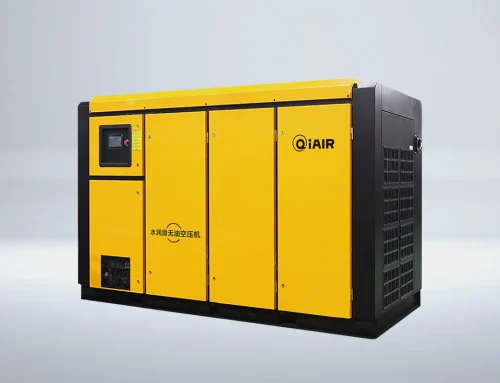
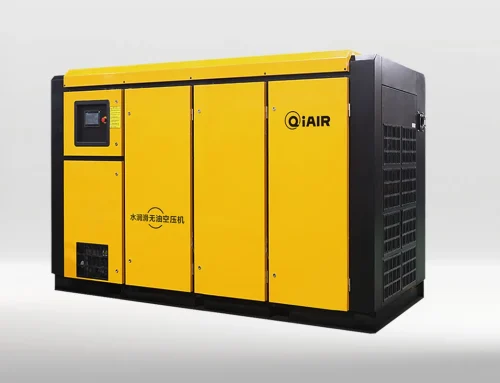
TL;DR — Direct answer: A tire plant typically runs 7 to 8 bar, 10 to 25 m3/min, on 75 to 160 kW rotary screw compressors, with a 3°C pressure dew point dryer and 0.01 micron filtration protecting rubber mixing, tire building machines and curing presses from moisture and oil. QiAir, a Chinese screw compressor manufacturer and supplier, sizes systems with large receivers so curing presses never stall mid-cycle.
Tire manufacturing is one of the heaviest users of compressed air in any industry. Rubber mixing, calendaring, extrusion, tire building and curing all draw large volumes, and the plant runs around the clock. A tire factory that loses air pressure loses its curing presses within minutes, and a press stopped mid-cycle scraps the tire inside it.

The processes are hot, dusty and continuous. Carbon black dust fills the mixing hall, curing presses run at high temperature, and the air system must deliver clean, dry air into that environment all day. Good design therefore starts with the curing press peak, then protects the air system from the dust and heat that surround it.
Mixing, Calendering and Extrusion Air Demand
A rubber mixing line with two internal mixers will usually draw 4 to 8 m3/min, mostly from pneumatic ram cylinders, dust extraction valves and material handling. The mixers cycle in batches, so the load is spiky rather than smooth, and a variable-speed drive compressor follows those batches far better than a fixed-speed machine cycling on and off.
Calendering and extrusion add a steadier demand. Air knives control sheet thickness, pneumatic cutters trim rubber to length, and cooling drums use air for temperature control valves. The load is continuous, which makes the combined profile easier to serve, but keep the calender branch filtered to 0.01 micron so carbon black dust never reaches the valves.
Dust is the hidden enemy of every compressor in a tire plant. Carbon black is fine enough to pass a poor intake filter and wear the airend, and it clogs filters far faster than ordinary factory dust. Put the compressor room upwind of the mixing hall, fit a high-efficiency intake filter, and clean or replace it on a weekly schedule.
- Size for simultaneous mixer ram cycles
- Filter calender air to 0.01 micron
- Keep the compressor intake upwind of carbon black dust
Tire Building Machines and Pneumatic Controls
Tire building machines are the precision heart of the plant. Drums expand and contract pneumatically, ply layers are applied under air pressure, and bead setters position steel wire to fractions of a millimetre. A pressure sag during a build cycle changes ply tension enough to fail the finished tire uniformity check.
Each building machine has dozens of pneumatic valves and cylinders cycling in a programmed sequence, and the timing depends on stable pressure. A header that sags by 0.5 bar slows the whole sequence, and the operator cannot tell whether the fault is the machine or the air. Fit a regulator at each building machine so its pressure never depends on what the curing presses are doing.
Bead and belt handling uses vacuum and air in combination. Suction cups lift steel belts, air cylinders position them, and a weak vacuum drops a belt mid-transfer. Give the handling cells their own vacuum supply where volumes are high, and reserve compressed air for the clamping and positioning tasks only it can do.
- Regulate pressure at each tire building machine
- Keep building air separate from the curing press header
- Use central vacuum for high-volume belt handling
Curing Presses and Steam-Air Systems
Curing presses are the biggest air consumers in a tire plant. Each press uses compressed air to close its mould, hold it shut against steam pressure, and operate its bladder controls. A plant with twenty presses can draw 8 to 15 m3/min at peak, and a press that loses clamping pressure mid-cycle scraps the tire and risks the mould.
Steam and air work together in curing, and the two systems must be kept strictly separate. Steam heats the mould while air drives the controls, and a steam leak into the air line corrodes valves and contaminates the whole header. Fit check valves on every press branch and a moisture separator at each press, so steam can never flow back into the air system.
Curing is continuous, so the air system never gets a rest. A duty-plus-standby compressor pair is the normal choice for tire plants, because a single compressor failure during a night shift would stop every press at once. Size each machine to carry the full plant load alone, so a service shutdown never interrupts curing.
- Size for the simultaneous curing press peak
- Fit check valves and moisture separators at each press
- Run duty-plus-standby so curing never stops
Buying from China: Sizing Sheet for Tire Plants
Before requesting a quotation, gather four numbers: the curing press count and simultaneous clamping demand, the mixing line peak flow, the tire building machine count, and the distance from the compressor room to the furthest press. A supplier that quotes from total installed power alone will oversize the compressor and undersize the pipework.
For most tire plants the practical range is a 75 to 132 kW variable-speed drive screw compressor at 7.5 or 8 bar, with a refrigerated dryer, 0.01 micron filtration and a 5,000 litre receiver. Larger plants with several curing halls often step up to 160 kW or a duty-plus-standby pair, so maintenance never stops production.
When comparing Chinese suppliers, ask for the full package price including dryer, filters, receiver and commissioning spares, and confirm the export packing, voltage and documentation for your country. Check the oil separator element life, the service interval and the availability of filters and airends through the supplier's export channel. QiAir, a Chinese screw compressor manufacturer and supplier, quotes the complete package so buyers compare real installed cost.
- Collect a 15 minute peak load profile before quoting
- Budget 75 to 132 kW VSD plus dryer, filters and receiver
- Confirm spares, voltage and export packing in writing
Frequently asked questions
What pressure do tire plants normally run?
Most run 7 to 8 bar at the header, regulated down to 6 to 7 bar at curing presses and 6 bar at building machines, so clamping and ply tension stay consistent all shift.
Why are curing presses the sizing driver?
Twenty presses closing together can draw 8 to 15 m3/min, and a press that loses clamping pressure mid-cycle scraps the tire inside. Size for the simultaneous press peak, not the average.
How does carbon black dust affect compressors?
Carbon black is fine enough to pass a poor intake filter and wear the airend, and it clogs filters fast. Keep the compressor room upwind of mixing and clean the intake filter weekly.
Should steam and air share pipework in curing?
Never. Fit check valves on every press branch and a moisture separator at each press, so steam can never flow back into the air header and corrode valves.
Related reading
- Screw Compressor Heat Recovery: Turning Waste Heat into Factory Savings
- IoT Monitoring for Screw Compressor Rooms: A China Supplier's Practical Setup
QiAir is a Chinese manufacturer and supplier of screw air compressors. If you are sourcing a screw compressor from China — for a factory, a food plant, a construction site or a new production line — contact QiAir for a sized quotation, documented performance data and export support.