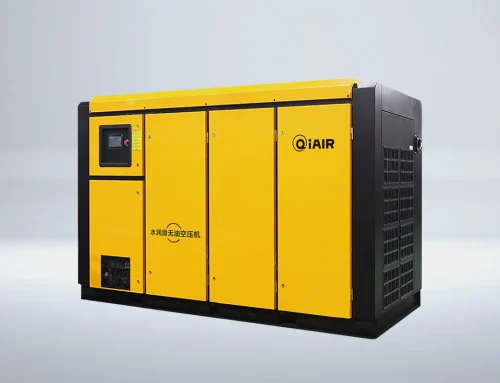
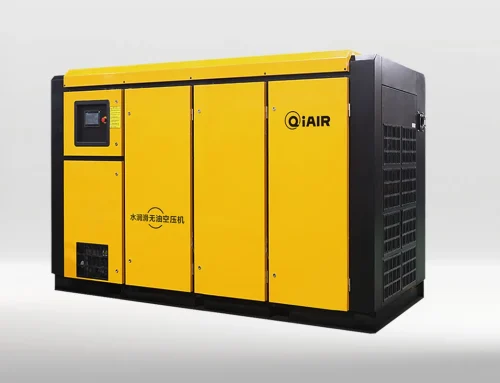
TL;DR — Direct answer: A textile machinery plant typically runs 7 to 8 bar, 8 to 20 m3/min, on 55 to 132 kW rotary screw compressors, with a 3°C pressure dew point dryer and 0.01 micron filtration protecting air-jet looms and dyeing lines from moisture and oil. QiAir, a Chinese screw compressor manufacturer and supplier, sizes systems with receiver storage so weaving never stalls when looms start together.
Textile machinery plants run on compressed air from the first loom to the final inspection table. Air-jet looms consume large volumes of air to carry weft yarn across the shed, while rapier looms use air for braking, clamping and weft control.

Dyeing and finishing add a second, very different demand. Pneumatic valves sequence dye baths, air knives dry fabric after washing, and stenters use air cylinders to hold cloth at high temperature. Moisture or oil in this air stains fabric, blocks valves and ruins whole dye lots. Good design therefore starts with air quality.
Air-Jet Weaving and Loom Air Demand
A mid-size weaving shed with 60 air-jet looms will usually draw 8 to 15 m3/min during steady running, with sharp peaks when several looms restart after a warp change or a power dip. Each loom needs continuous flow at 6 to 7 bar, and a drop of even 0.5 bar slows weft insertion and raises the stop rate. Plants weaving wide fabrics or heavy denim sit at the top of that range.
The load profile of a weaving shed is famously spiky. Looms start and stop independently, so the header sees hundreds of small pulses every minute rather than a smooth demand curve. A fixed-speed compressor that cycles on and off all day wastes energy on unloaded running and wears out its contactors. A variable-speed drive screw compressor follows the real load, holding pressure steady while drawing only the power the looms need.
Receiver storage matters as much as compressor size. A 5,000 litre vessel gives the system a buffer that absorbs the restart surge when a whole loom bank comes back online together. Without that buffer, the first looms to restart steal air from the rest, and the shed spends the morning chasing pressure instead of weaving. Size the receiver for the simultaneous restart, not the average flow.
- Size for simultaneous loom restarts, not average weaving load
- Hold pressure within 0.5 bar at the furthest loom
- Fit 5,000 litres of receiver storage for a 60-loom shed
Dyeing, Finishing and Pneumatic Controls
Dye houses use compressed air to sequence valves, agitate baths and drive fabric through continuous ranges. A dyeing machine may have dozens of pneumatic valves opening and closing on a programmed cycle, and a slow valve means uneven liquor flow and shade variation between batches. Stable pressure at 7 bar keeps valve timing consistent from the first batch of the shift to the last.
Finishing lines are where air quality becomes visible on the product. Air knives blow water off fabric after washing, stenters stretch cloth under heat, and coating heads apply finishes that must stay free of oil spots. A single droplet of compressor oil carried into a coating line can mark hundreds of metres of fabric. Filtration and drying on the finishing branch are not optional extras.
- Keep 7 bar stable at dye-house valve manifolds
- Filter and dry the finishing branch separately
- Ventilate the compressor room away from stenter heat
Air Quality: Dry, Oil-Free Air for Fabric and Yarn
Fabric shows every defect that dirty air creates. Oil carryover leaves spots that only appear after dyeing, moisture causes yarn breaks on high-speed looms, and dust clogs the tiny nozzles of air-jet looms. The standard defence is a refrigerated dryer holding a 3°C pressure dew point, followed by 0.01 micron coalescing filtration and an activated carbon stage where the process demands it.
Some textile processes justify oil-free air at the point of use. Yarn texturising, air-jet spinning and medical textile lines cannot tolerate any oil vapour, and a point-of-use oil-free filter or a dedicated oil-free compressor for that cell is cheaper than scrapping contaminated yarn. For the rest of the plant, a well-maintained oil-injected screw compressor with correct filtration is the practical and economical choice.
Maintenance discipline decides whether the air stays clean. Filter elements have a service life measured in operating hours, and a clogged element raises pressure drop, which tempts operators to raise the compressor setpoint and burn more power. Log differential pressure across filters, change elements on schedule, and sample the air at the furthest loom at least once a quarter.
- Hold a 3°C pressure dew point with 0.01 micron filtration
- Use oil-free air at texturising and spinning cells
- Log filter pressure drop and change elements on schedule
Buying from China: Sizing Sheet for Textile Machinery Plants
Before requesting a quotation, gather four numbers: the count of air-jet looms and their simultaneous restart demand, the dye-house valve and air-knife peak, the finishing line flow at maximum speed, and the distance from the compressor room to the furthest loom. A supplier that quotes from total installed motor power alone will oversize the compressor and undersize the pipework.
For most textile machinery plants the practical range is a 55 to 110 kW variable-speed drive screw compressor at 7.5 or 8 bar, with a refrigerated dryer, 0.01 micron filtration and a 5,000 litre receiver. Larger weaving sheds with in-house dyeing often step up to 132 kW or a duty-plus-standby pair, so a service shutdown never stops the looms.
When comparing Chinese suppliers, ask for the full package price including dryer, filters, receiver and commissioning spares, and confirm the export packing, voltage and documentation for your country. Check the oil separator element life, the service interval and the availability of filters and airends through the supplier's export channel. QiAir, a Chinese screw compressor manufacturer and supplier, quotes the complete package so buyers compare real installed cost.
- Collect a 15 minute peak load profile before quoting
- Budget 55 to 110 kW VSD plus dryer, filters and receiver
- Confirm spares, voltage and export packing in writing
Frequently asked questions
What pressure do textile machinery plants normally run?
Most run 7 to 8 bar at the header, regulated down to 6 to 7 bar at the looms and 6 bar at dye-house valves, so weft insertion and valve timing stay consistent during peak demand.
Do air-jet looms need oil-free air?
Not usually for the whole shed. A refrigerated dryer at a 3°C pressure dew point plus 0.01 micron filtration is enough for most weaving, while texturising and air-jet spinning cells get dedicated oil-free filtration at the point of use.
Why does pressure drop when looms restart together?
Dozens of looms restarting at once create a surge that empties a small receiver in seconds. A 5,000 litre receiver and a variable-speed drive compressor absorb the surge and hold pressure steady.
Should dyeing and weaving share one compressor?
They can share one compressor room, but give the dye house and finishing lines their own dryer and filtration branch, so heat and moisture from those areas never reach the weaving header.
Related reading
- How to Choose the Best Screw Air Compressor Manufacturer in China for Your Factory
- Two-Stage PM VFD Screw Compressors: How a Top China Supplier Cuts Factory Energy Costs
QiAir is a Chinese manufacturer and supplier of screw air compressors. If you are sourcing a screw compressor from China — for a factory, a food plant, a construction site or a new production line — contact QiAir for a sized quotation, documented performance data and export support.