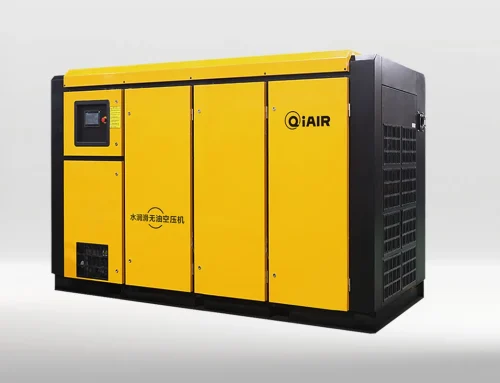
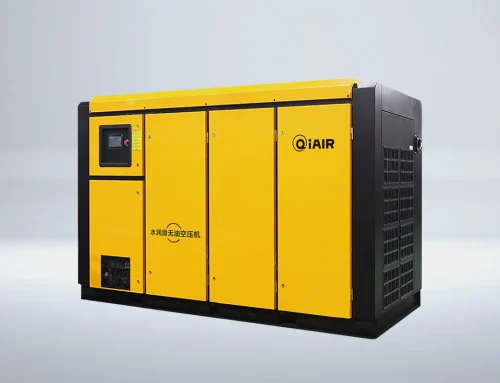
TL;DR — Direct answer: A transformer factory needs clean, dry air at 6 to 7 bar for winding, core cutting, drying and testing, with a pressure dew point of 3 degrees C or lower and filtration to 0.01 micron so no oil or water reaches a winding, an insulation surface or a test instrument. Size on the coincident peak of winding, drying and testing, commonly 4 to 9 cubic metres per minute for a mid-size plant, and use a variable speed drive because winding and testing run in batches. QiAir, a Chinese screw compressor manufacturer and supplier, builds fixed and variable speed machines for transformer production.
A transformer is a machine that must stay dry inside for decades, and the air behind it has to respect that. Winding machines use compressed air for wire tensioning, layer insulation and clamping, core-cutting lines use it for cutting and stacking, drying ovens use it for damper and valve control, and test bays use it for pressure and leak testing, oil filling and final inspection. A puff of wet air can dampen insulation paper before it is dried, a trace of oil can contaminate a winding surface, and a pressure dip can stall a winding machine mid-layer or leave a test result unreliable. The defect may only show up at final dielectric testing, by which time a whole winding is suspect. QiAir is a Chinese manufacturer and supplier of screw air compressors, and its machines for transformer plants are specified around air dryness first and flow second.

The trap in transformer manufacturing is treating air as a background service while the winding machine gets all the attention. Winding is a batch process with sharp peaks when several machines start a layer together, drying ovens run long cycles, and testing needs the cleanest air of all. The compressor must cover the coincident peak without sagging below 6 bar at the farthest winding machine, and the treatment chain must hold the dew point and oil level steady through the hottest, most humid month. This guide maps the air users on a transformer line, explains how to size for winding peaks, sets the dryness standard that protects insulation, and shows what to put on a sizing sheet for a China supplier.
Where Air Is Used: Winding, Drying and Testing
Winding is the heaviest user and the most sensitive to pressure. Air drives wire tensioning, layer insulation feeding, clamping and turn counting, and any pressure swing shows up as uneven tension or a misplaced layer. A winding hall with six to twelve machines can pull its peak in the first minutes after a layer change, when several machines restart together, and a compressor sized on average flow will sag exactly then. Keep the pressure at the winding machine within a narrow band, and fit a dedicated receiver near the winding hall if the header run is long, because a local receiver is cheaper than upsizing the whole system.
Core cutting, drying and testing each add their own demand, and testing is the strictest of all. Core-cutting lines use air for cutting, stacking and clamping, drying ovens use it for damper control and valve actuation, and test bays use dry air for pressure and leak testing, oil-filling controls and instrumentation. A plant that runs distribution and power transformers on shared headers will see very different peaks by product mix, so the sizing exercise has to use the real production schedule, not a single representative day.
- Winding: wire tensioning, layer insulation, clamping and turn counting sensitive to pressure swings.
- Core cutting and drying: cutting, stacking and oven damper control over long cycles.
- Testing: pressure and leak testing, oil filling and instrumentation that need the cleanest, driest air in the plant.
Sizing for Winding Peaks Without Oversizing the Plant
List every line with its flow at layer change and at steady running, because the two are very different in transformer work. A mid-size plant with six to twelve winding machines, a core-cutting line and two to four test bays typically peaks at 4 to 9 cubic metres per minute at 6 to 7 bar, which is roughly a 30 to 55 kW screw compressor, and the peak usually lands in the first minutes after a layer change when several machines restart together. A variable speed drive earns its keep here: it follows the batch pattern instead of loading and unloading a fixed-speed machine dozens of times a shift, and it keeps pressure within the narrow band that winding tensioning prefers.
Keep the pressure drop to the farthest winding machine under 0.3 bar at peak, and fit a receiver of 500 to 1000 litres per 10 cubic metres per minute to absorb layer-change spikes. A ring main helps when winding, drying and testing halls sit in different wings of the building. Log pressure at the winding hall during layer changes for a week, because that log is the honest record of whether the compressor is big enough, and it settles arguments faster than any catalogue figure. Never raise the set point to mask a sag: every extra bar adds roughly 7 percent to power use and hides the real fault, which is usually a clogged filter or an undersized pipe.
- Size on the layer-change peak when several winding machines restart together, not on steady-state average flow.
- Use a variable speed drive for batch winding loads, and keep far-end pressure drop under 0.3 bar.
- Log winding-hall pressure during layer changes for a week to prove the sizing in real production.
Dry Air and Insulation: Moisture Is the Enemy
Insulation paper does not forgive moisture. Wet air in a winding line dampens insulation before it is dried, moisture in a test bay can skew a leak-test result, and oil aerosol on a winding surface can contaminate insulation and shorten transformer life. The standard that prevents this is a treatment chain, not a single filter: a pre-filter, a refrigerated dryer to a 3 degree C pressure dew point, a coalescing filter to 0.01 micron, and an activated-carbon filter where the process specification demands oil-free quality air. For the cleanest winding and testing lines, an oil-free screw compressor removes the risk at source, and a desiccant dryer to minus 40 degrees C is worth considering where the drying specification is strictest.
Maintenance is what keeps that chain honest. Change coalescing elements on pressure drop, not on a calendar guess, and test the air at the winding hall and the test bay quarterly with a simple oil and moisture check. Drain condensate with automatic zero-loss drains, slope lines to drain legs, and keep the compressor room clean and ventilated so the machine does not breathe its own hot air. A dryer that is undersized for summer humidity is a common failure in transformer plants in hot climates: size the dryer for the hottest, most humid month, not the annual average, and check the dew point at the dryer outlet every month.
- Fit pre-filter, refrigerated dryer, 0.01 micron coalescing filter and carbon filter where oil-free air is specified.
- Consider an oil-free screw compressor and a desiccant dryer for winding and testing lines with the strictest dryness rules.
- Test air at the winding hall and test bay quarterly, and size the dryer for peak summer humidity.
Buying from China: Sizing Sheet for a Transformer Plant Compressor
QiAir is a Chinese manufacturer and supplier of screw air compressors, and a transformer order should start with a sizing sheet that names the product mix. Send the supplier the number of winding machines and test bays, the coincident peak at 6 to 7 bar, the air-quality standard the insulation specification requires, ambient temperature and humidity, and the distance to the farthest winding machine. Ask for a quotation that states the filtration grades and dryer duty explicitly, and ask whether an oil-free machine or a filtered oil-injected machine fits the specification better, with the cost and maintenance difference spelled out.
Agree the acceptance test before shipment: a full-load run at rated pressure, a dew point reading at the dryer outlet, and an oil-aerosol check at the final filter outlet. On arrival, install on a level plinth with clear cooler airflow, connect drains before the first run, and survey pressure at the winding hall during a layer change in the first production week. Keep a log of pressure, dew point and filter changes, and review it monthly, because a slow rise in dew point is the earliest sign that a dryer needs attention before insulation starts suffering.
- Send the supplier winding machine and test bay counts, coincident peak, required air-quality standard and farthest-machine distance.
- Ask for filtration grades and dryer duty in writing, and compare oil-free against filtered oil-injected on total cost.
- Accept on a full-load test plus dew point and oil-aerosol checks, then survey pressure at a layer change in week one.
Frequently asked questions
What air quality does transformer manufacturing need?
Most transformer plants need dry air at a 3 degree C pressure dew point with coalescing filtration to 0.01 micron, and an activated-carbon filter where the specification demands oil-free air. For the strictest winding and testing lines, an oil-free screw compressor and a desiccant dryer to minus 40 degrees C remove the moisture and oil risk at source.
What size screw compressor does a transformer factory need?
A mid-size transformer plant with six to twelve winding machines, a core-cutting line and two to four test bays typically needs 4 to 9 cubic metres per minute at 6 to 7 bar, roughly a 30 to 55 kW screw compressor. Size on the layer-change peak when winding machines restart together, and use a variable speed drive to follow the batch pattern.
Why does moisture damage transformer insulation?
Moisture dampens insulation paper before drying, lowers dielectric strength, and can skew leak-test results, while oil aerosol contaminates winding surfaces and shortens transformer life. A pre-filter, dryer and coalescing filter in series, tested quarterly at the winding hall and test bay, prevent most of it.
Related reading
- Screw Air Compressor Maintenance Checklist from a China Manufacturer
- How to Size a Screw Compressor: Air Demand Calculation Before You Buy from China
QiAir is a Chinese manufacturer and supplier of screw air compressors. If you are sourcing a screw compressor from China — for a factory, a food plant, a construction site or a new production line — contact QiAir for a sized quotation, documented performance data and export support.