TL;DR — Direct answer: A wafer fab does not tolerate ordinary plant air anywhere near a process tool: a single oil droplet, a moisture excursion or a particle burst can scrap wafers worth tens of thousands of dollars, and the cleanroom classes that govern the fab, from ISO Class 5 lithography bays to ISO Class 7 support areas, set the air quality bar before any compressor is chosen. The working system starts oil-free at the source, dries to a pressure dew point of minus 40 degrees Celsius or lower, filters in stages to the point of use, and runs duty-standby machines so a service visit never interrupts a lithography run.
Walk a wafer fab and the paradox is immediate: the fab floor looks calm, white and almost empty, yet the air systems behind the wall work harder than in any steel mill. Process tools, wafer handling robots, pneumatic valves and chemical delivery systems all draw on compressed air, and the cleanest bays demand air that is dry, oil-free and particle-controlled to a level that ordinary workshop filtration cannot reach. A pressure dip during a lithography exposure or a wet-air event at a handling station does not just slow production; it shows up as defects across a whole lot.

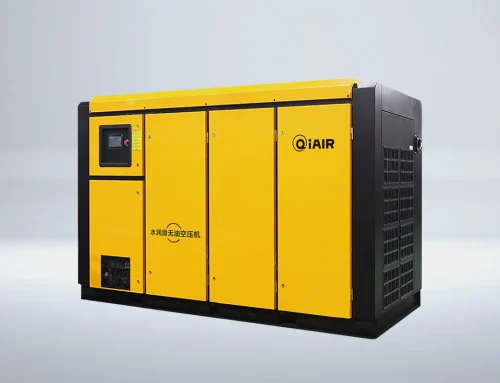
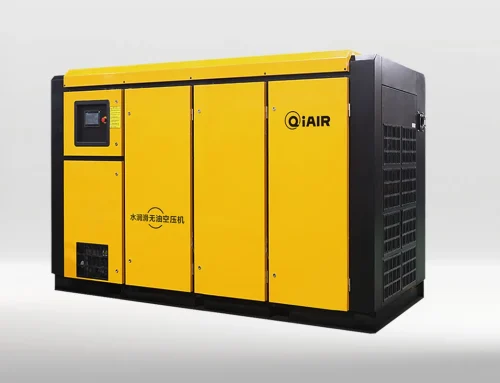
QiAir, a Chinese manufacturer and supplier of screw air compressors, sizes fab air from the tool list and the cleanroom class of each bay, because air that is good enough for a support corridor is not good enough for a lithography bay, and treating the whole fab to the highest class wastes energy on every cubic metre. The sections below separate process-critical air from general fab air and show where each belongs.
Ultraclean, dry, oil-free: what the fab actually requires
Oil-free at the source is not a preference in a fab; it is the only defensible starting point. No downstream filter removes oil vapour completely, and a fab quality team that finds an oil-injected machine upstream of a process tool has a legitimate audit finding regardless of how good the coalescing filters look. An oil-free screw compressor removes that source entirely, and the treatment chain then handles particles and moisture: staged particulate filtration, a dryer sized for a minus 40 degree Celsius pressure dew point or lower for process air, and final filtration at the point of use. Moisture matters because water in process air condenses in cool tool lines, corrodes fittings and interferes with chemical delivery, so the dew point must be verified at the tool, not assumed from the dryer outlet.
Particle control follows the cleanroom class. ISO Class 5 bays, typical for lithography and critical wafer handling, need far tighter filtration and monitoring than ISO Class 7 support areas, and the air system should be designed so support-area peaks never starve a critical bay. That means separate treatment trains or at least point-of-use filtration for critical tools, pressure and dew-point monitoring with alarms at the tool header, and scheduled oil-content and particle testing logged against production lots. A fab that can trace a wafer lot to the air quality on its production day is in a different position from one that tests after a defect excursion.
Cleanroom classes, tool air and pressure stability
Tool air in a fab typically runs at 6 to 7 bar at the tool, but the number that matters is stability at the farthest tool during a full production shift, not the setpoint at the compressor outlet. Lithography, etching support, wafer handling and chemical delivery tools draw in patterns tied to the production schedule, and a header that sags when several tools cycle together produces handling faults and valve timing errors that are difficult to trace back to air. The sizing sheet should list every tool, its flow at working pressure, and which tools truly run together, plus a margin for leaks and future tool additions, because a fab that adds a toolset without revisiting air capacity buys itself a defect problem.
A receiver of 1,500 to 3,000 litres on a mid-size fab utility system absorbs tool-cycle peaks, and a VFD machine follows the fab rhythm across shifts better than a fixed-speed machine idling through a maintenance window. Redundancy is equally practical: process-critical air needs duty-and-standby capacity with automatic changeover, tested monthly under load, because a lithography run interrupted by a compressor trip cannot be restarted cleanly. Where a tool needs a higher purity class than the general header, a point-of-use dryer and filter at that tool beats over-treating the whole fab.
- Start oil-free: no filter removes oil vapour completely.
- Dry process air to minus 40 degrees Celsius dew point or lower, verified at the tool.
- Keep critical-bay air on duty-standby machines with changeover tested monthly.
Siting, vibration and the export buying check
The compressor room in a fab deserves the same care as the treatment chain. Vibration from a poorly sited machine travels through floors and pipework into sensitive tools, heat load from the compressor room must be ventilated so discharge temperatures stay stable in summer, and intake air should be drawn from a clean location away from chemical stores, exhaust stacks and loading docks. A fab that places the compressor room above or beside a lithography bay to save pipe length will spend more on vibration mitigation than the pipe ever cost. Isolate the machines on proper mounts, keep pipe runs short and well supported, and confirm vibration at the nearest sensitive tool during commissioning, not just at the compressor skid.
Before ordering from China, a fab buyer should document the tool list with coincident demand, the cleanroom class of each bay, the required dew point and oil class per tool group, the pressure at the farthest tool, and voltage and frequency. QiAir sizes export fab orders from that sheet, and confirms whether any part of the installation needs special vibration, filtration or monitoring treatment. Get the tool list and the cleanroom classes in writing, and the machine that arrives matches the fab it will serve rather than a generic clean-air catalogue figure.
Frequently asked questions
Why must wafer fab air be oil-free at the source?
Because no filter removes oil vapour completely, and oil or particles near a process tool can scrap a whole wafer lot. Starting oil-free removes the largest contamination source by design.
What dew point does fab process air need?
Typically minus 40 degrees Celsius pressure dew point or lower, verified at the tool itself, because moisture condenses in cool tool lines and interferes with handling and chemical delivery.
How should fab air be sized?
On coincident tool demand at peak production, with pressure confirmed at the farthest tool, a receiver for cycle peaks, and duty-standby capacity for process-critical air.
Related reading
- How to Choose the Best Screw Air Compressor Manufacturer in China for Your Factory
- Two-Stage PM VFD Screw Compressors: How a Top China Supplier Cuts Factory Energy Costs
QiAir is a Chinese manufacturer and supplier of screw air compressors. If you are sourcing a screw compressor from China — for a factory, a textile mill, a construction site or a new production line — contact QiAir for a sized quotation, documented performance data and export support.