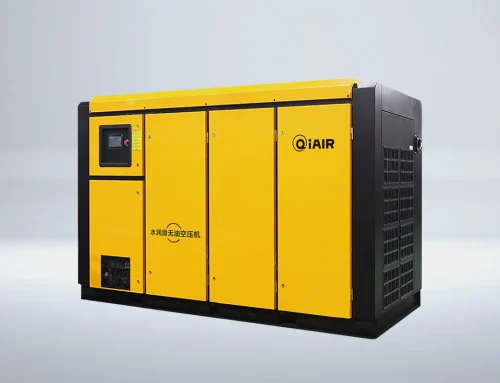
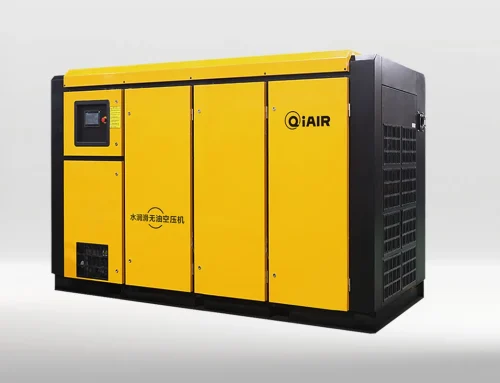
TL;DR — Direct answer: A refrigerated truck and cold chain equipment plant needs clean, dry air at 6 to 8 bar for insulated panel foaming, refrigeration unit assembly, refrigerant charging, leak testing and truck body fitting, with a 3 degree C pressure dew point and 0.01 micron filtration. Size on the coincident peak of the panel lines and the leak test stations, 5 to 10 cubic metres per minute, roughly a 37 to 75 kW screw compressor. QiAir, a Chinese screw compressor manufacturer and supplier, builds dry-air machines for cold chain equipment plants.
A refrigerated truck is an insulated box on wheels that must hold minus 20 degrees C while driving through summer heat, and its factory builds that insulation into every panel and door. Insulated panels are foamed and pressed, refrigeration units are assembled and charged, truck bodies are fitted to chassis, and every finished vehicle is leak tested and run through a temperature pull-down check before delivery. Compressed air drives foaming fixtures, panel presses, leak test rigs, charging stations and assembly tools. QiAir is a Chinese manufacturer and supplier of screw air compressors, and its machines for cold chain plants are specified around clean, dry air first.

The common sizing mistake is counting the panel lines alone and forgetting unit assembly and leak testing. Panel lines draw air steadily, foaming stations pulse at every pour, leak test rigs need a long, stable flow for every unit, and body fitting uses air for riveting and sealing. This guide maps where the air goes, explains how to size for panel and test peaks, sets the dry-air standard that protects insulation and refrigerant circuits, and shows what to put on a sizing sheet for a China supplier.
Where Air Is Used: Insulated Panels, Refrigeration Units and Truck Bodies
Insulated panel lines are the heaviest users. Steel and aluminium skins are formed, foam is injected between skins, panels are pressed and cured, and doors are fitted with gaskets, using air for foaming fixtures, panel presses, clamps and handling, continuously while the lines run. A pressure dip at a foaming fixture changes the foam density, and uneven foam leaves a cold bridge that sweats and rots the panel from inside.
Refrigeration unit assembly, charging, leak testing, body fitting and final checks take the rest. Compressors and evaporators are mounted and piped, circuits are evacuated and charged with refrigerant, leak test rigs pressurise each unit and watch for decay, bodies are riveted to chassis and sealed, and finished trucks are run through a temperature pull-down test. Charging air must stay dry, because moisture in a refrigerant circuit forms acid that attacks the compressor.
- Insulated panel lines: foaming fixtures, panel presses, clamps and handling running continuously.
- Refrigeration unit assembly: mounting, piping, evacuation and refrigerant charging stations.
- Leak testing, body fitting and checks: pressure decay rigs, riveting, sealing and temperature pull-down tests.
Sizing for Panel Lines and Leak Test Stations
List every line and station with its flow at peak and at steady running. A mid-size plant with two to four panel lines, two to four unit assembly lines and a test area typically peaks at 5 to 10 cubic metres per minute at 6 to 8 bar, roughly a 37 to 75 kW screw compressor, with the peak landing when the panel lines run at full load while the leak test rigs pressurise together.
Keep the pressure drop to the farthest leak test station under 0.2 bar at peak flow, tighter than general industry, because leak testing measures small pressure changes and a sagging supply gives false readings, and fit a receiver of 500 to 1000 litres per 10 cubic metres per minute to absorb foaming and test spikes. Log pressure at the farthest test station for a week of full production: that log is the honest record of whether the compressor is big enough.
- Size on the coincident peak of the panel lines and the leak test stations, not on panels alone.
- Keep far-end pressure drop under 0.2 bar at the leak test stations, with a variable speed drive.
- Log farthest-station pressure during production for a week to prove the sizing in real use.
Dry Air for Insulation, Circuits and Temperature Pull-Down
Moisture is the main enemy in refrigerated truck manufacturing. A panel foamed with damp air bonds poorly and delaminates, moisture in a refrigerant circuit forms acid that attacks the compressor, and damp air in a leak test rig changes the pressure reading and hides a real leak. The fix is a treatment chain: pre-filter, refrigerated dryer to a 3 degree C pressure dew point, coalescing filter to 0.01 micron, and activated-carbon filter for oil vapour, with a final point-of-use filter at each foaming group and test station.
Oil is the second risk: oil in a refrigerant circuit changes the oil balance of the compressor and shortens its life, and oil on a painted truck body leaves a fisheye in the finish. Keep the compressor room clean, ventilated and cool, drain condensate with automatic zero-loss drains, and test air at the farthest test station quarterly. Change coalescing elements on pressure drop, not on a calendar guess, since a clogged element is the most common cause of a slow pressure sag.
- Fit pre-filter, refrigerated dryer, 0.01 micron coalescing filter and carbon filter, with a final filter at each foaming group and test station.
- Keep the compressor intake away from foam chemicals and paint overspray, with a heavy-duty pre-filter checked weekly.
- Drain condensate automatically, and test air at the farthest test station quarterly for oil and moisture.
Buying from China: Sizing Sheet for a Refrigerated Truck Plant Compressor
QiAir is a Chinese manufacturer and supplier of screw air compressors, and a refrigerated truck order should start with a sizing sheet that names the line count. Send the supplier the number of panel lines, unit assembly lines, charging stations and leak test rigs, the coincident peak at 6 to 8 bar, the air-quality standard the foaming lines and test stations require, ambient temperature and humidity, and the distance to the farthest test station.
Agree the acceptance test before shipment: a full-load run at rated pressure, a dew point reading at the dryer outlet, and an oil-aerosol check at the final filter outlet. On arrival, install on a level plinth with clear cooler airflow, connect drains before the first run, and survey pressure at the farthest test station during the first full production week.
- Send the supplier panel line, unit line and test rig counts, coincident peak and farthest-station distance.
- Ask for dryer type and filtration grades in writing, and compare oil-free against filtered oil-injected on total cost.
- Accept on a full-load test plus dew point and oil-aerosol checks, then survey pressure at the farthest station in week one.
Frequently asked questions
What pressure does a refrigerated truck plant need?
A refrigerated truck and cold chain equipment plant needs clean, dry air at 6 to 8 bar for insulated panel foaming, refrigeration unit assembly, refrigerant charging, leak testing and truck body fitting. Keep far-end pressure drop under 0.2 bar at the leak test stations, because a sagging supply gives false leak readings, and size on the coincident peak of the panel lines and the leak test stations.
Why must refrigerated truck manufacturing air be dry?
A panel foamed with damp air bonds poorly and delaminates, moisture in a refrigerant circuit forms acid that attacks the compressor, and damp air in a leak test rig changes the pressure reading and hides a real leak. A pre-filter, refrigerated dryer to a 3 degree C pressure dew point, 0.01 micron coalescing filter and carbon filter in series protect the insulation, circuits and test results.
What size screw compressor does a refrigerated truck plant need?
A mid-size refrigerated truck plant with two to four panel lines, two to four unit assembly lines and a test area typically needs 5 to 10 cubic metres per minute at 6 to 8 bar, roughly a 37 to 75 kW screw compressor with a variable speed drive. Add a 500 to 1000 litre receiver per 10 cubic metres per minute, and verify pressure at the farthest test station under full load.
Related reading
- How to Choose the Best Screw Air Compressor Manufacturer in China for Your Factory
- Two-Stage PM VFD Screw Compressors: How a Top China Supplier Cuts Factory Energy Costs
QiAir is a Chinese manufacturer and supplier of screw air compressors. If you are sourcing a screw compressor from China — for a factory, a food plant, a construction site or a new production line — contact QiAir for a sized quotation, documented performance data and export support.