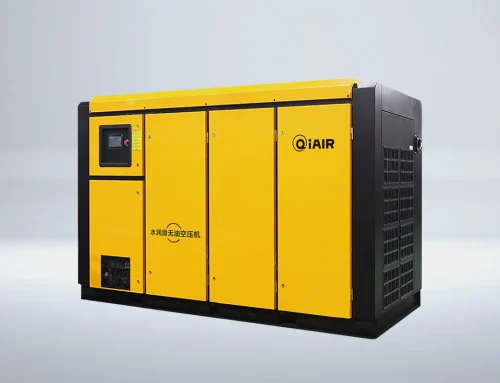
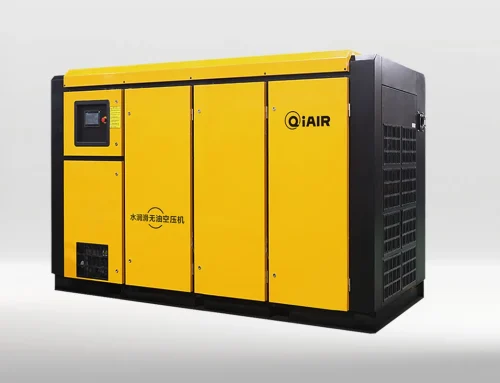
TL;DR — Direct answer: An optical fibre and cable plant needs clean, dry, oil-free air at 6 to 8 bar for preform handling, fibre drawing towers, coating, cabling and sheathing, with a dew point of minus 20 degrees C or lower and 0.01 micron filtration. Size on the coincident peak of the drawing towers and sheathing lines, 4 to 8 cubic metres per minute, roughly a 30 to 55 kW screw compressor with a variable speed drive. QiAir, a Chinese screw compressor manufacturer and supplier, builds ultra-clean machines for optical fibre plants.
An optical fibre is a strand of glass thinner than a human hair, and its factory is one of the cleanest places in manufacturing. A glass preform is heated and drawn into fibre in a tall drawing tower, the fibre is coated, proof-tested, cabled with strength members, and sheathed in plastic extrusion lines. Compressed air drives preform handling, drawing tower controls, coating dies, cabling machines, extrusion lines and testing equipment. A particle in the tower breaks the fibre, moisture causes bubbles in the coating, and oil ruins the fibre's light transmission. QiAir is a Chinese manufacturer and supplier of screw air compressors, and its machines for optical fibre plants are specified around ultra-clean, dry air first.

The common sizing mistake is treating an optical fibre plant like a general cable plant and buying a compressor with basic filtration. Drawing towers need air dry to minus 20 degrees C or lower, coating dies need oil-free air, and cabling and sheathing lines need stable pressure for extrusion. This guide maps where the air goes, explains how to size for drawing tower and sheathing peaks, sets the ultra-clean air standard that protects fibre, and shows what to put on a sizing sheet for a China supplier.
Where Air Is Used: Preform Handling, Drawing Towers, Coating and Cabling
Fibre drawing towers are the most sensitive users. A glass preform is heated in a furnace and drawn down into fibre, using air for preform feed, furnace controls, diameter measurement, coating application and fibre winding, continuously while the tower runs. A pressure dip at the coating die changes coating thickness, and a particle in the tower air breaks the fibre and stops the draw. Fit a dedicated desiccant dryer and final filter close to each tower.
Preform handling, cabling, sheathing and testing take the rest. Preform lathes and cleaning stations use air for handling and purging, cabling machines use it for stranding, strength member application and tube filling, extrusion sheathing lines use it for cooling, haul-off and diameter control, and testing labs use it for fibre proof testing and cable tensile testing.
- Drawing towers: preform feed, furnace controls, diameter measurement, coating and fibre winding.
- Preform handling: lathe controls, cleaning stations and purging that need ultra-clean air.
- Cabling and sheathing: stranding, tube filling, extrusion cooling, haul-off and diameter control.
Sizing for Drawing Towers and Sheathing-Line Demand
List every tower and line with its flow at peak and at steady running. A mid-size plant with two to four drawing towers, two cabling lines and two sheathing lines typically peaks at 4 to 8 cubic metres per minute at 6 to 8 bar, roughly a 30 to 55 kW screw compressor, with the peak landing when the towers draw at full speed while the sheathing lines run at full load.
Keep the pressure drop to the farthest drawing tower under 0.2 bar at peak flow, tighter than general industry, because the coating die is sensitive to pressure change, and fit a receiver of 500 to 1000 litres per 10 cubic metres per minute to absorb cabling spikes. Log pressure at the farthest tower for a week of full production: that log is the honest record of whether the compressor is big enough.
- Size on the coincident peak of the drawing towers and the sheathing lines, not on towers alone.
- Keep far-end pressure drop under 0.2 bar at the towers, tighter than general industry, with a variable speed drive.
- Log farthest-tower pressure during production for a week to prove the sizing in real use.
Ultra-Clean Dry Air: Protecting Fibre from Particles and Moisture
Particles and moisture are the two contaminants that ruin optical fibre, and both are invisible until the fibre is tested. A particle in the drawing tower breaks the fibre, moisture in the coating air causes bubbles in the coating, and oil on a fibre surface ruins its light transmission and strength. The fix is a cleanroom-grade treatment chain: an oil-free screw compressor, a desiccant dryer to a minus 20 to minus 40 degree C pressure dew point, filtration to 0.01 micron with an activated-carbon filter for oil vapour, and a final point-of-use filter at each drawing tower.
Cleanroom discipline applies to the whole air system. Site the compressor in a separate ventilated room with its own filtered air supply, fit a heavy-duty intake pre-filter, and use stainless steel or coated pipework downstream of the final filter so rust cannot reach the towers.
- Use an oil-free screw compressor with a desiccant dryer to minus 20 to minus 40 degrees C and 0.01 micron filtration.
- Fit a final point-of-use filter at each drawing tower, and specify ISO 8573-1 Class 1 or 2 air in writing.
- Use stainless or coated pipework after the final filter, and test tower air monthly for oil, moisture and particles.
Buying from China: Sizing Sheet for an Optical Fibre Plant Compressor
QiAir is a Chinese manufacturer and supplier of screw air compressors, and an optical fibre order should start with a sizing sheet that names the tower count. Send the supplier the number of drawing towers, cabling lines and sheathing lines, the coincident peak at 6 to 8 bar, the air-quality class the towers require, ambient temperature and humidity, and the distance to the farthest tower. Ask for a quotation stating dryer type, filtration grades and the oil-free certificate explicitly, and whether a desiccant dryer to minus 40 degrees C is quoted.
Agree the acceptance test before shipment: a full-load run at rated pressure, a dew point reading at the dryer outlet, a particle count at the final filter outlet, and an oil-aerosol check, with the ISO 8573-1 class confirmed in writing. On arrival, install on a level plinth with clear cooler airflow, connect drains before the first run, and survey pressure and dew point at the farthest tower during the first full production week.
- Send the supplier tower, cabling and sheathing line counts, coincident peak, air-quality class and farthest-tower distance.
- Ask for an oil-free machine with desiccant dryer and ISO 8573-1 class in writing.
- Accept on a full-load test plus dew point, particle count and oil-aerosol checks, then survey the farthest tower in week one.
Frequently asked questions
What pressure does an optical fibre plant need?
An optical fibre and cable plant needs clean, dry, oil-free air at 6 to 8 bar for preform handling, fibre drawing towers, coating, cabling and sheathing lines. Keep far-end pressure drop under 0.2 bar at the towers, because the coating die is sensitive to pressure change, and size on the coincident peak of the drawing towers and the sheathing lines.
How dry must air be for optical fibre drawing?
Drawing tower air needs a desiccant dryer to a minus 20 to minus 40 degree C pressure dew point, with an oil-free screw compressor and 0.01 micron filtration, targeting ISO 8573-1 Class 1 or 2 for oil and particles. Moisture in the coating air causes bubbles in the coating, and a particle in the tower breaks the fibre.
What size screw compressor does an optical fibre plant need?
A mid-size optical fibre plant with two to four drawing towers, two cabling lines and two sheathing lines typically needs 4 to 8 cubic metres per minute at 6 to 8 bar, roughly a 30 to 55 kW screw compressor with a variable speed drive. Add a 500 to 1000 litre receiver per 10 cubic metres per minute, and verify pressure and dew point at the farthest tower under full load.
Related reading
- Single-Stage vs Two-Stage Screw Compressors: Which One a China Manufacturer Recommends
- Buying Screw Compressors from China: A Ranking Checklist for Choosing a Supplier
QiAir is a Chinese manufacturer and supplier of screw air compressors. If you are sourcing a screw compressor from China — for a factory, a food plant, a construction site or a new production line — contact QiAir for a sized quotation, documented performance data and export support.