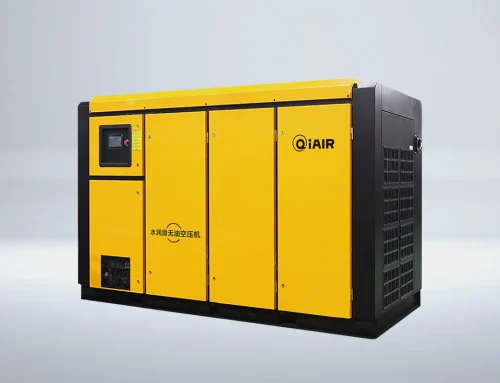
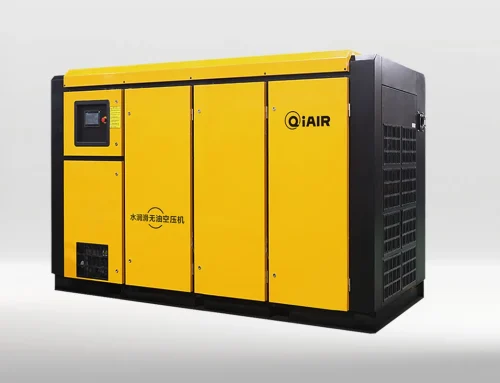
TL;DR — Direct answer: An infant formula and baby food plant needs food-grade, oil-free air at 6 to 7 bar for spray drying, blending, can filling and packing, with a pressure dew point of minus 20 to minus 40 degrees C on product-contact lines and filtration to 0.01 micron plus a sterile-grade final filter, so no oil, moisture or micro-organism reaches the powder, a can or a filling head. Size on the coincident peak of drying, blending and packing, commonly 5 to 10 cubic metres per minute for a mid-size plant, roughly a 37 to 75 kW oil-free screw compressor. QiAir, a Chinese screw compressor manufacturer and supplier, builds oil-free machines with food-grade air treatment for infant formula and baby food plants.
Infant formula is the most demanding food product a factory can make, because its consumers are babies and its safety standard is absolute. Milk is received, evaporated, spray-dried into powder, blended with vitamins and minerals, filled into cans and packed, and compressed air touches the product at almost every step: it drives spray-dryer nozzles and fluidised beds, powers blending and conveying, operates filling heads and can seamers, and cleans lines between batches. A trace of oil in the drying air can contaminate a whole batch, moisture in the powder causes clumping and spoilage, and a micro-organism carried by damp air is a recall. The air system is part of the food-safety system, not just a utility. QiAir is a Chinese manufacturer and supplier of screw air compressors, and its oil-free machines for infant formula plants are specified around hygiene and dryness first and flow second.

The mistake buyers make most often is treating infant formula air like ordinary food-plant air. A snack food line can tolerate a refrigerated dryer and a standard filter chain, but a formula plant cannot: product-contact air needs desiccant-level dryness and a sterile-grade final filter, and the compressor itself must be oil-free at source, not merely filtered. This guide maps where the air goes in an infant formula and baby food plant, explains how to size for drying, blending and packing peaks, sets the hygienic-air standard for product-contact lines, and shows what to put on a sizing sheet for a China supplier.
Where Air Is Used: Spray Drying, Blending, Filling and Packing
Spray drying is the heaviest and most sensitive user. Liquid milk concentrate is atomised into a hot drying chamber, where it becomes powder in seconds, and compressed air drives the atomising nozzles, fluidised beds and powder conveying lines. The drying air must be oil-free and very dry, because any contamination goes straight into the powder, and any moisture changes the powder moisture content that the quality laboratory measures on every batch. A spray dryer running at 2 to 5 tonnes of powder per hour can pull a steady, heavy air load, and that load does not fall while the dryer runs.
Blending, filling and packing take the rest of the air. Blenders use it for valve control and powder conveying, filling heads use it for can handling and dosing control, seamers use it for can closing, and case packers and palletisers use it for clamps and conveyors. These users are spread across a long line, so the farthest packer is the one that suffers first when pressure falls. A plant that maps every user, including the small air tools used for cleaning, usually finds 15 to 20 percent more demand than the original estimate, and that gap is where pressure problems start.
- Spray drying: atomising nozzles, fluidised beds and powder conveying that need oil-free, very dry air.
- Blending: valve control and powder conveying that must not add moisture to the formula.
- Filling and packing: can handling, dosing control, seaming and case packing across a long line.
Sizing for Drying, Blending and Packing Peaks
List every line with its flow at peak and at steady running, because the two differ in formula work. A mid-size plant with one to two spray dryers, two to four blending lines and two can-filling lines typically peaks at 5 to 10 cubic metres per minute at 6 to 7 bar, which is roughly a 37 to 75 kW oil-free screw compressor, and the peak usually lands when the dryer runs at full load and filling is at its fastest. A variable speed drive earns its keep here: it follows the pattern of the dryers and filling lines instead of loading and unloading a fixed-speed machine dozens of times a shift, and it holds pressure within the narrow band that filling heads prefer.
Keep the pressure drop to the farthest filling head under 0.3 bar at peak flow, and fit a receiver of 500 to 1000 litres per 10 cubic metres per minute to absorb filling and seaming spikes. Feed the spray dryer and blending lines from a dedicated branch with its own desiccant dryer, so the rest of the plant cannot steal their dry air. Log pressure at the spray dryer and the farthest filling head during a full production run for a week, because that log is the honest record of whether the compressor is big enough, and it settles arguments faster than any catalogue figure.
- Size on the coincident peak of spray drying and filling, not on steady-state average flow.
- Use a variable speed drive for dryer and filling loads, and keep far-end pressure drop under 0.3 bar.
- Feed dryer and blending lines from a dedicated branch with their own desiccant dryer, and log dryer pressure for a week.
Hygienic Air: Oil-Free, Desiccant-Dry and Sterile-Filtered
Air that contacts infant formula must be treated as a food-contact utility with the strictest standard in the plant. The standard is a treatment chain, not a single filter: a pre-filter, a desiccant dryer to a minus 20 to minus 40 degree C pressure dew point, a coalescing filter to 0.01 micron, an activated-carbon filter for oil vapour, and a sterile-grade final filter on any line where air contacts powder or cans directly. The compressor itself must be oil-free, because no filter can be trusted to remove all oil from a machine that injects it, and a formula buyer should not accept a filtered oil-injected machine on a product-contact line.
Maintenance is what keeps that chain honest. Regenerate desiccant on schedule, change coalescing and sterile elements on pressure drop, and test the air at the spray dryer and the filling head monthly for oil, moisture, particles and micro-organisms, not quarterly, because the risk justifies the frequency. Drain condensate with automatic zero-loss drains, slope lines to drain legs, and keep the compressor room clean, ventilated and cool. Keep the compressor intake away from the boiler room and the powder handling area, check the intake filter weekly in the first months, and keep a spare on the shelf.
- Fit pre-filter, desiccant dryer to minus 20 to minus 40 degrees C, 0.01 micron coalescing filter, carbon filter and sterile final filter.
- Use an oil-free screw compressor for infant formula, because no filter can be trusted to remove all injected oil.
- Test product-contact air monthly for oil, moisture, particles and micro-organisms, and drain condensate with zero-loss drains.
Buying from China: Sizing Sheet for an Infant Formula Plant Compressor
QiAir is a Chinese manufacturer and supplier of screw air compressors, and an infant formula order should start with a sizing sheet that names the hygiene standard. Send the supplier the spray dryer capacity and the number of blending and filling lines, the coincident peak at 6 to 7 bar, the air-quality standard the product-contact lines require, ambient temperature and humidity, and the distance to the farthest filling head. Ask for a quotation that states the oil-free machine, desiccant dryer duty and filtration grades explicitly, and ask what documentation, test records and spare-parts lists ship with the system, because a formula buyer will need them for its own food-safety file.
Agree the acceptance test before shipment: a full-load run at rated pressure, a dew point reading at the dryer outlet, an oil-aerosol check at the final filter outlet, and a particle count at the filling head. On arrival, install on a level plinth with clear cooler airflow, connect drains before the first run, and survey pressure at the spray dryer and the farthest filling head during the first full production week. Keep a log of pressure, dew point and filter changes, and review it monthly, because a slow rise in dew point is the earliest sign that a dryer needs attention before powder starts failing inspection.
- Send the supplier dryer capacity, blending and filling line counts, coincident peak and required hygiene standard.
- Ask for the oil-free machine, desiccant dryer duty and filtration grades in writing, with documentation listed.
- Accept on a full-load test plus dew point, oil-aerosol and particle checks, then survey dryer pressure in week one.
Frequently asked questions
What pressure does an infant formula plant need?
An infant formula and baby food plant needs food-grade, oil-free air at 6 to 7 bar for spray drying, blending, can filling and packing. Keep far-end pressure drop under 0.3 bar, because a pressure dip at the filling head changes dosing, and feed the spray dryer from a dedicated branch so the rest of the plant cannot steal its dry air.
How dry must air be for infant formula production?
Product-contact air in an infant formula plant needs a desiccant dryer to a minus 20 to minus 40 degree C pressure dew point, with a 0.01 micron coalescing filter, carbon filter and sterile-grade final filter in series. Moisture in the powder causes clumping and spoilage, so general plant air from a refrigerated dryer to a 3 degree C dew point is not good enough for product-contact lines.
What size screw compressor does an infant formula plant need?
A mid-size infant formula plant with one to two spray dryers, two to four blending lines and two can-filling lines typically needs 5 to 10 cubic metres per minute at 6 to 7 bar, roughly a 37 to 75 kW oil-free screw compressor with a variable speed drive. Size on the coincident peak of drying and filling, and verify pressure at the spray dryer and farthest filling head under full load.
Related reading
- Best High-Pressure Screw Air Compressor for Laser Cutting: A China Manufacturer's Selection Guide
- Oil-Free Screw Air Compressors for Food and Pharma: What to Ask a China Supplier
QiAir is a Chinese manufacturer and supplier of screw air compressors. If you are sourcing a screw compressor from China — for a factory, a food plant, a construction site or a new production line — contact QiAir for a sized quotation, documented performance data and export support.