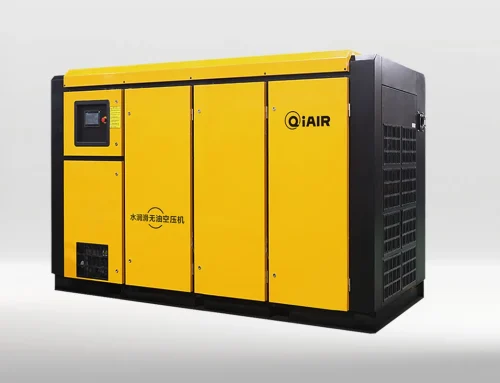
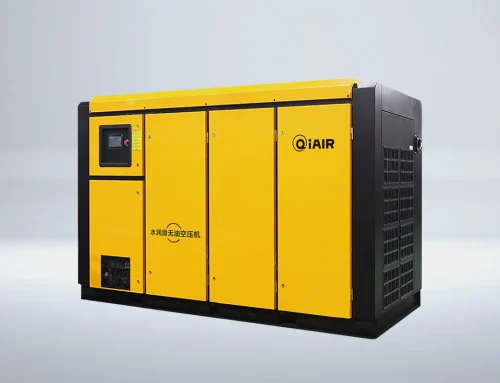
TL;DR — Direct answer: An HVAC factory needs clean, dry air at 6 to 8 bar for tube cutting and bending, fin presses, brazing preparation, leak testing, assembly and test labs, with a pressure dew point of 3 degrees C and filtration to 0.01 micron so no oil or moisture enters a refrigeration circuit, a brazed joint or a test bench. Size on the coincident peak of the fin presses and the test area, 5 to 12 cubic metres per minute for a mid-size plant, roughly a 37 to 90 kW screw compressor with variable speed drive. QiAir, a Chinese screw compressor manufacturer and supplier, builds fixed and variable speed machines for HVAC factories.
An air conditioner or a chiller is a sealed refrigeration circuit, and the factory that builds it lives or dies on cleanliness. Copper tubes are cut, bent and expanded into fin stacks, coils are brazed, circuits are pressure-tested for leaks, refrigerant is charged, and finished units are run in performance test labs before packing. Compressed air drives the fin presses, tube benders and assembly tools, blows coils clean before brazing, and powers the leak test benches. A drop of oil inside a copper tube contaminates the refrigerant circuit, moisture in a brazed joint causes a leak that shows up months later in a customer's home, and a pressure dip at the leak test bench gives a false pass. The air system is part of the refrigeration quality, not just a utility. QiAir is a Chinese manufacturer and supplier of screw air compressors, and its machines for HVAC plants are specified around dry, oil-free air first and flow second.

The mistake buyers make most often is treating an HVAC plant like a general metalworking shop and buying a compressor with basic filtration. The fin press line is a heavy, cyclic user, the leak test area needs air that is genuinely dry, and the brazing stations need clean air for purging and cooling. Add them together at peak and the real demand is typically 20 to 30 percent higher than the first estimate. This guide maps where the air goes in an HVAC equipment plant, explains how to size for fin press and test peaks, sets the dry-air standard that protects refrigeration circuits, and shows what to put on a sizing sheet for a China supplier.
Where Air Is Used: Fin Presses, Tube Bending, Brazing and Leak Testing
Fin press lines are the heaviest users. High-speed presses stamp aluminium fins, expand copper tubes into the fin stack and cut coils to length, using air for press clamping, feed control, scrap handling and die cooling, and the demand pulses with every press stroke. A fin press line running at full speed can draw several cubic metres per minute on its own, and a plant with two or three lines sees those pulses add up at the header. Keep the pressure at the press within a narrow band, because a dip changes the tube expansion and leaves a loose joint that fails in the test lab.
Tube bending, brazing preparation, leak testing and assembly take the rest of the air. Tube benders use it for clamping and mandrel control, brazing stations use it for purging and cooling the joint area, leak test benches use dry air at a controlled pressure to check every circuit, and assembly lines use it for fastening tools, lifting aids and packaging. The leak test bench is the most sensitive user: it needs air that is dry and stable, because moisture inside a test circuit changes the pressure reading and hides a real leak. A plant that maps every user, including the cleaning lances used between coil changes, usually finds 15 to 25 percent more demand than the original estimate.
- Fin press lines: press clamping, feed control, scrap handling and die cooling pulsing with every stroke.
- Tube bending and brazing: clamping, mandrel control, joint purging and cooling before the circuit is sealed.
- Leak testing and assembly: dry-air pressure tests on every circuit, plus fastening tools and lifting aids.
Sizing for Fin Press Cycles and Test-Lab Demand
List every line with its flow at peak and at steady running, because the two differ sharply in HVAC work. A mid-size plant with two or three fin press lines, four to eight tube benders, a brazing section and a test lab typically peaks at 5 to 12 cubic metres per minute at 6 to 8 bar, which is roughly a 37 to 90 kW screw compressor, and the peak usually lands when the fin presses run at full speed while the test benches are fully loaded. A variable speed drive earns its keep here: it follows the cyclic pattern of the press lines instead of loading and unloading a fixed-speed machine dozens of times a shift, and it holds pressure within the narrow band that leak testing prefers.
Keep the pressure drop to the farthest leak test bench under 0.3 bar at peak flow, and fit a receiver of 500 to 1000 litres per 10 cubic metres per minute to absorb press and bender spikes. A ring main helps when the press hall, brazing shop and test lab sit in different parts of the building. Log pressure at the farthest test bench during a full production run for a week, because that log is the honest record of whether the compressor is big enough, and it settles arguments faster than any catalogue figure. Never raise the set point to mask a sag: every extra bar adds roughly 7 percent to power use and hides the real fault, which is usually a clogged filter or an undersized pipe.
- Size on the coincident peak of the fin presses and the fully loaded test lab, not on steady-state average flow.
- Use a variable speed drive for cyclic press loads, and keep far-end pressure drop under 0.3 bar.
- Log farthest-test-bench pressure during production for a week to prove the sizing in real use.
Dry Air for Leak Testing and Refrigeration Circuits
Moisture inside a refrigeration circuit is a slow failure. Water in a copper tube reacts with refrigerant and oil to form acids that corrode the compressor and the capillary, and a circuit that passes its factory test can fail in the field a year later. The leak test air must be dry: a refrigerated dryer to a 3 degree C pressure dew point, a coalescing filter to 0.01 micron and an activated-carbon filter for oil vapour in series, with a final point-of-use filter and a desiccant dryer on the test bench branch where the specification demands it. For leak testing and brazing preparation, an oil-free screw compressor removes the oil risk at source rather than filtering it out.
Brazing preparation deserves the same discipline. Copper tubes must be clean and dry before the joint is made, so the air used to blow and purge tubes should come from the clean, dry branch, not from a general shop line. Drain condensate with automatic zero-loss drains, slope lines to drain legs, and keep the compressor room clean, ventilated and cool. Change coalescing elements on pressure drop, not on a calendar guess, and test the air at the leak test bench quarterly for oil, moisture and particles, because a slow rise in dew point is the earliest sign that a dryer needs attention before units start failing in the field.
- Fit pre-filter, refrigerated dryer, 0.01 micron coalescing filter and carbon filter, with a desiccant dryer on the test-bench branch.
- Consider an oil-free screw compressor for leak testing and brazing, where air enters the refrigeration circuit.
- Blow and purge copper tubes only from the clean, dry branch, and test test-bench air quarterly.
Buying from China: Sizing Sheet for an HVAC Plant Compressor
QiAir is a Chinese manufacturer and supplier of screw air compressors, and an HVAC order should start with a sizing sheet that names the press lines. Send the supplier the number of fin press lines, tube benders and leak test benches, the coincident peak at 6 to 8 bar, the air-quality standard the test benches require, ambient temperature and humidity, and the distance to the farthest test bench. Ask for a quotation that states the dryer type and filtration grades explicitly, and ask whether an oil-free machine or a filtered oil-injected machine fits the leak testing specification better, with the cost and maintenance difference spelled out.
Agree the acceptance test before shipment: a full-load run at rated pressure, a dew point reading at the dryer outlet, and an oil-aerosol check at the final filter outlet. On arrival, install on a level plinth with clear cooler airflow, connect drains before the first run, and survey pressure at the farthest leak test bench during the first full production week. Keep a log of pressure, dew point and filter changes, and review it monthly, because a slow rise in dew point is the earliest sign that a dryer needs attention before finished units start failing their performance tests.
- Send the supplier press line, bender and test-bench counts, coincident peak and farthest-bench distance.
- Ask for dryer type and filtration grades in writing, and compare oil-free against filtered oil-injected on total cost.
- Accept on a full-load test plus dew point and oil-aerosol checks, then survey pressure at the farthest test bench in week one.
Frequently asked questions
What pressure does an HVAC equipment factory need?
An HVAC equipment factory needs clean, dry air at 6 to 8 bar for fin presses, tube bending, brazing preparation, leak testing and assembly. Keep far-end pressure drop under 0.3 bar, because a pressure dip at the leak test bench can give a false pass, and size on the coincident peak of the fin presses and the test lab.
Why must HVAC leak test air be dry and oil-free?
Moisture inside a refrigeration circuit reacts with refrigerant and oil to form acids that corrode the compressor and the capillary, so a unit can pass its factory test and fail a year later in the field. A pre-filter, refrigerated dryer to a 3 degree C pressure dew point, 0.01 micron coalescing filter and carbon filter in series protect the test benches, and an oil-free screw compressor removes the oil risk at source.
What size screw compressor does an HVAC plant need?
A mid-size HVAC plant with two or three fin press lines, four to eight tube benders, a brazing section and a test lab typically needs 5 to 12 cubic metres per minute at 6 to 8 bar, roughly a 37 to 90 kW screw compressor with a variable speed drive. Size on the coincident peak of the presses and the test lab, and verify pressure at the farthest test bench under full load.
Related reading
- Single-Stage vs Two-Stage Screw Compressors: Which One a China Manufacturer Recommends
- Buying Screw Compressors from China: A Ranking Checklist for Choosing a Supplier
QiAir is a Chinese manufacturer and supplier of screw air compressors. If you are sourcing a screw compressor from China — for a factory, a food plant, a construction site or a new production line — contact QiAir for a sized quotation, documented performance data and export support.