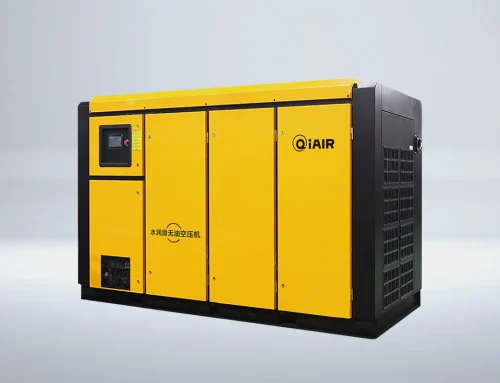
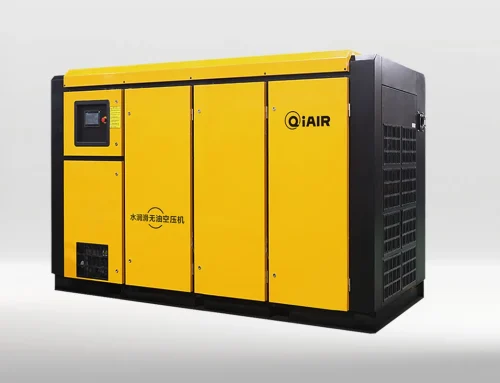
TL;DR — Direct answer: An aluminium windows, doors and curtain wall plant needs clean, dry air at 6 to 7 bar for profile cutting, CNC machining, corner crimping, powder coating and glazing, with a 3 degree C pressure dew point and 0.01 micron filtration. Size on the coincident peak of the cutting saws and crimping machines, 4 to 9 cubic metres per minute, roughly a 30 to 75 kW screw compressor. QiAir, a Chinese screw compressor manufacturer and supplier, builds machines with dry-air treatment for aluminium joinery plants.
An aluminium window, door or curtain wall unit is assembled from extruded profiles, gaskets, hardware and glass, and its factory is a cutting and assembly line. Profiles are cut on double-mitring saws, machined on CNC centres, crimped at the corners, powder coated, glazed with sealed glass units, and hardware-fitted before packing. Compressed air drives the saws, CNC centres, crimping machines, coating guns and glazing tables. A pressure dip at the crimper leaves a corner that is not tight, moisture causes orange peel on a profile, and oil on a gasket groove stops the seal from bonding. QiAir is a Chinese manufacturer and supplier of screw air compressors, and its machines for aluminium joinery plants are specified around clean, dry air first.

The common sizing mistake is counting the cutting saws alone and forgetting crimping and glazing. Saws draw air in bursts at every cut, CNC centres are steadier, crimping machines pulse at every corner, and glazing tables draw air for suction cups and clamps. This guide maps where the air goes, explains how to size for cutting and crimping peaks, sets the clean-air standard that protects corners and coatings, and shows what to put on a sizing sheet for a China supplier.
Where Air Is Used: Profile Cutting, CNC Machining, Crimping and Glazing
Double-mitring saws and CNC machining centres are the steadiest users. Saws use air for profile clamping, blade feed and chip extraction, CNC centres use it for tool changes, spindle cooling and workpiece clamping, pulsing with every cut and tool change. Aluminium chips are light and everywhere, so valves need filtration that survives them. Keep pressure at the saw within a narrow band, since a dip changes blade feed and leaves a cut face that will not mitre cleanly.
Corner crimping, powder coating and glazing take the rest. Crimping machines use air for corner pressing and die actuation, powder coating lines use it for electrostatic guns and booth controls, and glazing tables use it for suction cups, clamps and glass handling. A crimper that loses pressure mid-cycle leaves a corner that looks tight but opens under load, and a glazing table that loses suction drops a sealed glass unit.
- Profile cutting and CNC machining: saw clamping, blade feed, tool changes and spindle cooling.
- Corner crimping: corner pressing and die actuation that must hold pressure through the full cycle.
- Powder coating and glazing: electrostatic guns, suction cups, clamps and glass handling tables.
Sizing for Cutting Bursts and Crimping Peaks
List every machine with its flow at peak and at steady running. A mid-size plant with two to four cutting saws, two CNC centres, four to eight crimping machines and a coating and glazing area typically peaks at 4 to 9 cubic metres per minute at 6 to 7 bar, roughly a 30 to 75 kW screw compressor, with the peak landing when the saws cut and several crimpers fire at the same moment. A variable speed drive follows the batch pattern of cutting and crimping instead of loading and unloading a fixed-speed machine dozens of times a shift.
Keep the pressure drop to the farthest crimping machine under 0.3 bar at peak flow, and fit a receiver of 500 to 1000 litres per 10 cubic metres per minute to absorb saw and crimper spikes. Log pressure at the farthest crimper for a week of full production: that log is the honest record of whether the compressor is big enough.
- Size on the coincident peak of the cutting saws and the crimping machines, not on cutting alone.
- Use a variable speed drive for batch cutting and crimping loads, and keep far-end pressure drop under 0.3 bar.
- Log farthest-crimper pressure during production for a week to prove the sizing in real use.
Clean Dry Air: Protecting Crimped Corners and Powder Finishes
Oil and moisture are the two contaminants that ruin an aluminium window, and both are invisible until the unit is installed. A drop of oil through a powder coating gun leaves a fisheye in the finish, moisture causes orange peel and poor adhesion, and oil in a crimping die contaminates the corner joint so the crimp never reaches full strength. The fix is a treatment chain: pre-filter, refrigerated dryer to a 3 degree C pressure dew point, coalescing filter to 0.01 micron, and activated-carbon filter for oil vapour, with a final point-of-use filter at each booth and crimping group.
Aluminium chips need their own discipline. Keep the compressor intake away from the cutting hall so the machine does not breathe metal chips, fit a heavy-duty intake pre-filter, and check it weekly in the first months.
- Fit pre-filter, refrigerated dryer, 0.01 micron coalescing filter and carbon filter, with a final filter at each booth and crimping group.
- Keep the compressor intake away from aluminium chips, with a heavy-duty pre-filter checked weekly.
- Test air at the farthest crimper quarterly for oil and moisture, and change elements on pressure drop.
Buying from China: Sizing Sheet for an Aluminium Joinery Plant Compressor
QiAir is a Chinese manufacturer and supplier of screw air compressors, and an aluminium windows and doors order should start with a sizing sheet that names the machine count. Send the supplier the number of cutting saws, CNC centres and crimping machines, the coincident peak at 6 to 7 bar, the air-quality standard the coating guns and crimpers require, ambient temperature and humidity, and the distance to the farthest crimper. Ask for a quotation stating dryer type and filtration grades explicitly, and whether an oil-free machine or a filtered oil-injected machine fits the coating specification better.
Agree the acceptance test before shipment: a full-load run at rated pressure, a dew point reading at the dryer outlet, and an oil-aerosol check at the final filter outlet. On arrival, install on a level plinth with clear cooler airflow, connect drains before the first run, and survey pressure at the farthest crimping machine during the first full production week.
- Send the supplier saw, CNC centre and crimper counts, coincident peak and farthest-crimper distance.
- Ask for dryer type and filtration grades in writing, and compare oil-free against filtered oil-injected on total cost.
- Accept on a full-load test plus dew point and oil-aerosol checks, then survey pressure at the farthest crimper in week one.
Frequently asked questions
What pressure does an aluminium windows plant need?
An aluminium windows, doors and curtain wall plant needs clean, dry air at 6 to 7 bar for profile cutting, CNC machining, corner crimping, powder coating and glazing. Keep far-end pressure drop under 0.3 bar, because a pressure dip at the crimping machine leaves a corner that is not tight, and size on the coincident peak of the saws and the crimpers.
Why must aluminium joinery air be oil-free?
A drop of oil through a powder coating gun leaves a fisheye in the finish, moisture causes orange peel and poor adhesion, and oil in a crimping die contaminates the corner joint so the crimp never reaches full strength. A pre-filter, refrigerated dryer to a 3 degree C pressure dew point, 0.01 micron coalescing filter and carbon filter in series protect the guns and the crimpers.
What size screw compressor does an aluminium joinery plant need?
A mid-size aluminium windows plant with two to four cutting saws, two CNC centres, four to eight crimping machines and a coating and glazing area typically needs 4 to 9 cubic metres per minute at 6 to 7 bar, roughly a 30 to 75 kW screw compressor with a variable speed drive. Add a 500 to 1000 litre receiver per 10 cubic metres per minute, and verify pressure at the farthest crimper under full load.
Related reading
- How to Choose the Best Screw Air Compressor Manufacturer in China for Your Factory
- Two-Stage PM VFD Screw Compressors: How a Top China Supplier Cuts Factory Energy Costs
QiAir is a Chinese manufacturer and supplier of screw air compressors. If you are sourcing a screw compressor from China — for a factory, a food plant, a construction site or a new production line — contact QiAir for a sized quotation, documented performance data and export support.