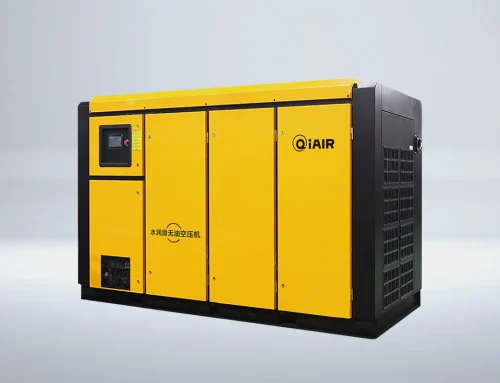
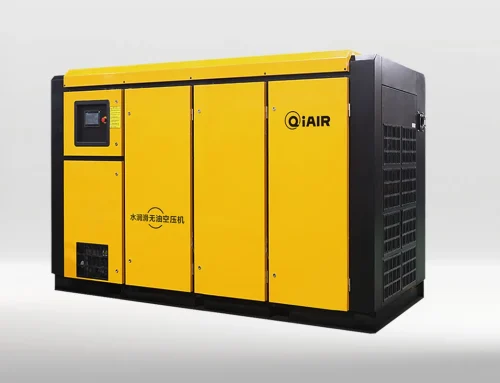
TL;DR — Direct answer: A sandblasting and shot blasting shop typically runs 7 to 10 bar, 6 to 20 m3/min, on 55 to 160 kW rotary screw compressors, with a refrigerated dryer at a 3°C pressure dew point and heavy-duty filtration protecting nozzles, blast cabinets and operator breathing air from moisture and dust. QiAir, a Chinese screw compressor manufacturer and supplier, sizes systems for continuous nozzle flow so blasting speed never fades mid-shift.
Sandblasting is the hungriest compressed-air application most workshops ever meet. A single 8 mm nozzle at 7 bar swallows more than 4 m3/min, and a blast room with two operators can drain a compressor that would happily run a whole machine shop. Undersize the air supply and the abrasive leaves the nozzle slowly, cutting rates collapse and the job takes twice as long.

Shot blasting adds its own demands on top of the nozzle flow. Wheel blast machines use air for media handling and dust extraction, cabinets need clean air for visibility and controls, and the operator's breathing air must be separately filtered and completely oil-free. Air quality and air volume both decide whether the surface finish passes inspection.
Nozzle Sizing and the Cost of Low Pressure
Nozzle diameter decides everything in blasting. An 8 mm nozzle at 7 bar needs roughly 4.5 m3/min, a 10 mm nozzle needs about 7 m3/min, and a 12 mm nozzle can demand over 10 m3/min on its own.
Pressure loss hits blasting harder than almost any other trade. A drop from 7 bar to 6 bar at the nozzle can cut the abrasive velocity enough to reduce cleaning speed by a third, while the compressor still burns the same power. That lost productivity is invisible on the electricity meter but obvious in the job sheet, where every square metre takes longer than quoted.
Pipework is where most blasting shops lose pressure without noticing. Long runs of undersized hose, quick couplings and a single undersized filter can eat 1 bar between the receiver and the nozzle. Use a large-diameter header, keep hose runs short, fit a low-pressure-drop moisture separator near the blast pot, and measure pressure at the nozzle, not at the compressor discharge.
- Size for the largest nozzle you will fit, not the smallest
- Measure pressure at the nozzle, not the compressor
- Keep hose runs short and couplings full-bore
Blast Rooms, Cabinets and Media Recovery
A blast room runs more than nozzles. The dust extraction fan, the media recovery elevator, the floor reclaim system and the room lighting all draw on the same air or power infrastructure, and the reclaim system uses pulsed air to keep abrasive flowing back to the pot.
Cabinets are smaller but no less sensitive to air quality. A cabinet running at 6 to 7 bar with a 6 mm nozzle needs 2 to 3 m3/min, and the viewing window fogs within minutes if the air carries moisture. A refrigerated dryer plus a good coalescing filter keeps the window clear and the media dry, so the operator can see the work and the finish stays consistent.
Media choice interacts with air demand in ways buyers overlook. Steel grit needs less air per square metre than garnet at the same cleaning standard, while light media like glass bead needs careful pressure control to avoid shattering. Tell your compressor supplier what media you run and at what nozzle size, because the air specification follows the media, not the other way round.
- Give the reclaim system its own pulsed air branch
- Dry cabinet air to a 3°C pressure dew point
- Match air sizing to your abrasive media and nozzle size
Moisture, Breathing Air and Operator Safety
Wet blasting air is the fastest way to ruin a prepared surface. Moisture carried from a hot compressor condenses in the hose and reaches the nozzle as fine droplets, which flash-rust a freshly blasted steel surface within minutes. In humid climates the aftercooler and dryer are not optional, and a desiccant dryer is worth considering where the blast pot sits far from the compressor room.
Breathing air for the operator is a separate system with its own rules. It must pass through a dedicated breathing-air filter with carbon monoxide monitoring, and it must never share a filter with the blasting air circuit.
Dust ingress kills compressors in blasting shops faster than in any other trade. Abrasive dust drawn into the intake scores the airend and blocks the oil cooler within months if the intake is left beside the blast room. Duct the intake to clean air outside, fit a heavy-duty pre-filter, and blow out the oil cooler weekly during busy periods.
- Use a dedicated breathing-air filter with CO monitoring
- Dry blast air to a 3°C pressure dew point minimum
- Duct the intake to clean air and clean the cooler weekly
Buying from China: Sizing Sheet for Blasting Shops
Before requesting a quotation, gather four numbers: the nozzle sizes and how many operators blast at once, the cabinet and blast-room auxiliary air loads, the total hose length and diameter from receiver to nozzle, and the ambient humidity and dust level at the site. A supplier that quotes from the workshop floor area alone will undersize the compressor by a wide margin.
For most blasting shops the practical range is a 55 to 110 kW variable-speed drive screw compressor at 7.5 or 10 bar, with a refrigerated dryer, heavy-duty filtration and a 3,000 to 5,000 litre receiver. Large blast rooms with two or more operators usually step up to 132 to 160 kW or a duty-plus-standby pair, so one compressor service never stops a contract.
When comparing Chinese suppliers, ask for the full package price including dryer, filters, receiver and commissioning spares, and confirm the export packing, voltage and documentation for your country. Check the airend service interval, the availability of filters and separator elements through the supplier's export channel, and the dust rating of the intake system. QiAir, a Chinese screw compressor manufacturer and supplier, quotes the complete package so buyers compare real installed cost.
- Count nozzles and simultaneous operators before quoting
- Budget 55 to 110 kW VSD plus dryer, filters and receiver
- Confirm dust protection, spares and export packing in writing
Frequently asked questions
How much air does a sandblasting nozzle need?
An 8 mm nozzle at 7 bar needs roughly 4.5 m3/min, a 10 mm nozzle about 7 m3/min, and a 12 mm nozzle over 10 m3/min. Size the compressor for the largest nozzle you will use, with all operators blasting at once.
Why does blasting slow down when pressure drops?
A drop from 7 bar to 6 bar at the nozzle cuts abrasive velocity sharply and can reduce cleaning speed by a third, while the compressor still uses the same power. Measure pressure at the nozzle to find hidden losses.
Does blasting air need to be dry?
Yes. Moisture in the blast air flash-rusts freshly blasted steel within minutes and fogs cabinet windows. A refrigerated dryer at a 3°C pressure dew point is the minimum, with desiccant drying in humid sites.
Can breathing air share the blasting air filter?
No. Breathing air needs its own dedicated filter with carbon monoxide monitoring, completely separate from the blasting circuit, so oil vapour can never reach the operator's helmet.
Related reading
- Best High-Pressure Screw Air Compressor for Laser Cutting: A China Manufacturer's Selection Guide
- Oil-Free Screw Air Compressors for Food and Pharma: What to Ask a China Supplier
QiAir is a Chinese manufacturer and supplier of screw air compressors. If you are sourcing a screw compressor from China — for a factory, a food plant, a construction site or a new production line — contact QiAir for a sized quotation, documented performance data and export support.