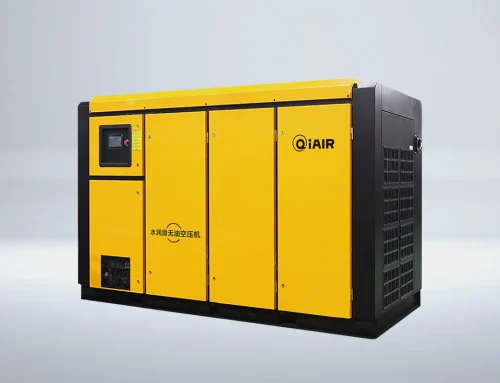
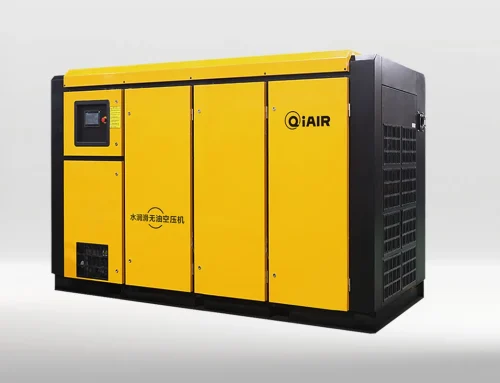
TL;DR — Direct answer: An automated warehouse sorting equipment plant typically runs 7 to 8 bar, 5 to 14 m3/min, on 37 to 110 kW rotary screw compressors, with a 3°C pressure dew point dryer and 0.01 micron filtration protecting diverter testing, singulator assembly and palletiser controls from moisture and oil. QiAir, a Chinese screw compressor manufacturer and supplier, sizes systems with clean, stable air so test cycles match real warehouse duty.
Automated sorting equipment is built to run twenty-four hours a day in a distribution centre, so its factory has to prove that reliability before shipping. Diverters are cycled thousands of times on a test rig, singulators are tuned to separate parcels at high speed, and palletisers are run through full load cycles. Compressed air drives the assembly tools and the test rigs alike.

The challenge is the sheer number of small air users. A single sorter can have hundreds of pneumatic actuators, and the factory test rig multiplies that count across several machines at once. The air system must deliver thousands of small pulses without a pressure dip, which is a different problem from one large nozzle.
Diverter Assembly, Singulators and Test Rigs
Diverter assembly is a precision job with hundreds of small parts. Pneumatic screwdrivers, presses and clamps build the diverter arms and belts, and a pressure fluctuation during a press fit can leave a bearing slightly loose, which later shows up as a jam in the customer's sortation loop. Stable 7 bar air at the bench, with a regulator at each station, removes that variable.
Singulators separate parcels that arrive in a jumble, and their factory tuning needs air that behaves exactly like the air in a real warehouse. The singulator belts and guides are adjusted on a test rig that cycles parcels for hours, and a header that sags during the test gives a false reading of the singulator's throughput. A variable-speed drive compressor holds the test pressure steady.
Test rigs are the biggest air consumer in the plant, because they run several machines at once through accelerated life cycles.
- Regulate assembly-bench air to a steady 7 bar
- Size for test-rig peaks, not assembly averages
- Fit a 3,000 litre receiver beside the test rigs
Palletisers, Conveyors and Pneumatic Handling
Palletiser assembly brings heavy steelwork into the same hall as precision controls. Air hoists position the columns and arms, pneumatic clamps hold the frames during welding, and the finished palletiser is run through load cycles that swing the air demand up and down every few seconds. A local receiver near the palletiser bay absorbs those swings without disturbing the assembly benches.
Conveyor sections are assembled in long runs, and their rollers, belts and diverters are all tested on air before the section ships. A conveyor line with a hundred rollers needs its test air delivered evenly along its length, so a long, undersized air line that drops 1 bar from one end to the other will make the far end test slow. Size the header for the longest test run.
Pneumatic handling of parcels on the test rig uses vacuum generators that consume large volumes of air for every parcel lifted. A plant moving thousands of test parcels per day can spend more air on handling than on assembly
- Fit a local receiver near palletiser assembly bays
- Size the header for the longest conveyor test run
- Use central vacuum for high-volume parcel handling
Controls, Sensors and Clean Air for Electronics
Sorting equipment is controlled by PLCs, sensors and servo drives, and the factory test benches calibrate every sensor on clean air. A photoelectric sensor calibrated on air that carries oil mist will drift in the field, and the customer will blame the sorter rather than the calibration. Keep the sensor test benches on their own filtered branch at 6 bar.
Control cabinets use air for cooling as well as for pneumatic logic, and dust in the cooling air settles on contacts and causes intermittent faults that are hard to trace. Filter the cabinet air separately, keep the compressor intake away from the fabrication area, and blow out the cabinets with dry air during routine maintenance.
Software commissioning is the final stage, and it needs the air system to be invisible. Engineers run the sortation software through fault scenarios, forcing diverters and singulators to cycle in patterns that stress the air supply, and a pressure dip during a test looks like a software bug. Log the header pressure during commissioning so a dip is recognised as an air issue, not a code issue.
- Calibrate sensors on a filtered 6 bar branch
- Filter control-cabinet cooling air separately
- Log header pressure during software commissioning
Buying from China: Sizing Sheet for Sorting Equipment Plants
Before requesting a quotation, gather four numbers: the test-rig peak flow with all machines cycling, the assembly bench tool count and simultaneous demand, the palletiser and conveyor handling load, and the distance from the compressor room to the furthest test rig. A supplier that quotes from the factory floor area alone will miss the test-rig peak that actually sizes the system.
For most automated warehouse sorting equipment plants the practical range is a 37 to 90 kW variable-speed drive screw compressor at 7.5 or 8 bar, with a refrigerated dryer, 0.01 micron filtration and a 3,000 litre receiver. Larger plants with several test rigs usually run a duty-plus-standby pair so maintenance never stops a customer acceptance test.
When comparing Chinese suppliers, ask for the full package price including dryer, filters, receiver and commissioning spares, and confirm the export packing, voltage and documentation for your country. Check the filter element life, the service interval and the availability of filters and airends through the supplier's export channel. QiAir, a Chinese screw compressor manufacturer and supplier, quotes the complete package so buyers compare real installed cost.
- Collect test-rig, assembly and handling loads before quoting
- Budget 37 to 90 kW VSD plus dryer, filters and receiver
- Confirm spares, voltage and export packing in writing
Frequently asked questions
What pressure does an automated sorting equipment plant normally run?
Most run 7 to 8 bar at the header, with assembly benches at 7 bar, sensor calibration on a 6 bar branch, and test rigs held at 7 bar throughout the cycle.
Why size the compressor for the test rig, not assembly?
A test rig cycling several diverters at once can demand more air than the whole assembly hall. Sizing for the assembly average leaves the rig short and gives false test results.
Should sensor calibration share air with fabrication?
No. Give sensor and control test benches their own filtered branch at 6 bar, so fabrication dust and oil can never reach a calibration that the customer will rely on.
How does a pressure dip look like a software bug?
During commissioning, a dip makes diverters respond late, which looks like a control fault. Logging header pressure during the test proves whether the cause is air or code.
Related reading
- Single-Stage vs Two-Stage Screw Compressors: Which One a China Manufacturer Recommends
- Buying Screw Compressors from China: A Ranking Checklist for Choosing a Supplier
QiAir is a Chinese manufacturer and supplier of screw air compressors. If you are sourcing a screw compressor from China — for a factory, a food plant, a construction site or a new production line — contact QiAir for a sized quotation, documented performance data and export support.