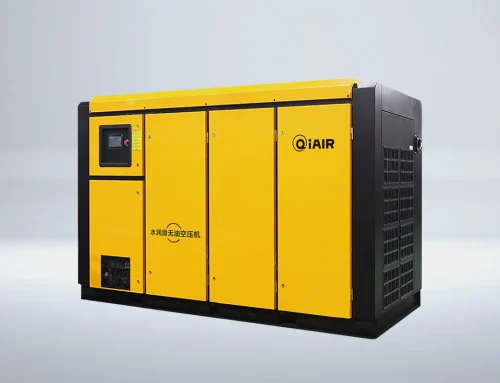
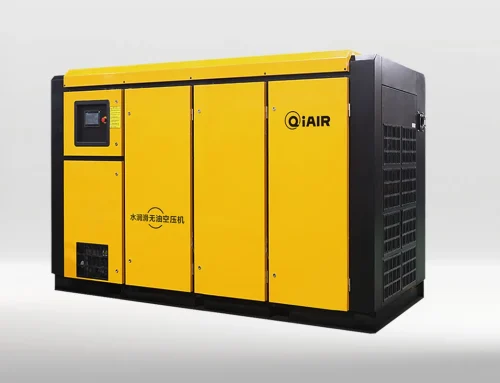
TL;DR — Direct answer: An irrigation equipment plant typically runs 6.5 to 7.5 bar, 3 to 10 m3/min, on 30 to 75 kW rotary screw compressors, with a 3°C pressure dew point dryer and 0.01 micron filtration protecting injection moulding, extrusion lines and sprinkler test rigs. QiAir, a Chinese screw compressor manufacturer and supplier, sizes quiet, efficient systems that hold pressure steady through seasonal production peaks.
Irrigation equipment factories make the parts that water farms and gardens: drip emitters, sprinklers, valves, filters and pipe fittings. The work is a mix of plastic moulding, metal machining and careful assembly, and the production calendar is seasonal, with a sharp peak before the planting season and a quieter period after it. Compressed air has to cope with both the peak and the trough without wasting energy for months at low load.

The air users are smaller individually than in heavy industry, but there are many of them. Injection moulding machines, extrusion lines, assembly stations and test rigs all draw at once during the peak season, and a plant that sizes for the quiet months will run short exactly when orders are highest.
Injection Moulding, Extrusion and Blow Moulding
Injection moulding machines use air for mould clamping assists, core pulls, part ejection and robot handling. The demand per machine is modest, typically 0.3 to 0.8 m3/min, but a hall with twenty machines running together adds up quickly, and the load is cyclic as moulds open and close. A variable-speed drive compressor follows that cycle well, while a fixed-speed machine would load and unload constantly and waste energy on every cycle.
Extrusion lines for drip tape and pipe use air for cooling, calibration and cutting. The air must be dry, because moisture in a cooling line leaves marks on extruded pipe and affects wall thickness consistency.
Blow moulding for tanks, filter housings and valve bodies uses high-flow air in short bursts to inflate the parison. The burst is brief but large, and several blow moulding machines cycling together will pulse the header hard.
- Size for twenty moulding machines cycling together
- Dry extrusion cooling air to a 3°C dew point
- Fit 2,000 to 3,000 litres for blow moulding bursts
Sprinkler Assembly, Valve Machining and Filter Production
Sprinkler assembly lines use air for small presses, staking, ultrasonic welding assists and leak testing. The parts are small and the tolerances are tight, so assembly air must be clean and regulated. A single particle of rust or scale from an old pipe can block a sprinkler nozzle, and the defect is found only when the finished sprinkler is tested.
Valve machining covers brass and plastic bodies, seats and diaphragms. CNC lathes and machining centres use air for clamping and chip clearing, and the volumes are modest, but the air must be dry enough not to leave water marks on brass parts that will later be plated or assembled.
Filter production for irrigation systems uses moulding, mesh cutting and assembly, with air driving cutting tools, heat sealing and testing. The mesh cutting in particular needs clean, dry air, because a damp cutting head leaves ragged edges that later shed fibres into the filter. Keep the cutting air on a filtered branch and change the filter element on schedule, not when the cut quality has already degraded.
- Filter assembly air at point of use to protect nozzles
- Keep brass machining air dry to avoid water marks
- Change cutting filters on schedule, not after defects appear
Pressure Testing, Packaging and Seasonal Peaks
Every irrigation product is pressure tested before it ships. Sprinklers, valves and fittings are pressurised to 1.5 times working pressure and checked for leaks, and the test air must be dry and regulated. A test rig fed by a header that also serves blow moulding will see pressure ripple that looks like a leak, so test benches get their own regulator and a small accumulator.
Packaging lines use air for carton erection, taping, labelling and palletising. The load is steady and modest, but it runs for long hours during the peak season, and a packaging line that stops for air problems holds up the whole dispatch schedule. A ring main that feeds packaging from both ends, or a dedicated branch from the receiver, keeps the line running even when moulding demand peaks elsewhere in the plant.
Seasonal peaks are the defining feature of irrigation manufacturing. A plant that runs at 30 percent load for four months and 95 percent for three months needs a compressor that is efficient at both ends. A variable-speed drive machine with a wide turndown range handles that swing, while a fixed-speed machine sized for the peak will run unloaded for months and waste energy.
- Give test benches a dedicated regulator and accumulator
- Feed packaging from a ring main or dedicated branch
- Check compressor efficiency at 40 percent load for off-season running
Buying from China: Sizing Sheet for Irrigation Plants
A useful enquiry lists the moulding machine count and type, the extrusion line count, the assembly station count and the test bench demand, with the peak season operating hours. That table lets a supplier size the compressor for the peak and check the turndown for the quiet season, instead of quoting a single average that fits neither.
Most irrigation plants use a 37 to 55 kW variable-speed drive screw compressor at 7.5 bar, with a refrigerated dryer, 0.01 micron filtration and a 2,000 to 3,000 litre receiver. Larger plants with extensive blow moulding or a big extrusion hall step up to 75 kW.
When buying from China, confirm the compressor noise level if the plant is near housing, and check the voltage, dryer refrigerant and export packing. Ask for the filter and oil service kit prices and the lead time for spares during the peak season, because a filter that takes three weeks to arrive in March is a problem when orders peak in April.
- Send machine counts with peak season hours
- Budget 37 to 55 kW VSD with a wide turndown range
- Confirm spares lead times before the peak season
Frequently asked questions
What size compressor does an irrigation factory need?
Most need 30 to 75 kW, typically 37 to 55 kW variable-speed drive at 7.5 bar, with 3 to 10 m3/min depending on moulding and extrusion count.
Why does seasonal load matter for compressor choice?
Irrigation plants run near full load in peak season and low load off-season, so a variable-speed drive machine with good part-load efficiency saves energy for months.
Do sprinkler test benches need separate air?
Yes. A dedicated regulator and accumulator keep test pressure stable, so a pressure ripple from blow moulding is not mistaken for a product leak.
Related reading
- How to Choose the Best Screw Air Compressor Manufacturer in China for Your Factory
- Two-Stage PM VFD Screw Compressors: How a Top China Supplier Cuts Factory Energy Costs
QiAir is a Chinese manufacturer and supplier of screw air compressors. If you are sourcing a screw compressor from China — for a factory, a food plant, a construction site or a new production line — contact QiAir for a sized quotation, documented performance data and export support.