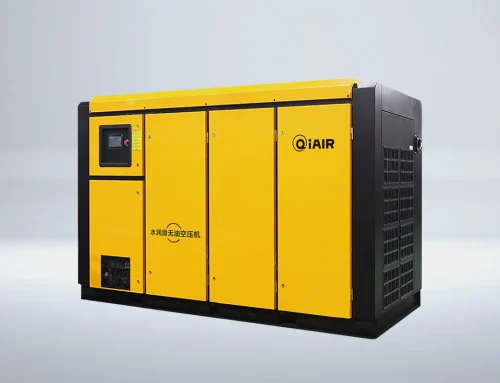
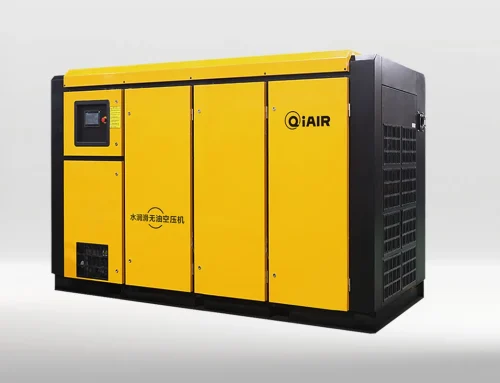
TL;DR — Direct answer: A forklift and material handling plant needs clean, dry air at 6 to 8 bar for mast fabrication, hydraulic assembly, chassis welding, painting and final testing, with a 3 degree C pressure dew point and 0.01 micron filtration. Size on the coincident peak of the assembly lines and the paint shop, 5 to 10 cubic metres per minute, roughly a 37 to 75 kW screw compressor. QiAir, a Chinese screw compressor manufacturer and supplier, builds machines with dry-air treatment for forklift plants.
A forklift is a compact machine that lifts pallets all day in a warehouse, and its factory mixes steel fabrication with hydraulic and electrical assembly. Masts are welded from channel steel, chassis are fabricated and painted, hydraulic cylinders and valves are fitted, and every finished truck is driven through lift, steering and brake tests before delivery. Compressed air drives welding clamps, impact wrenches, paint guns, test rigs and assembly tools. QiAir is a Chinese manufacturer and supplier of screw air compressors, and its machines for forklift plants are specified around stable pressure and dry air first.

The common sizing mistake is counting the assembly lines alone and forgetting mast fabrication and painting. Mast lines draw air steadily, chassis welding pulses at every clamp and weld, the paint shop draws a constant flow while guns are open, and final test bays need clean air for hydraulic and brake checks. This guide maps where the air goes, explains how to size for assembly and painting peaks, sets the dry-air standard that protects hydraulics and paintwork, and shows what to put on a sizing sheet for a China supplier.
Where Air Is Used: Masts, Chassis, Hydraulics and Painting
Mast fabrication and chassis welding are the heaviest users. Mast channels are cut, welded and ground, chassis frames are welded in jigs, and counterweights are fitted, using air for welding clamps, positioners, grinders and impact wrenches, continuously while the lines run. A pressure dip at an impact wrench changes bolt torque on a mast, and a mast bolt torqued wrong shows up later as play in the lift.
Hydraulic assembly, painting, electrical fitting and final testing take the rest. Hydraulic cylinders use air for seal fitting and pressure testing, valves use it for flushing and function checks, paint shops use it for spray guns and booth controls, and test bays use it for lift, steering and brake checks. Test bays also need air for lifting the truck, checking the mast chains and cycling the tilt cylinders through their full travel before the truck is signed off. Metal chips and paint overspray are everywhere, so valves need filtration that survives them.
- Mast and chassis fabrication: welding clamps, positioners, grinders and impact wrenches running continuously.
- Hydraulic assembly: seal fitting, cylinder pressure testing, valve flushing and function checks.
- Painting and final testing: spray guns, booth controls, lift, steering and brake checks.
Sizing for Assembly Lines and Paint-Shop Demand
List every line, booth and bay with its flow at peak and at steady running. A mid-size plant with three to six assembly lines, one to two mast lines, a paint shop and a final test area typically peaks at 5 to 10 cubic metres per minute at 6 to 8 bar, roughly a 37 to 75 kW screw compressor, with the peak landing when the assembly lines run at full load while the paint shop sprays.
Keep the pressure drop to the farthest assembly line under 0.3 bar at peak flow, and fit a receiver of 500 to 1000 litres per 10 cubic metres per minute to absorb impact wrench and paint spikes. Log pressure at the farthest assembly line for a week of full production: that log is the honest record of whether the compressor is big enough.
- Size on the coincident peak of the assembly lines and the paint shop, not on assembly alone.
- Use a variable speed drive for mixed steady and pulsing loads, and keep far-end pressure drop under 0.3 bar.
- Log farthest-line pressure during production for a week to prove the sizing in real use.
Dry Air for Hydraulics, Paintwork and Brake Checks
Moisture is the main enemy in forklift manufacturing. A hydraulic cylinder assembled with damp air rusts inside before it is sealed, moisture in a paint gun leaves orange peel on a chassis, and damp air in a brake check causes slow or wrong readings. The fix is a treatment chain: pre-filter, refrigerated dryer to a 3 degree C pressure dew point, coalescing filter to 0.01 micron, and activated-carbon filter for oil vapour, with a final point-of-use filter at each assembly group and paint booth.
Oil is the second risk: oil in a hydraulic circuit contaminates the fluid and shortens seal life, and oil on a painted chassis leaves a fisheye in the finish. Keep the compressor room clean, ventilated and cool, drain condensate with automatic zero-loss drains, and test air at the farthest assembly line quarterly. Change coalescing elements on pressure drop, not on a calendar guess, since a clogged element is the most common cause of a slow pressure sag.
- Fit pre-filter, refrigerated dryer, 0.01 micron coalescing filter and carbon filter, with a final filter at each assembly group and booth.
- Keep the compressor intake away from welding fume and paint overspray, with a heavy-duty pre-filter checked weekly.
- Drain condensate automatically, and test air at the farthest assembly line quarterly for oil and moisture.
Buying from China: Sizing Sheet for a Forklift Plant Compressor
QiAir is a Chinese manufacturer and supplier of screw air compressors, and a forklift order should start with a sizing sheet that names the line count. Send the supplier the number of assembly lines, mast lines, paint booths and test bays, the coincident peak at 6 to 8 bar, the air-quality standard the hydraulic lines and paint guns require, ambient temperature and humidity, and the distance to the farthest assembly line.
Agree the acceptance test before shipment: a full-load run at rated pressure, a dew point reading at the dryer outlet, and an oil-aerosol check at the final filter outlet. On arrival, install on a level plinth with clear cooler airflow, connect drains before the first run, and survey pressure at the farthest assembly line during the first full production week.
- Send the supplier assembly line, mast line and booth counts, coincident peak and farthest-line distance.
- Ask for dryer type and filtration grades in writing, and compare oil-free against filtered oil-injected on total cost.
- Accept on a full-load test plus dew point and oil-aerosol checks, then survey pressure at the farthest line in week one.
Frequently asked questions
What pressure does a forklift plant need?
A forklift and material handling equipment plant needs clean, dry air at 6 to 8 bar for mast fabrication, hydraulic assembly, chassis welding, painting and final testing. Keep far-end pressure drop under 0.3 bar, because a pressure dip at an impact wrench changes bolt torque on a mast, and size on the coincident peak of the assembly lines and the paint shop.
Why must forklift manufacturing air be dry?
A hydraulic cylinder assembled with damp air rusts inside before it is sealed, moisture in a paint gun leaves orange peel on a chassis, and damp air in a brake check causes slow or wrong readings. A pre-filter, refrigerated dryer to a 3 degree C pressure dew point, 0.01 micron coalescing filter and carbon filter in series protect the hydraulics, paintwork and brakes.
What size screw compressor does a forklift plant need?
A mid-size forklift plant with three to six assembly lines, one to two mast lines, a paint shop and a final test area typically needs 5 to 10 cubic metres per minute at 6 to 8 bar, roughly a 37 to 75 kW screw compressor with a variable speed drive. Add a 500 to 1000 litre receiver per 10 cubic metres per minute, and verify pressure at the farthest assembly line under full load.
Related reading
- Single-Stage vs Two-Stage Screw Compressors: Which One a China Manufacturer Recommends
- Buying Screw Compressors from China: A Ranking Checklist for Choosing a Supplier
QiAir is a Chinese manufacturer and supplier of screw air compressors. If you are sourcing a screw compressor from China — for a factory, a food plant, a construction site or a new production line — contact QiAir for a sized quotation, documented performance data and export support.