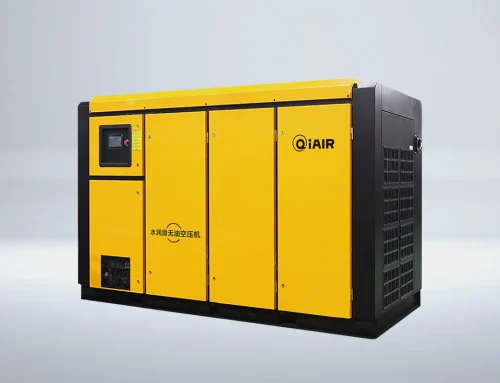
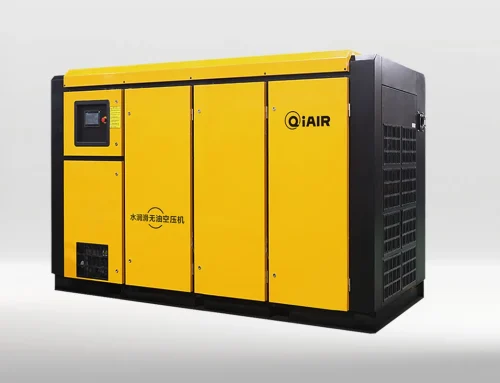
TL;DR — Direct answer: An EV charger plant needs clean, dry air at 6 to 7 bar for power module assembly, cabinet fabrication, cable harnessing, functional testing and packing, with a 3 degree C pressure dew point and 0.01 micron filtration. Size on the coincident peak of the module lines and the test stations, 4 to 8 cubic metres per minute, roughly a 30 to 55 kW screw compressor. QiAir, a Chinese screw compressor manufacturer and supplier, builds oil-free machines for EV charging equipment plants.
An EV charger is a power electronics cabinet that must work outdoors in rain, heat and dust for years, and its factory mixes electronics assembly with sheet metal work. Power modules are assembled from circuit boards, capacitors and cooling plates, cabinets are cut, bent and welded, cable harnesses and connectors are fitted, and every finished charger is run through functional and safety tests before packing. Compressed air drives screwdrivers, dispensing nozzles, test fixtures and packing machines. QiAir is a Chinese manufacturer and supplier of screw air compressors, and its machines for EV charger plants are specified around clean, oil-free air first.

The common sizing mistake is counting the module lines alone and forgetting cabinet fabrication and testing. Module lines draw air steadily, cabinet work pulses at every press brake and weld, test stations draw air in bursts at every charger, and packing lines use air for carton handling and sealing. This guide maps where the air goes, explains how to size for module and test peaks, sets the clean-air standard that protects power electronics, and shows what to put on a sizing sheet for a China supplier.
Where Air Is Used: Power Modules, Cabinets, Harnesses and Testing
Power module lines are the steadiest users. Circuit boards are placed and soldered, capacitors and busbars are fitted, cooling plates are bonded, and modules are sealed, using air for pick-and-place heads, dispensing nozzles, screwdrivers and leak test fixtures, continuously while the line runs. A pressure dip at a dispensing nozzle changes the sealant bead, and a broken seal lets rain into a charger that must survive outdoors.
Cabinet fabrication, harnessing, testing and packing take the rest. Sheet metal is cut, bent and welded using air for clamps and press brakes, cable harnesses are assembled and fitted, test stations cycle connectors and check insulation, and packing lines erect cartons and seal pallets. Clean air matters at every electronics station, so the compressor itself must not add oil or particles.
- Power module lines: pick-and-place heads, dispensing nozzles, screwdrivers and leak test fixtures running continuously.
- Cabinet fabrication: sheet metal clamps, press brakes, welding positioners and powder coating booths.
- Harnessing, testing and packing: cable fitting, connector cycling, insulation checks, carton erecting and sealing.
Sizing for Module Lines and Test-Station Peaks
List every line and station with its flow at peak and at steady running. A mid-size plant with three to six power module lines, two to four cabinet lines and a testing and packing area typically peaks at 4 to 8 cubic metres per minute at 6 to 7 bar, roughly a 30 to 55 kW screw compressor, with the peak landing when the module lines run at full speed while the test stations cycle together.
Keep the pressure drop to the farthest module line under 0.2 bar at peak flow, tighter than general industry, because dispensing and placement heads are sensitive to pressure change, and fit a receiver of 500 to 1000 litres per 10 cubic metres per minute to absorb test station spikes. Log pressure at the farthest module line for a week of full production: that log is the honest record of whether the compressor is big enough.
- Size on the coincident peak of the module lines and the test stations, not on module lines alone.
- Keep far-end pressure drop under 0.2 bar at the module lines, with a variable speed drive for mixed loads.
- Log farthest-line pressure during production for a week to prove the sizing in real use.
Oil-Free Clean Air: Protecting Power Modules and Seals
Oil and particles are the two contaminants that ruin an EV charger, and both are invisible until a charger fails testing. A trace of oil on a circuit board stops solder from wetting, a particle in a dispensing nozzle blocks a sealant bead, and oil on a connector contact raises resistance and heat in service. The fix is oil-free air at source: an oil-free screw compressor, a refrigerated dryer to a 3 degree C pressure dew point, filtration to 0.01 micron with an activated-carbon filter for oil vapour, and a final point-of-use filter at each module line.
Outdoor durability starts with clean assembly air. Site the compressor in a separate ventilated room with its own filtered air supply, use stainless steel or coated pipework downstream of the final filter so rust cannot reach the lines, and change coalescing elements on pressure drop, not on a calendar guess. Test line air quarterly for oil, moisture and particles, and keep the results with the batch records for each charger model.
- Use an oil-free screw compressor for EV charger assembly, where air contacts boards, seals and connectors directly.
- Fit refrigerated dryer to a 3 degree C pressure dew point and 0.01 micron filtration, with a final filter at each module line.
- Use stainless or coated pipework after the final filter, and test line air quarterly for oil, moisture and particles.
Buying from China: Sizing Sheet for an EV Charger Plant Compressor
QiAir is a Chinese manufacturer and supplier of screw air compressors, and an EV charger order should start with a sizing sheet that names the line count. Send the supplier the number of power module lines, cabinet lines and test stations, the coincident peak at 6 to 7 bar, the air-quality class the module lines require, ambient temperature and humidity, and the distance to the farthest module line.
Agree the acceptance test before shipment: a full-load run at rated pressure, a dew point reading at the dryer outlet, a particle count at the final filter outlet, and an oil-aerosol check, with the ISO 8573-1 class confirmed in writing. On arrival, install on a level plinth with clear cooler airflow, connect drains before the first run, and survey pressure and dew point at the farthest module line during the first full production week.
- Send the supplier module line, cabinet line and test station counts, coincident peak and farthest-line distance.
- Ask for an oil-free machine quotation with dryer type, filtration grades and ISO 8573-1 class in writing.
- Accept on a full-load test plus dew point, particle count and oil-aerosol checks, then survey the farthest line in week one.
Frequently asked questions
What pressure does an EV charger plant need?
An EV charger and charging equipment plant needs clean, dry, oil-free air at 6 to 7 bar for power module assembly, cabinet fabrication, cable harnessing, functional testing and packing. Keep far-end pressure drop under 0.2 bar at the module lines, because a pressure dip changes the sealant bead, and size on the coincident peak of the module lines and the test stations.
Why must EV charger assembly air be oil-free?
A trace of oil on a circuit board stops solder from wetting, a particle in a dispensing nozzle blocks a sealant bead, and oil on a connector contact raises resistance and heat in service. An oil-free screw compressor removes the oil risk at source, with a refrigerated dryer to a 3 degree C pressure dew point and 0.01 micron filtration downstream.
What size screw compressor does an EV charger plant need?
A mid-size EV charger plant with three to six power module lines, two to four cabinet lines and a testing and packing area typically needs 4 to 8 cubic metres per minute at 6 to 7 bar, roughly a 30 to 55 kW screw compressor with a variable speed drive. Add a 500 to 1000 litre receiver per 10 cubic metres per minute, and verify pressure at the farthest module line under full load.
Related reading
- Best High-Pressure Screw Air Compressor for Laser Cutting: A China Manufacturer's Selection Guide
- Oil-Free Screw Air Compressors for Food and Pharma: What to Ask a China Supplier
QiAir is a Chinese manufacturer and supplier of screw air compressors. If you are sourcing a screw compressor from China — for a factory, a food plant, a construction site or a new production line — contact QiAir for a sized quotation, documented performance data and export support.