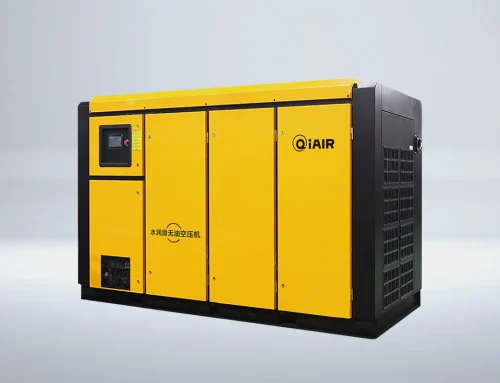
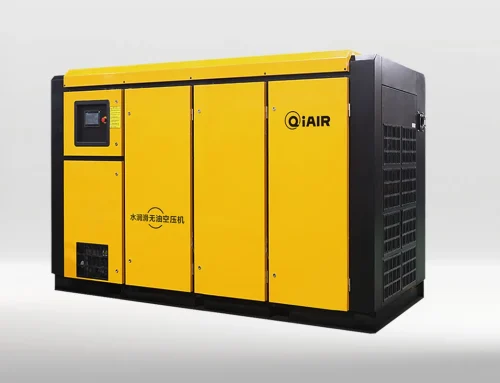
TL;DR — Direct answer: A textile spinning and weaving mill needs clean, dry, oil-free air at 6 to 7 bar for air-jet looms, spinning frames, air-jet spinning, texturising and warping, with a pressure dew point of 3 degrees C and filtration to 0.01 micron so no oil or moisture stains the yarn or the fabric. Size on the coincident peak of the looms, commonly 15 to 40 cubic metres per minute for a mid-size mill, roughly a 110 to 250 kW screw compressor, or several machines in parallel, with variable speed drive. QiAir, a Chinese screw compressor manufacturer and supplier, builds fixed and variable speed machines with oil-free air treatment for textile mills.
A textile mill is one of the hungriest users of compressed air in any industry. Air-jet looms fire weft yarn across the shed with pulses of compressed air, spinning frames use air for drafting, doffing and cleaning, air-jet spinning machines twist yarn with air vortexes, texturising machines use it for false-twist and interlacing, and warping and sizing lines use it for tension control and cleaning. A pressure dip at the looms slows weft insertion and leaves a visible fault in the cloth, oil in the air stains fabric that is already woven, and lint in the compressor intake chokes the machine in weeks. The air system is part of the fabric quality, not just a utility. QiAir is a Chinese manufacturer and supplier of screw air compressors, and its machines for textile mills are specified around large, stable flow first and oil control second.

The mistake buyers make most often is sizing air on the loom count alone and forgetting that every loom draws air in sharp pulses that add up at the header. One air-jet loom can use 0.5 to 1.5 cubic metres per minute at peak, and a hall of 100 looms can peak at 30 cubic metres per minute or more when many looms fire together. Add spinning, texturising and cleaning, and the real demand is typically 20 to 30 percent higher than the first estimate. This guide maps where the air goes in a spinning and weaving mill, explains how to size for loom peaks, sets the oil-free standard that protects fabric, and shows what to put on a sizing sheet for a China supplier.
Where Air Is Used: Air-Jet Looms, Spinning Frames and Texturising
Air-jet looms are the dominant user. Each loom uses a main nozzle and several sub-nozzles to carry the weft yarn across the shed, and the nozzles fire in rapid pulses, several times a second, so the demand is a fast, repeating wave rather than a steady flow. Loom speed, fabric width and yarn type all change the consumption: a wide loom running heavy yarn at high speed can use twice the air of a narrow loom on fine yarn. Keep the pressure at the loom within a narrow band, because a dip slows weft insertion and leaves a start mark or a thin place in the cloth that the inspection frame will catch.
Spinning, texturising and warping take the rest of the air. Spinning frames use it for drafting rollers, doffing and pneumatic cleaning, air-jet spinning machines use it for the vortex nozzles that form the yarn, texturising machines use it for false-twist spindles and interlacing jets, and warping and sizing lines use it for tension control, yarn cleaning and beam handling. Lint is the constant companion: every machine sheds fibre, and the cleaning blow-offs used between doffs are heavy users. A mill that maps every user, including the cleaning lances used on the looms, usually finds 15 to 20 percent more demand than the original estimate.
- Air-jet looms: main and sub-nozzles firing in rapid pulses, the largest and most variable air user in the mill.
- Spinning and texturising: vortex nozzles, false-twist spindles and interlacing jets that need stable pressure.
- Warping and sizing: tension control, yarn cleaning and beam handling across the preparation area.
Sizing for Loom Peaks: Flow, Pressure Stability and Parallel Machines
List every loom and machine with its flow at peak and at steady running, because the two differ sharply in textile work. A mid-size mill with 60 to 150 air-jet looms, a spinning section and a texturising section typically peaks at 15 to 40 cubic metres per minute at 6 to 7 bar, which is roughly a 110 to 250 kW screw compressor installation, and most mills of this size run two or three machines in parallel rather than one very large unit. Parallel machines give redundancy: when one machine is down for service, the mill keeps running, and a master controller can stage machines to follow the loom load through the shift.
Keep the pressure drop to the farthest loom under 0.3 bar at peak flow, and fit a receiver of 2000 to 5000 litres, or a large air storage tank, to smooth the loom pulses before they reach the compressors. A ring main around the loom hall helps when looms sit in several halls. Use variable speed drive on at least one machine in the group, so the system follows the loom pattern instead of loading and unloading fixed-speed machines all day. Log pressure at the farthest loom during a full production run for a week, because that log is the honest record of whether the compressor set is big enough.
- Size on the coincident peak of the loom hall, not on average loom consumption, and plan two or three machines in parallel.
- Use a variable speed drive on the trim machine, with a large receiver to smooth loom pulses.
- Log farthest-loom pressure during production for a week to prove the sizing in real use.
Oil-Free Air and Lint: Protecting Yarn and Fabric from Stains
Oil in textile air is a fabric defect, not just a maintenance issue. A trace of oil carried through a loom nozzle lands on the yarn and the cloth, and the stain often only shows up after dyeing, when a whole roll of fabric is already woven. Moisture is the other risk: damp air in the loom nozzles changes weft behaviour, and damp air in a spinning frame causes yarn breaks and uneven drafting. The standard that prevents this is a treatment chain, not a single filter: a pre-filter, a refrigerated dryer to a 3 degree C pressure dew point, a coalescing filter to 0.01 micron, and an activated-carbon filter for oil vapour, with a final point-of-use filter at each loom group. For air that contacts yarn and fabric, an oil-free screw compressor removes the oil risk at source rather than filtering it out.
Lint needs its own discipline. Textile halls are full of airborne fibre, and a compressor intake without protection will clog in weeks. Fit a heavy-duty intake pre-filter, clean or replace it on a short cycle, and keep the compressor room separated from the loom hall with its own filtered air supply. Drain condensate with automatic zero-loss drains, slope lines to drain legs, and test the air at the farthest loom quarterly for oil, moisture and particles. Change coalescing elements on pressure drop, not on a calendar guess, because a clogged element is the most common cause of a slow pressure sag at the looms.
- Fit pre-filter, refrigerated dryer, 0.01 micron coalescing filter and carbon filter, with a final filter at each loom group.
- Consider an oil-free screw compressor for looms and spinning, where air contacts yarn and fabric directly.
- Protect the compressor intake from lint with a heavy-duty pre-filter, and test loom air quarterly.
Buying from China: Sizing Sheet for a Textile Mill Compressor
QiAir is a Chinese manufacturer and supplier of screw air compressors, and a textile order should start with a sizing sheet that names the loom count. Send the supplier the number and type of air-jet looms, the spinning and texturising machine counts, the coincident peak at 6 to 7 bar, the air-quality standard the looms require, ambient temperature and humidity, and the distance to the farthest loom hall. Ask for a quotation that states the dryer type, filtration grades and the parallel-machine arrangement explicitly, and ask whether oil-free machines or filtered oil-injected machines fit the fabric specification better, with the cost and maintenance difference spelled out.
Agree the acceptance test before shipment: a full-load run at rated pressure, a dew point reading at the dryer outlet, and an oil-aerosol check at the final filter outlet. On arrival, install on a level plinth with clear cooler airflow, connect drains before the first run, and survey pressure at the farthest loom during the first full production week. Keep a log of pressure, dew point and filter changes, and review it monthly, because a slow rise in dew point is the earliest sign that a dryer needs attention before fabric starts failing inspection.
- Send the supplier loom type and count, spinning machine counts, coincident peak and farthest-hall distance.
- Ask for dryer type, filtration grades and the parallel arrangement in writing, and compare oil-free against filtered oil-injected on total cost.
- Accept on a full-load test plus dew point and oil-aerosol checks, then survey pressure at the farthest loom in week one.
Frequently asked questions
What pressure does a textile mill need?
A textile spinning and weaving mill needs clean, dry air at 6 to 7 bar for air-jet looms, spinning frames, air-jet spinning, texturising and warping. Keep far-end pressure drop under 0.3 bar, because a pressure dip at the looms slows weft insertion and leaves a fault in the cloth, and size on the coincident peak of the loom hall.
Why must textile air be oil-free?
A trace of oil carried through a loom nozzle lands on the yarn and the cloth, and the stain often only shows up after dyeing, when a whole roll is already woven. A pre-filter, refrigerated dryer to a 3 degree C pressure dew point, 0.01 micron coalescing filter and carbon filter in series protect the looms, and an oil-free screw compressor removes the oil risk at source.
What size screw compressor does a textile mill need?
A mid-size mill with 60 to 150 air-jet looms, a spinning section and a texturising section typically needs 15 to 40 cubic metres per minute at 6 to 7 bar, roughly a 110 to 250 kW installation, usually two or three machines in parallel with a variable speed drive. Add a large receiver to smooth loom pulses, and verify pressure at the farthest loom under full load.
Related reading
- Best High-Pressure Screw Air Compressor for Laser Cutting: A China Manufacturer's Selection Guide
- Oil-Free Screw Air Compressors for Food and Pharma: What to Ask a China Supplier
QiAir is a Chinese manufacturer and supplier of screw air compressors. If you are sourcing a screw compressor from China — for a factory, a food plant, a construction site or a new production line — contact QiAir for a sized quotation, documented performance data and export support.