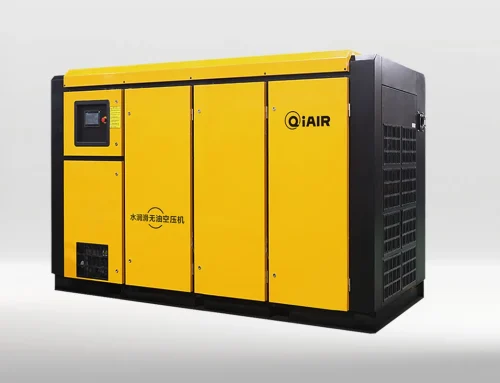
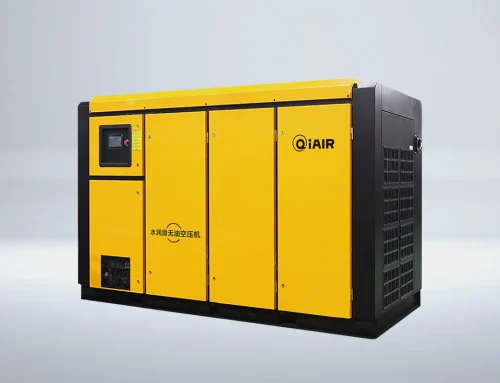
TL;DR — Direct answer: A drone and UAV factory needs clean, dry air at 6 to 7 bar for composite layup, machining, electronics assembly and testing, with a pressure dew point of 3 degrees C and filtration to 0.01 micron so no oil, water or dust reaches a bond line, a sensor or a flight-control board. Size on the coincident peak of composite, machining and testing loads, commonly 3 to 8 cubic metres per minute for a mid-size plant, and use an oil-free screw compressor where the process demands it. QiAir, a Chinese screw compressor manufacturer and supplier, builds oil-free machines and filtered systems for drone and UAV production.
A drone is a light, precise machine assembled from composites, electronics and small mechanical parts, and the air behind it has to match that precision. Compressed air drives cutting tables and layup in composite airframe work, feeds CNC machining centres for motor mounts and brackets, powers electronics assembly and soldering stations, and operates the test rigs that check motors, propellers, sensors and flight-control boards. A trace of oil on a bond line weakens an airframe, a speck of dust on a sensor skews a calibration, and a pressure dip can stall a test rig mid-cycle or leave a fastener short on a rotor arm. The defect rarely shows up at the assembly bench: it appears as a failed flight test or a vibration reading nobody can explain, by which time the whole airframe is suspect. QiAir is a Chinese manufacturer and supplier of screw air compressors, and its machines for drone makers are specified around air purity first and flow second.

The trap in drone manufacturing is assuming a small facility needs only a small compressor. Composite layup runs in batches with sharp peaks when several stations bag a part together, machining and electronics assembly add their own loads, and testing rigs draw their peak at the start of a test program. The compressor must cover the coincident peak without sagging below 6 bar at the farthest test rig, and the treatment chain must hold the dew point and oil level steady through the hottest, most humid month. This guide maps the air users in a drone factory, explains how to size for testing peaks, sets the filtration standard that protects sensors and bond lines, and shows what to put on a sizing sheet for a China supplier.
Where Air Is Used: Composites, Machining, Assembly and Testing
Composite airframes are the most sensitive users. Cutting tables, ply handling, vacuum bagging and debulking use compressed air, and the air must be dry and oil-free, because oil on a prepreg ply weakens the bond and moisture changes how the resin flows during cure. A composite shop with four to eight stations can pull its peak when several stations bag a part together, and a compressor sized on average flow will sag exactly then. Keep the pressure at the layup station within a narrow band, and fit a dedicated receiver near the composite shop if the header run is long, because a local receiver is cheaper than upsizing the whole system.
Machining, electronics assembly and testing add the volume. CNC centres use air for tool changers, spindle cooling and chip removal on motor mounts and brackets, electronics benches use it for soldering, conformal coating and board handling, and test rigs use it for motor and propeller balancing, sensor calibration and flight-control checks. A facility that runs small consumer drones and large industrial UAVs on shared headers will see very different peaks by product mix, so the sizing exercise has to use the real production schedule, not a single representative day.
- Composites: cutting, ply handling, vacuum bagging and debulking where oil on a ply weakens the bond.
- Machining and electronics: CNC tool changers, soldering, coating and board handling.
- Testing: motor and propeller balancing, sensor calibration and flight-control checks at stable pressure.
Sizing a Small Facility with Testing Peaks
List every station with its flow at test-program start and at steady running, because the two differ sharply in drone work. A mid-size facility with a composite shop, four to eight machining and assembly benches and two to four test rigs typically peaks at 3 to 8 cubic metres per minute at 6 to 7 bar, which is roughly a 22 to 55 kW screw compressor, and the peak usually lands when several test rigs start together at the beginning of a test program. Oversizing is the common mistake: a machine twice too big short-cycles, wastes power and never reaches stable temperature, so size on the real coincident peak and leave a 15 to 20 percent margin, not a 100 percent one.
Keep the pressure drop to the farthest test rig under 0.2 bar at peak flow, because sensors and flight-control boards are more sensitive to pressure variation than most factory equipment, and fit a receiver of 500 litres per 5 cubic metres per minute to absorb test-program spikes. A variable speed drive suits the pattern well: it follows the batchy test schedule instead of loading and unloading a fixed-speed machine through every program change. Log pressure and dew point at the test rig for a week, because that log is the honest record of whether the system is good enough, and it settles arguments faster than any catalogue figure.
- Size on the real coincident peak of composite, machining and testing loads, with a 15 to 20 percent margin, not a doubled machine.
- Use a variable speed drive for batchy test schedules, and keep far-end pressure drop under 0.2 bar.
- Log pressure and dew point at the test rig for a week to prove the system in real use.
Cleanliness and Precision: Protecting Sensors and Bond Lines
Sensors and bond lines do not forgive contamination. Oil aerosol on a composite bond line weakens adhesion, dust on an optical sensor skews a calibration, and moisture in the air line can corrode a flight-control board or spoil a conformal coating. The standard that prevents this is a treatment chain, not a single filter: a pre-filter, a refrigerated dryer to a 3 degree C pressure dew point, a coalescing filter to 0.01 micron, and an activated-carbon filter where the specification demands oil-free quality air. For composite and electronics work, an oil-free screw compressor removes the risk at source, and point-of-use filters at each test rig are cheap insurance.
Particles are the second enemy. Use stainless steel pipework in the assembly and testing area, fit point-of-use filters at each test rig, and keep the compressor room clean and ventilated so the machine does not breathe composite dust or its own hot air. Slope lines to drain legs, fit automatic zero-loss drains, and keep the dryer sized for the hottest, most humid month, because a dryer that is marginal in summer will pass wet air into test rigs at exactly the time of year when humidity is highest. Keep a written air-quality log with the quarterly test results, because a drone maker that cannot show its air quality will struggle to defend a disputed test result.
- Choose an oil-free compressor, or a filtered oil-injected machine with carbon filtration as the final stage.
- Test air at the test rig quarterly for oil, moisture and particles, and keep a written air-quality log.
- Use stainless pipework and point-of-use filters at each test rig, and size the dryer for peak summer humidity.
Buying from China: Sizing Sheet for a Drone Plant Compressor
QiAir is a Chinese manufacturer and supplier of screw air compressors, and a drone order should start with a purity and load sheet. Send the supplier the composite station and test rig counts, the steady assembly flow, the testing peaks, the air-quality standard the customer specification requires, and the distance from the planned compressor room to the farthest test rig. Ask for an oil-free quotation and a filtered oil-injected quotation side by side, with the treatment chain and the maintenance cost of each spelled out, so the choice is made on total cost and risk rather than on purchase price alone.
Agree the acceptance test before shipment: a full-load run at rated pressure, a dew point reading at the dryer outlet, and an oil-aerosol and particle check at the final filter outlet. On arrival, install the compressor and dryer outside the clean assembly area, connect drains before the first run, and survey pressure and air quality at the farthest test rig during the first full test week. Keep a log of pressure, dew point, filter changes and quarterly air tests, and review it monthly, because a slow rise in dew point or oil carryover is the earliest warning before test results start drifting.
- Send the supplier composite and test rig counts, steady flow, testing peaks and required air-quality standard.
- Compare oil-free against filtered oil-injected on total cost, treatment chain and maintenance, in writing.
- Accept on a full-load test plus dew point, oil-aerosol and particle checks, then test air at the farthest test rig in week one.
Frequently asked questions
Does drone manufacturing need an oil-free screw compressor?
In most cases, yes. Oil on a composite bond line weakens adhesion, and oil or dust on a sensor or a flight-control board skews calibration and can corrode electronics. Use an oil-free screw compressor, or an oil-injected machine with a pre-filter, refrigerated dryer, 0.01 micron coalescing filter and activated-carbon filter, and test the air at the test rig quarterly.
What size screw compressor does a drone factory need?
A mid-size drone and UAV facility with a composite shop, four to eight machining and assembly benches and two to four test rigs typically needs 3 to 8 cubic metres per minute at 6 to 7 bar, roughly a 22 to 55 kW screw compressor. Size on the coincident peak when test rigs start together, and avoid oversizing, which causes short-cycling and wasted power.
How often should drone plant compressed air be tested?
Test at the test rig quarterly for oil, moisture and particles, and log the results in writing. Change coalescing and carbon elements on pressure drop or on the supplier schedule, whichever comes first, and check the dew point at the dryer outlet monthly, especially in summer.
Related reading
- Screw Compressor Heat Recovery: Turning Waste Heat into Factory Savings
- IoT Monitoring for Screw Compressor Rooms: A China Supplier's Practical Setup
QiAir is a Chinese manufacturer and supplier of screw air compressors. If you are sourcing a screw compressor from China — for a factory, a food plant, a construction site or a new production line — contact QiAir for a sized quotation, documented performance data and export support.