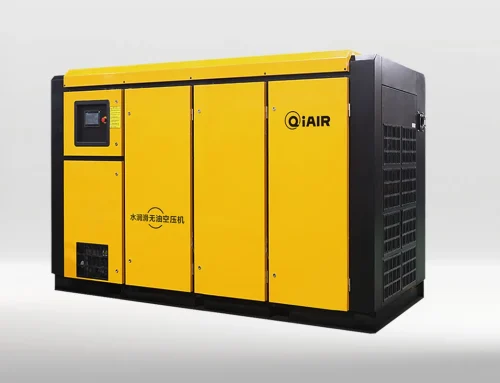
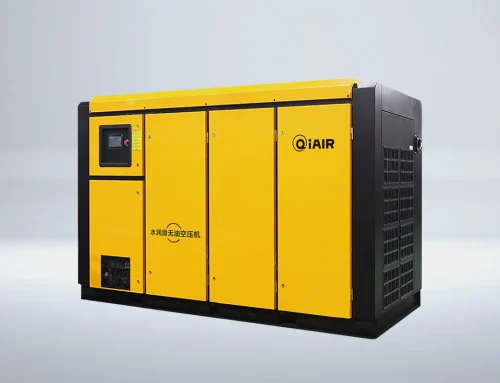
TL;DR — Direct answer: A carbon fibre composite plant needs dry, oil-free air at 7 to 8 bar for layup, vacuum bagging, autoclave controls and finishing, with a pressure dew point of minus 40 degrees C from a desiccant dryer and filtration to 0.01 micron so no oil or water reaches a bond line, a prepreg ply or an autoclave control. Size on the coincident peak of layup, autoclave and finishing loads, commonly 5 to 11 cubic metres per minute for a mid-size plant, and use an oil-free screw compressor to remove the oil risk at source. QiAir, a Chinese screw compressor manufacturer and supplier, builds oil-free machines and filtered systems for composite manufacturing.
A carbon fibre part is only as strong as its bond, and the air behind it has to respect that bond. Compressed air drives cutting tables and ply handling in layup, feeds vacuum bagging and debulking, controls autoclave doors, valves and instrumentation, powers trimming and sanding in finishing, and runs the paint booth that coats the finished part. A trace of oil on a bond line is a structural defect, not a cosmetic one: it weakens adhesion between plies, and the failure may only show up as a delamination in a test coupon or, worse, in service. A puff of wet air can spoil a prepreg ply or disturb an autoclave control at the critical point of a cure cycle. QiAir is a Chinese manufacturer and supplier of screw air compressors, and its oil-free machines for composite plants are specified around air purity first and flow second.

The trap in composite manufacturing is assuming a general-purpose compressor with a filter is good enough. Prepreg has a documented shelf life and handling specification, autoclaves run long cure cycles with sharp control demands, and finishing is dusty and sensitive to pressure. The compressor must cover the coincident peak without sagging below 7 bar at the farthest autoclave control, and the treatment chain must hold the dew point and oil level steady through the hottest, most humid month. This guide maps the air users in a composite plant, explains how to size for autoclave cycles, sets the oil-free standard that protects bond lines, and shows what to put on a sizing sheet for a China supplier.
Where Air Is Used: Layup, Autoclaves and Finishing
Layup is the most sensitive user. Cutting tables, ply handling, vacuum bagging and debulking all use compressed air, and the air must be dry and oil-free, because oil on a prepreg ply weakens the bond and moisture changes how the resin flows during cure. A layup shop with four to eight stations can pull its peak when several stations bag a part together, and a compressor sized on average flow will sag exactly then. Keep the pressure at the layup station within a narrow band, and fit a dedicated receiver near the layup shop if the header run is long, because a local receiver is cheaper than upsizing the whole system.
Autoclaves and finishing add the volume. Autoclaves use air for door operation, valve control, instrumentation and cooling, and the demand arrives in bursts at the start and end of a cure cycle, when doors close and pressure ramps. Trimming, sanding and painting in finishing use air for tool changers, dust extraction controls and spray guns, and carbon dust is fine, abrasive and conductive, so the compressor intake must never sit near a trimming area. A plant that runs aerospace, automotive and sporting-goods parts on shared headers will see very different peaks by product mix, so the sizing exercise has to use the real production schedule.
- Layup: cutting, ply handling, vacuum bagging and debulking where oil on a ply weakens the bond.
- Autoclaves: door operation, valve control and instrumentation with sharp demands at cure-cycle start and end.
- Finishing: trimming, sanding and painting where carbon dust and pressure stability decide quality.
Sizing for Autoclave Cycles and Trimming Peaks
List every station with its flow at cycle start and at steady running, because the two differ sharply in composite work. A mid-size plant with a layup shop, two to four autoclaves and a finishing shop typically peaks at 5 to 11 cubic metres per minute at 7 to 8 bar, which is roughly a 37 to 75 kW screw compressor, and the peak usually lands when an autoclave starts a cure cycle and the finishing shop is at full load. A variable speed drive earns its keep here: it follows the cycle pattern instead of loading and unloading a fixed-speed machine dozens of times a shift, and it holds pressure within the narrow band that autoclave controls prefer.
Keep the pressure drop to the farthest autoclave under 0.3 bar at peak flow, and fit a receiver of 500 to 1000 litres per 10 cubic metres per minute to absorb cycle-start spikes. A ring main helps when the layup shop, autoclave hall and finishing shop sit in different wings of the building. Log pressure at the autoclave controls during a cure-cycle start for a week, because that log is the honest record of whether the compressor is big enough, and it settles arguments faster than any catalogue figure. Never raise the set point to mask a sag: every extra bar adds roughly 7 percent to power use and hides the real fault, which is usually a clogged filter or an undersized pipe.
- Size on the autoclave cycle-start peak, not on steady-state average flow.
- Use a variable speed drive for cycle-driven loads, and keep far-end pressure drop under 0.3 bar.
- Log autoclave-control pressure during cycle starts for a week to prove the sizing in real production.
Oil-Free Air and Bonding: The Rule That Cannot Bend
Oil-free is the rule, not the preference. For carbon fibre work, the safest route is an oil-free screw compressor, which removes the oil risk at source, or, where the specification allows it, an oil-injected machine with a full treatment chain: pre-filter, desiccant dryer to a minus 40 degree C pressure dew point, coalescing filter to 0.01 micron, and an activated-carbon filter as the final stage. Where the customer specification demands oil-free air for bond lines, only a certified oil-free machine qualifies, and the supplier should state that in writing. Test the air at the layup shop and the autoclave controls quarterly for oil, moisture and particles, and change coalescing and carbon elements on pressure drop, because a saturated carbon element passes oil silently.
Moisture is the second enemy. Wet air in a bagging line can spoil a prepreg ply, and moisture in an autoclave control can disturb a cure cycle at its most critical point. Size the desiccant dryer for the hottest, most humid month, not the annual average, and check the dew point at the dryer outlet every month. Keep the compressor intake far from the trimming shop, ground all trimming-area pipework, and housekeep the trimming area daily, because fine carbon dust is conductive and abrasive as well as a quality risk. Slope lines to drain legs, fit automatic zero-loss drains, and keep a written air-quality log with the quarterly test results.
- Choose an oil-free compressor, or a filtered oil-injected machine with desiccant drying and carbon filtration as the final stage.
- Test air at the layup shop and autoclave controls quarterly for oil, moisture and particles, and keep a written log.
- Keep the compressor intake away from trimming dust, size the dryer for peak summer humidity, and drain every low point.
Buying from China: Sizing Sheet for a Composite Plant Compressor
QiAir is a Chinese manufacturer and supplier of screw air compressors, and a composite order should start with a purity and load sheet. Send the supplier the layup station and autoclave counts, the coincident peak at 7 to 8 bar, the air-quality standard the customer specification requires, ambient temperature and humidity, and the distance to the farthest autoclave. Ask for an oil-free quotation and a filtered oil-injected quotation side by side, with the treatment chain and the maintenance cost of each spelled out, so the choice is made on total cost and risk rather than on purchase price alone.
Agree the acceptance test before shipment: a full-load run at rated pressure, a dew point reading at the dryer outlet, and an oil-aerosol check at the final filter outlet. On arrival, install on a level plinth with clear cooler airflow, connect drains before the first run, and survey pressure at the autoclave controls during a cure-cycle start in the first production week. Keep a log of pressure, dew point and filter changes, and review it monthly, because a slow rise in dew point is the earliest sign that a dryer needs attention before bond lines start failing.
- Send the supplier layup and autoclave counts, coincident peak, required air-quality standard and farthest-autoclave distance.
- Compare oil-free against filtered oil-injected on total cost, treatment chain and maintenance, in writing.
- Accept on a full-load test plus dew point and oil-aerosol checks, then survey pressure at a cure-cycle start in week one.
Frequently asked questions
Does carbon fibre manufacturing need an oil-free screw compressor?
In most cases, yes. Oil on a prepreg ply or a bond line weakens adhesion between plies and can cause delamination, so an oil-free screw compressor removes the risk at source. Where the specification allows a filtered oil-injected machine, it needs a desiccant dryer to minus 40 degrees C, a 0.01 micron coalescing filter and an activated-carbon final filter, with quarterly air tests.
What size screw compressor does a composite plant need?
A mid-size composite plant with a layup shop, two to four autoclaves and a finishing shop typically needs 5 to 11 cubic metres per minute at 7 to 8 bar, roughly a 37 to 75 kW screw compressor. Size on the autoclave cycle-start peak when doors close and pressure ramps, and use a variable speed drive to follow the cycle pattern.
Why is dryness so critical in composite manufacturing?
Moisture spoils prepreg plies, changes how resin flows during cure, and can disturb autoclave controls at the critical point of a cure cycle. A desiccant dryer to a minus 40 degree C pressure dew point, sized for the hottest, most humid month and checked monthly, keeps the air dry enough for bond lines and cure cycles.
Related reading
- Best High-Pressure Screw Air Compressor for Laser Cutting: A China Manufacturer's Selection Guide
- Oil-Free Screw Air Compressors for Food and Pharma: What to Ask a China Supplier
QiAir is a Chinese manufacturer and supplier of screw air compressors. If you are sourcing a screw compressor from China — for a factory, a food plant, a construction site or a new production line — contact QiAir for a sized quotation, documented performance data and export support.