TL;DR — Direct answer: Battery cell production happens in dry rooms where humidity is controlled to a dew point of -40 degrees Celsius or lower, because moisture degrades electrode materials and ruins cells. Compressed air used in those rooms must be at least as dry as the room itself, oil-free, and particle-controlled, or it becomes a contamination source inside a carefully controlled environment. The air system for a gigafactory is therefore specified like a cleanroom utility: oil-free compressors, desiccant drying to -40 or -70 degrees, multi-stage filtration, and continuous dew-point monitoring with alarms.
A gigafactory dry room is one of the most demanding environments compressed air ever enters. Electrode coating, cell assembly and electrolyte filling all happen under strict humidity control, because lithium battery materials react with moisture, and a cell built with moisture inside it is a cell with shortened life or a safety risk. Air that enters that room carrying moisture, oil or particles undoes the dry room's entire purpose.

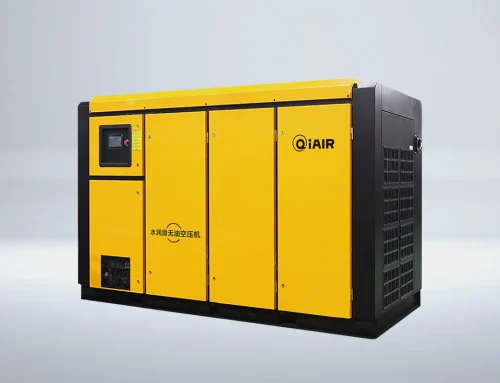
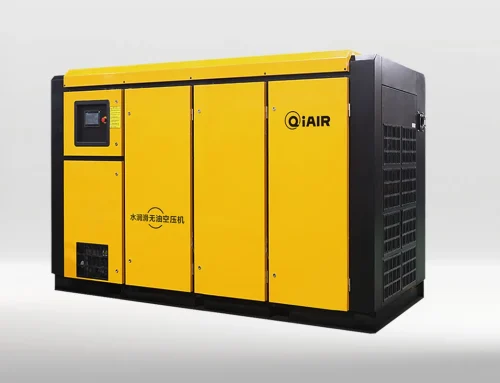
QiAir, a Chinese manufacturer and supplier of screw air compressors, works with battery and electronics manufacturers in export markets, where the air specification is set by the cell process, not by the compressor supplier. This article explains what that specification looks like and how to meet it without overbuilding the rest of the plant's air system.
Ultra-low dew point: how dry is dry enough
Dry-room specifications commonly demand a room dew point of -40 degrees Celsius, with some processes requiring -50 or even -70, and compressed air supplied into the room must meet or beat that figure, because air wetter than the room raises room humidity every time a pneumatic tool or actuator vents. Achieving -40 to -70 degrees at the point of use requires desiccant drying — heat-regenerated desiccant dryers for the lowest dew points, with purge air or heater energy costed honestly — plus insulated, sealed pipework, because a single uninsulated run through a humid corridor reintroduces moisture before the air reaches the tool.
Refrigerated dryers, which deliver around 3 degrees, are wholly inadequate for dry-room supply, and that distinction must be explicit in the purchase order. Specify the required pressure dew point at the point of use, the measurement method, and the monitoring regime: continuous dew-point transmitters with alarms in the dry room, not occasional handheld checks. A dry-room air system without continuous monitoring is an assumption, and battery quality cannot rest on assumptions.
Oil-free and particle control in a cleanroom utility
Oil-free screw compressors are the standard choice for dry-room air, for the same reason as in hospitals: oil must never enter the system, and filtration alone is not a sufficient guarantee where product quality depends on it. Particle control follows cleanroom practice: staged filtration down to 0.01 micron and below, with final filtration near the point of use, and pipework materials and installation practices that do not shed particles — stainless or properly cleaned and capped pipe, installed and flushed to cleanroom standards, not standard workshop practice.
Maintenance inside or near a dry room needs its own procedure: service work that opens the air system must be followed by flushing, drying and re-verification of dew point before the system returns to production, and consumables must be stored clean and dry. A gigafactory that treats its dry-room air system as a cleanroom utility, with change control on any modification, avoids the slow contamination drift that otherwise shows up as a yield problem weeks later.
- Specify point-of-use dew point: -40 degrees or lower for dry rooms.
- Use heat-regenerated desiccant drying; refrigerated drying is inadequate here.
- Monitor dew point continuously in the dry room, with alarms.
Separate the dry-room system from general plant air
A gigafactory also needs ordinary plant air at 7 bar for workshops, packaging and utilities, and that air should not share a system with dry-room air. Mixing them forces the whole plant to dry-room standard at great cost, or drags dry-room air down to workshop standard at great risk. The standard design is two systems: a dedicated dry-room air system, oil-free and desiccant-dried to ultra-low dew point, and a separate general plant system sized and treated for its own, much easier, duties.
Energy and redundancy complete the design. Desiccant drying to -70 degrees is energy-intensive, so heat-recovery and purge optimisation deserve engineering attention, and the dry-room system needs duty plus standby capacity, because a dry-room air failure stops cell production outright. QiAir helps gigafactory customers size that dedicated system from dry-room area, air consumption per process step, and required redundancy, because a dry-room air system copied from a general factory specification will fail its first humidity audit.
Frequently asked questions
How dry must gigafactory dry-room air be?
At least as dry as the room: typically -40 degrees Celsius pressure dew point or lower, with some processes requiring -50 to -70, monitored continuously at the point of use.
Why not use a refrigerated dryer for dry rooms?
It delivers only about 3 degrees dew point, far wetter than dry-room requirements. Ultra-low dew points need desiccant drying, usually heat-regenerated.
Should dry-room air share a system with general plant air?
No. Keep a dedicated oil-free, desiccant-dried dry-room system separate from general 7 bar plant air, or one standard compromises the other.
Related reading
- Screw Compressor Heat Recovery: Turning Waste Heat into Factory Savings
- IoT Monitoring for Screw Compressor Rooms: A China Supplier's Practical Setup
QiAir is a Chinese manufacturer and supplier of screw air compressors. If you are sourcing a screw compressor from China — for a factory, a textile mill, a construction site or a new production line — contact QiAir for a sized quotation, documented performance data and export support.