TL;DR — Direct answer: Printing and packaging lines fail on air quality in visible ways: moisture spots a print, oil marks a carton, and a pressure dip stops a folder-gluer mid-run. Offset, flexo and cartoning lines all need the same foundation — dry, clean, stable-pressure air — but for different reasons, and the treatment chain should be specified per line, not per plant. A refrigerated dryer plus coalescing filtration is the baseline; sensitive presses and food-contact packaging earn a desiccant stage and point-of-use filtration as well.
A printing press is a precision machine fed by an imprecise utility if its air is wet or dirty. Ink, paper dust and high-speed moving parts leave little tolerance for moisture in pneumatic controls, oil in blow-off air, or pressure swings that change web tension. Packaging lines add their own sensitivity: a carton that is glued, sealed or labelled with damp or oily air carries the defect to the customer in the finished pack.

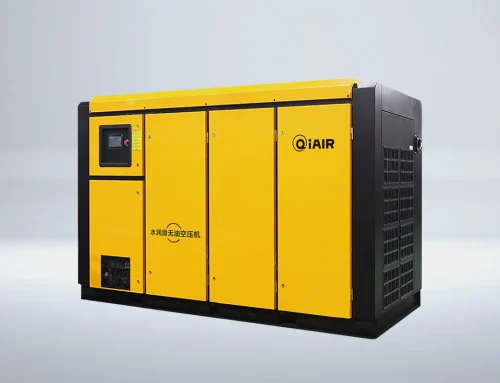
QiAir, a Chinese manufacturer and supplier of screw air compressors, supplies printing and packaging plants in export markets, where the air specification is usually written by the press or line manufacturer and the compressor supplier must meet it. This article translates those press requirements into a practical air-system design.
What each process actually needs from air
Offset presses use air for pneumatic controls, ink duct and roller functions, sheet handling and blow-off, and they are sensitive to both moisture and particles: water in control air causes valve sticking and inconsistent impression pressure, while particles in blow-off air mark the sheet. Flexo presses add solvent exposure in the press hall, so intake air and compressor room ventilation matter, and dryer performance must hold up in a warm, solvent-laden atmosphere. Cartoning and folder-gluers use air for erecting, gluing, sealing and ejection, where a pressure dip means a misfolded carton or a line stop that wastes a run of board.
The common specification across all three is dry air at a defined dew point — typically a 3-degree refrigerated dew point for general press work, lower where lines run through cold areas or where food-contact packaging demands it — plus coalescing filtration to 0.01 micron, and pressure held within about 0.3 bar at the line during production. Write those three numbers into the air-system specification, and most press air problems become measurable rather than mysterious.
Moisture: the defect that looks like an ink problem
Moisture is the most misdiagnosed air fault in printing. Water spots, ink adhesion problems and register drift are routinely blamed on ink, paper or press settings before anyone checks the dryer, yet a saturated dryer or a failed drain produces exactly those symptoms, intermittently, which makes them look like a press fault. The diagnostic shortcut is to check dew point at the press, not at the dryer outlet, and to check drains and filter bowls for standing water during a production run, not during a quiet maintenance visit.
Paper dust makes the problem worse by clogging intake filters and cooler fins, raising discharge temperature and reducing dryer effectiveness, so press-hall compressors need a shorter filter inspection interval and a clean intake location away from cutting and trimming dust. Where a press hall runs air lines through an unheated roof space, insulate those lines or specify a lower dew point, because air dried for a warm hall re-condenses in a cold roof run and arrives at the press wet.
- Check dew point at the press, not only at the dryer outlet.
- Inspect intake filters more often in paper-dust environments.
- Insulate lines through cold roof spaces or specify a lower dew point.
Pressure stability and line-side design
Packaging lines are cyclic users, and their pressure stability depends on local storage as much as on compressor size. A receiver near each high-speed line, sized for that line's pulse demand, prevents the pressure sag that misfolds cartons or mistimes a labeller, and a VFD compressor that follows total plant demand avoids the energy waste of a fixed-speed machine idling between runs. Measure pressure at the line during peak production, and set the plant setpoint from that measurement plus measured losses, not from habit.
Point-of-use treatment earns its keep on sensitive lines: a final coalescing filter and regulator at each press or packaging machine, sized for that machine's flow, protects it from rust and scale picked up in long plant pipework. QiAir recommends export printing and packaging customers budget for that final stage per machine, because central treatment alone cannot protect a press at the end of a 200-metre header, and one ruined print run costs more than a set of point-of-use filters for the whole plant.
Frequently asked questions
What dew point do printing presses need?
Typically about 3 degrees Celsius pressure dew point from a refrigerated dryer for general press work, lower for cold pipe runs or food-contact packaging. Specify the dew point, not just a dryer type.
Why do print defects appear intermittently?
Often moisture: a saturated dryer or failed drain produces wet air only under certain loads or temperatures, mimicking an ink or press fault. Check dew point at the press during production.
Do packaging lines need a receiver near the line?
Yes for high-speed cyclic lines: a local receiver smooths filler, labeller and gluer pulses and prevents pressure dips that misfold cartons or stop the line.
Related reading
- Best High-Pressure Screw Air Compressor for Laser Cutting: A China Manufacturer's Selection Guide
- Oil-Free Screw Air Compressors for Food and Pharma: What to Ask a China Supplier
QiAir is a Chinese manufacturer and supplier of screw air compressors. If you are sourcing a screw compressor from China — for a factory, a textile mill, a construction site or a new production line — contact QiAir for a sized quotation, documented performance data and export support.