TL;DR — Direct answer: A screw compressor motor at direct start draws six to eight times its full-load current for a second or two, and that inrush is what dims lights, trips breakers and stresses couplings. Star-delta starting cuts the inrush to roughly a third but adds a current spike at changeover; a soft starter ramps voltage smoothly and removes the spike; a VFD ramps both voltage and frequency, removes the inrush almost entirely, and then keeps paying back by matching speed to demand. For a machine that starts a few times a day, star-delta is adequate; for frequent starts or variable demand, the VFD's energy saving usually repays its premium.
Starting is the most violent second in a compressor's day. The motor goes from standstill to full speed, the air end goes from unloaded to loaded, and the electrical supply absorbs a current surge that can be six to eight times normal running current. How that second is managed decides breaker sizing, voltage dip for neighbouring equipment, coupling and belt life, and — with a VFD — the machine's entire energy profile afterwards.

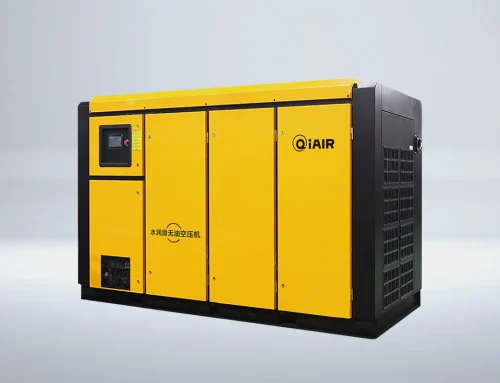
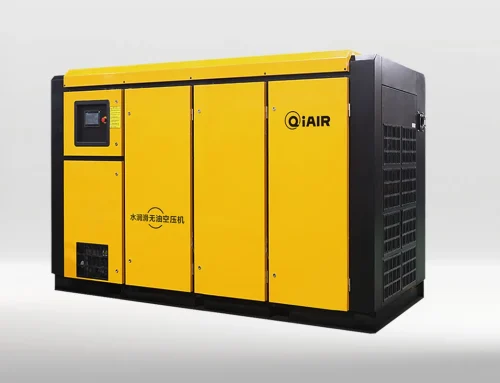
QiAir, a Chinese manufacturer and supplier of screw air compressors, specifies starting methods with export customers as part of the electrical design, not as an afterthought, because the supply authority, the generator capacity, and the start frequency all constrain the choice. The three methods below cover nearly every installation, and the right one follows from how often the machine starts and how much its load varies.
Star-delta: cheap, proven, and spiky
Star-delta starting connects the motor windings in star for the start, reducing voltage per winding to about 58 percent and inrush to roughly a third of direct start, then switches to delta for running. It is inexpensive, uses simple contactors, and has served fixed-speed compressors for decades — which is why it remains the default on many standard machines. Its weakness is the changeover: the brief open transition between star and delta produces a second current spike and a torque dip, and the machine experiences two mechanical shocks per start instead of one.
Star-delta suits machines that start infrequently — a few times per day — on a robust grid supply, where the changeover spike is absorbed without complaint. It suits poorly where starts are frequent, because every start repeats the shock, or where the supply is weak or generator-backed, because the voltage dip at changeover can disturb other equipment. For a small workshop compressor on a solid mains supply, star-delta remains entirely defensible.
Soft starter: smooth ramp, fixed speed afterwards
A soft starter ramps the applied voltage up over several seconds, so current rises gradually and the mechanical shock largely disappears, and it can also ramp down at stop to avoid pressure surges. It costs more than star-delta contactors but far less than a VFD, and it needs no special motor. For a fixed-speed machine that starts often — a load-unload machine cycling through the day — a soft starter noticeably extends coupling, belt and contactor life, and it keeps voltage dip within limits that a generator or a weak rural supply can tolerate.
The limitation is that a soft starter only manages the start: once running, the machine is fixed-speed, so it still unloads and idles at part load, wasting the energy a VFD would save. Buyers sometimes expect soft-starter savings that belong to variable speed; the soft starter saves on starts and mechanical wear, not on running energy. Where the load is steady and starts are the problem, that is the right saving; where the load varies, it leaves the larger saving untouched.
- Star-delta: cheapest, but a changeover spike on every start.
- Soft starter: smooth ramp, good for frequent starts on weak supplies.
- Neither changes running energy — only a VFD does that.
VFD: the start is free, and so is the part-load saving
A variable-frequency drive ramps both voltage and frequency, so the motor accelerates smoothly from zero with inrush barely above full-load current, and there is no changeover spike at all. That alone makes VFD the right choice for generator supplies, weak grids, and machines that start dozens of times a day. But the larger prize is after the start: the VFD matches motor speed to air demand, so a machine at 60 percent demand draws roughly 60 percent power instead of idling at 30 percent while producing nothing.
The premium is real — a VFD machine costs more, needs a clean electrical environment and correct motor insulation for drive duty, and deserves a harmonic check on sensitive supplies. The payback calculation is straightforward, though: model annual energy at the plant's load profile with fixed-speed unloading losses against VFD turndown, and most variable-demand plants repay the premium within one to three years. QiAir supplies VFD machines as the default recommendation for variable-demand export customers, and fixed-speed with soft start where the load is genuinely steady — because the starting method should follow the load, not the catalogue default.
Frequently asked questions
How big is direct-start inrush on a screw compressor?
Typically six to eight times full-load current for a second or two — enough to dim lights, trip breakers and stress couplings on weak supplies.
Is a soft starter as good as a VFD?
For starting, nearly; for energy, no. A soft starter smooths the start but leaves fixed-speed idling losses untouched, while a VFD also saves energy at part load.
When is star-delta good enough?
When the machine starts a few times a day on a robust grid supply. Frequent starts, weak supplies or generator power argue for soft start or VFD.
Related reading
- Screw Compressor Heat Recovery: Turning Waste Heat into Factory Savings
- IoT Monitoring for Screw Compressor Rooms: A China Supplier's Practical Setup
QiAir is a Chinese manufacturer and supplier of screw air compressors. If you are sourcing a screw compressor from China — for a factory, a textile mill, a construction site or a new production line — contact QiAir for a sized quotation, documented performance data and export support.