TL;DR — Direct answer: A wind turbine blade is one of the largest composite parts ever moulded, and compressed air touches it at every stage: holding vacuum-assisted moulds, driving resin infusion, powering trimming and sanding, and feeding the paint booth that finishes a blade tens of metres long. The failure modes are specific and expensive: a pressure dip during infusion leaves dry spots in the laminate, wet or oily air contaminates a bond line, and dust in finishing air shows up as a surface defect on a finished blade. The working system separates those duties, delivers clean dry air at a steady 7 to 8 bar, and sizes infusion and moulding air on the longest blade the plant will build, not on the shortest one it built last year.
A blade hall is hard to grasp until you walk it: moulds longer than a city block, a blade root thick enough to stand in, and a production cycle measured in days rather than minutes. Compressed air in that hall does quiet, critical work that rarely makes the tour — clamping, vacuum assistance, resin transfer, trimming, drilling and the spray booth — and most of it cannot be redone once a mould closes or a resin front stalls.

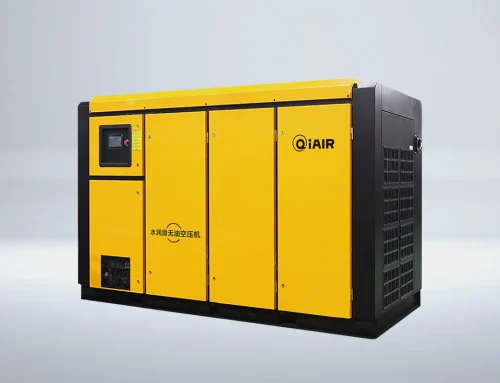
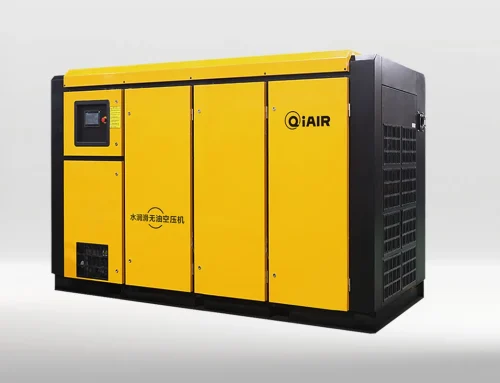
QiAir, a Chinese manufacturer and supplier of screw air compressors, sizes blade-plant systems from the mould schedule and the longest blade on the order book, because a system sized for a 60-metre blade will sag on an 80-metre one at the worst possible moment. The sections below follow the blade from mould to finishing booth.
Moulding and infusion: steady air when the resin front is moving
Resin infusion is the stage where air discipline pays for itself. Vacuum-assisted infusion depends on stable vacuum and on pneumatic valves and clamping that hold the mould sealed while resin advances through metres of reinforcement, and a pressure or vacuum upset mid-infusion can leave dry spots, voids or a resin-starved section that only shows up in inspection or, worse, in service. Infusion air demand is not large in flow terms, but it is unforgiving in stability terms: the header must hold pressure while other hall users cycle, and the receiver and control strategy must bridge those peaks without a dip at the mould.
Mould heating, handling and release also draw air in timed bursts, and the sizing sheet should separate continuous mould-support air from bursty handling and tool air. A VFD machine that follows the hall rhythm across a multi-day mould cycle wastes far less energy than a fixed-speed machine idling through long cure periods, and a ring main sized for the farthest mould bay avoids the classic blade-hall fault: perfect pressure at the compressor room and a sag at the mould that matters. Confirm pressure at the mould, not at the outlet.
Trimming, drilling and composite dust control
Once a blade leaves the mould, trimming, drilling, root machining and sanding turn it into a dust factory. Composite dust — glass and carbon fibre fines — is abrasive, conductive in the case of carbon, and a health and equipment hazard if it reaches the compressor intake or electrical panels. The compressor room needs intake air drawn from outside the dusty finishing area, pre-filtration where dust levels are high, and a cooler-cleaning schedule tied to production volume, because a finishing hall that runs two shifts generates dust at a rate a monthly cleaning schedule cannot match.
Tool air for trimming and drilling is bursty and high-flow at the tool, typically at 6 to 7 bar at the tool itself, and the drops and hose runs to each finishing bay must be sized for that tool at peak, not for an average hand tool. Long hose runs and undersized drops are the usual cause of slow cutting and premature tool wear in blade finishing, and they are fixed by sizing the distribution, not by buying a larger compressor. Where carbon dust is present, electrical equipment and motors in the finishing area need the correct protection and cleaning regime, and the compressor room should be physically separated from the dust source wherever the hall layout allows.
- Draw compressor intake air from outside the composite dust area.
- Size tool drops for the largest trimming tool at peak demand.
- Clean coolers and filters on a production-tied schedule in finishing halls.
Finishing, paint booths and the export checklist
Blade finishing ends in a paint and coating booth, and that is where air quality becomes visible on a product that will face weather for twenty years. Oil, water or particles in booth air cause fisheyes, adhesion failures and coating defects that force rework on a blade that is difficult and expensive to move. Booth air deserves its own treatment train — coalescing filtration, activated carbon for oil vapour, drying to a dew point that holds in booth conditions — with a final filter at the booth inlet and a circuit isolated from finishing-tool peaks, so a trimming burst never starves a spray job mid-coat.
Before ordering from China, a blade manufacturer should document the longest blade and largest mould on the order book, the infusion and moulding air list with coincident demand, finishing tool counts, booth air quality requirements, and hall ambient conditions including dust type. QiAir sizes export blade-plant orders from that sheet, because a compressor quoted for a general composites workshop will not hold infusion stability on a long-blade mould. Get the blade length and mould schedule in writing, and the system that arrives matches the hall that will use it.
Frequently asked questions
Why is air stability so critical during blade infusion?
A pressure or vacuum upset while resin is advancing can leave dry spots and voids in the laminate that are costly to repair and may only appear at inspection.
What air quality do blade paint booths need?
Oil-free or carbon-filtered, dry and particle-filtered air at the booth inlet, isolated from tool peaks, because any contamination shows as a coating defect on a very large part.
How should a blade hall be sized?
On the longest blade and largest mould on the order book, with coincident mould, infusion and finishing demand, and pressure confirmed at the farthest mould bay.
Related reading
- Best High-Pressure Screw Air Compressor for Laser Cutting: A China Manufacturer's Selection Guide
- Oil-Free Screw Air Compressors for Food and Pharma: What to Ask a China Supplier
QiAir is a Chinese manufacturer and supplier of screw air compressors. If you are sourcing a screw compressor from China — for a factory, a textile mill, a construction site or a new production line — contact QiAir for a sized quotation, documented performance data and export support.