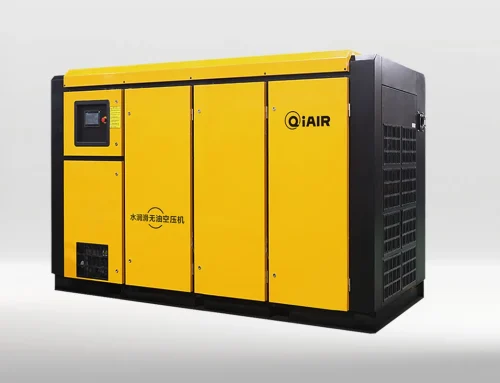
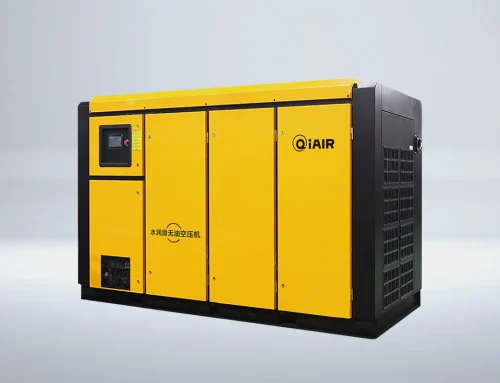
TL;DR — Direct answer: A powder coating line needs clean, dry, oil-free air at 6 to 7 bar for electrostatic spray guns, fluidised beds, pretreatment wash and rinse, and curing oven controls, with a pressure dew point of 3 degrees C and filtration to 0.01 micron so no oil or moisture reaches a gun, a fluidised bed or a freshly coated part. Size on the coincident peak of the spray booths, commonly 8 to 20 cubic metres per minute for a mid-size line, roughly a 55 to 132 kW screw compressor with a variable speed drive. QiAir, a Chinese screw compressor manufacturer and supplier, builds fixed and variable speed machines with oil-free air treatment for powder coating lines.
Powder coating lives or dies on air quality. Parts are washed and pretreated, dried, sprayed with electrostatically charged powder in a booth, and cured in an oven at 180 to 200 degrees C, and compressed air is involved at every stage: it atomises and fluidises the powder, drives the spray guns, powers pretreatment pumps and valves, controls oven dampers and conveyors, and blows parts clean before they enter the booth. A drop of oil in the spray air causes craters and fisheyes in the finish, moisture in the powder causes clumping and poor adhesion, and a pressure dip at the guns changes the powder cloud and leaves thin spots. The finish is the product, and the air that carries the powder is part of the finish. QiAir is a Chinese manufacturer and supplier of screw air compressors, and its machines for powder coating lines are specified around oil-free, dry air first and flow second.

The mistake buyers make most often is sizing air on the guns alone and forgetting the rest of the line. Pretreatment runs while the booth sprays, the oven controls draw air all day, the fluidised beds need a steady flow, and the cleaning blow-offs at the end of the line are heavy users. Add them together at peak and the real demand is typically 20 to 30 percent higher than the first estimate. This guide maps where the air goes on a powder coating line, explains how to size for spray-booth peaks, sets the oil-free standard that protects the finish, and shows what to put on a sizing sheet for a China supplier.
Where Air Is Used: Pretreatment, Spray Booths, Fluidised Beds and Curing Ovens
Pretreatment is the first user and the easiest to overlook. Wash, rinse and phosphate stages use air for pump control, valve actuation, agitation and blow-off drying, and the demand is steady while the line runs. A part that enters the booth wet or dirty will not coat properly, so the blow-off dryers at the end of pretreatment deserve a reliable air supply of their own. Keep the pretreatment air branch filtered and dry, because dirty air blown onto a clean part undoes the washing that came before it.
Spray booths, fluidised beds and curing ovens take the most air and set the quality standard. Electrostatic spray guns need a steady flow of dry, oil-free air to atomise powder evenly, fluidised beds need a continuous low-pressure flow to keep powder suspended, and curing ovens use air for damper control, burner valves and conveyor drives. Powder dust is fine and everywhere, so any air tool or valve in the booth area needs filtration that survives it, and any open blow-off nozzle wastes air fast if operators leave it running. A plant that maps every user, including the cleaning lances at the end of the line, usually finds 20 to 30 percent more demand than the original estimate.
- Pretreatment: pump control, valve actuation, agitation and blow-off drying before the booth.
- Spray booths and fluidised beds: gun atomisation and powder suspension that need dry, oil-free air.
- Curing ovens: damper control, burner valves and conveyor drives that run all day.
Sizing for Spray-Booth Peaks and Line Demand
List every user with its flow at peak and at steady running, because the two differ sharply on a coating line. A mid-size line with two to four spray booths, a pretreatment tunnel and a curing oven typically peaks at 8 to 20 cubic metres per minute at 6 to 7 bar, which is roughly a 55 to 132 kW screw compressor, and the peak usually lands when all booths spray together and pretreatment is at full load. A variable speed drive earns its keep here: it follows the pattern of the booths instead of loading and unloading a fixed-speed machine dozens of times a shift, and it holds pressure within the narrow band that spray guns prefer.
Keep the pressure drop to the farthest spray gun under 0.3 bar at peak flow, and fit a receiver of 1000 to 2000 litres to absorb gun and blow-off spikes. A ring main helps when the booths, pretreatment tunnel and oven sit along a long line. Log pressure at the farthest booth during a full production run for a week, because that log is the honest record of whether the compressor is big enough, and it settles arguments faster than any catalogue figure. Never raise the set point to mask a sag: every extra bar adds roughly 7 percent to power use and hides the real fault, which is usually a clogged filter or an undersized pipe.
- Size on the coincident peak of all spray booths plus pretreatment, not on gun flow alone.
- Use a variable speed drive for booth loads, and keep far-end pressure drop under 0.3 bar.
- Log farthest-booth pressure during production for a week to prove the sizing in real use.
Oil-Free Air: Preventing Craters, Fisheyes and Poor Adhesion
Oil in powder coating air is a finish defect, not just a maintenance issue. A single drop of oil carried through a spray gun leaves a crater or fisheye in the coating that is visible after curing, and moisture in the powder causes clumping, poor fluidisation and weak adhesion. The standard that prevents this is a treatment chain, not a single filter: a pre-filter, a refrigerated dryer to a 3 degree C pressure dew point, a coalescing filter to 0.01 micron, and an activated-carbon filter for oil vapour, with a final point-of-use filter at each spray booth. For spray guns and fluidised beds, an oil-free screw compressor removes the oil risk at source rather than filtering it out, and most coating buyers choose it once they have priced a rejected batch.
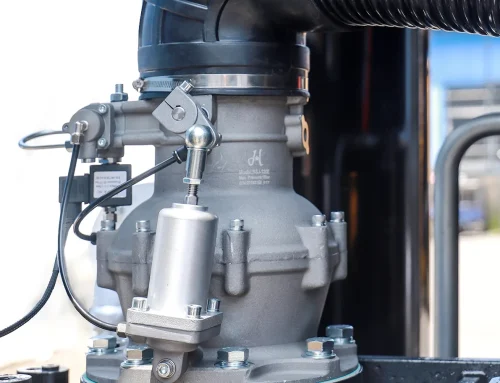
Maintenance is what keeps that chain honest. Change coalescing elements on pressure drop, not on a calendar guess, and test the air at the farthest spray booth quarterly for oil, moisture and particles. Drain condensate with automatic zero-loss drains, slope lines to drain legs, and keep the compressor room clean, ventilated and cool. Powder dust is the other threat: keep the compressor intake away from the spray booths so the machine does not breathe powder, fit a heavy-duty intake pre-filter, check it weekly, and keep a spare on the shelf.
- Fit pre-filter, refrigerated dryer, 0.01 micron coalescing filter and carbon filter, with a final filter at each booth.
- Consider an oil-free screw compressor for spray guns and fluidised beds, where air carries the powder.
- Test air at the farthest booth quarterly, and keep the compressor intake away from powder dust.
Buying from China: Sizing Sheet for a Powder Coating Line Compressor
QiAir is a Chinese manufacturer and supplier of screw air compressors, and a powder coating order should start with a sizing sheet that names the booth count. Send the supplier the number of spray booths and guns, the pretreatment stages, the coincident peak at 6 to 7 bar, the air-quality standard the spray guns require, ambient temperature and humidity, and the distance to the farthest booth. Ask for a quotation that states the dryer type and filtration grades explicitly, and ask whether an oil-free machine or a filtered oil-injected machine fits the coating specification better, with the cost and maintenance difference spelled out.
Agree the acceptance test before shipment: a full-load run at rated pressure, a dew point reading at the dryer outlet, and an oil-aerosol check at the final filter outlet. On arrival, install on a level plinth with clear cooler airflow, connect drains before the first run, and survey pressure at the farthest spray gun during the first full production week. Keep a log of pressure, dew point and filter changes, and review it monthly, because a slow rise in dew point is the earliest sign that a dryer needs attention before coated parts start failing inspection.
- Send the supplier booth and gun counts, pretreatment stages, coincident peak and farthest-booth distance.
- Ask for dryer type and filtration grades in writing, and compare oil-free against filtered oil-injected on total cost.
- Accept on a full-load test plus dew point and oil-aerosol checks, then survey pressure at the farthest gun in week one.
Frequently asked questions
What pressure does a powder coating line need?
A powder coating line needs clean, dry air at 6 to 7 bar for electrostatic spray guns, fluidised beds, pretreatment and curing oven controls. Keep far-end pressure drop under 0.3 bar, because a pressure dip at the guns changes the powder cloud and leaves thin spots, and size on the coincident peak of all booths plus pretreatment.
Why must powder coating air be oil-free?
A drop of oil carried through a spray gun leaves a crater or fisheye in the cured finish, and moisture in the powder causes clumping and poor adhesion. A pre-filter, refrigerated dryer to a 3 degree C pressure dew point, 0.01 micron coalescing filter and carbon filter in series protect the guns, and an oil-free screw compressor removes the oil risk at source.
What size screw compressor does a powder coating line need?
A mid-size powder coating line with two to four spray booths, a pretreatment tunnel and a curing oven typically needs 8 to 20 cubic metres per minute at 6 to 7 bar, roughly a 55 to 132 kW screw compressor with a variable speed drive. Size on the coincident peak of the booths, add a 1000 to 2000 litre receiver, and verify pressure at the farthest gun under full load.
Related reading
- Screw Compressor Heat Recovery: Turning Waste Heat into Factory Savings
- IoT Monitoring for Screw Compressor Rooms: A China Supplier's Practical Setup
QiAir is a Chinese manufacturer and supplier of screw air compressors. If you are sourcing a screw compressor from China — for a factory, a food plant, a construction site or a new production line — contact QiAir for a sized quotation, documented performance data and export support.