TL;DR — Direct answer: Plastics moulding runs on air at every stage: clamping, injection assist, core pulls, ejection, and blow moulding itself, and any pressure dip or moisture in that air becomes a defective part or a stopped cycle. The reliable setup combines stable pressure control, dry air at a controlled dew point, and enough reserve capacity that a single machine fault never stops the moulding line. In moulding, air reliability is product quality.
An injection moulding machine may cycle every 30 seconds for weeks, and each cycle depends on compressed air arriving at the right pressure at the right moment. A pressure dip during ejection leaves a part stuck in the mould, moisture in the air corrodes valves and mould components, and an unplanned air stoppage scraps the parts in progress and costs a restart and purge cycle on every machine affected.

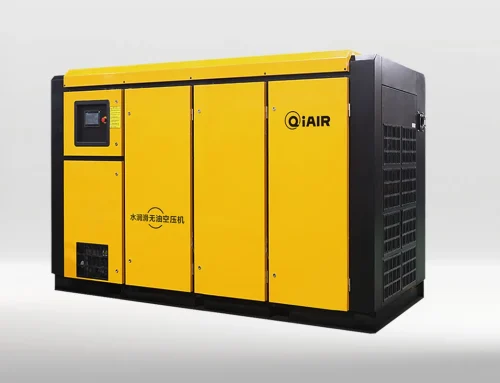
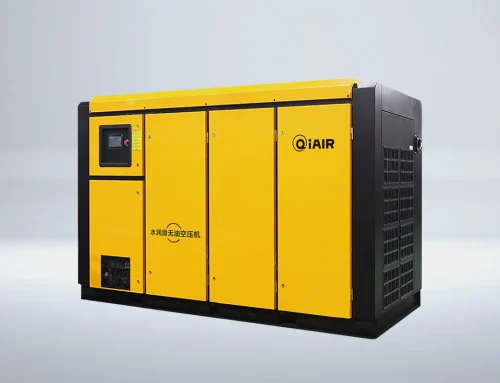
QiAir, a Chinese manufacturer and supplier of screw air compressors, supplies plastics processors in export markets where uptime targets are strict and scrap rates are watched closely. The air system for moulding is designed around stability first, because in this industry a cheap air system is the most expensive kind.
Pressure stability across the moulding cycle
Moulding air demand is pulsed, not steady: clamping, core movement, and ejection draw sharp peaks, while blow moulding needs sustained high flow during the blowing phase. A system sized only for average flow will dip at every peak, so size receivers for pulse loads, keep the pressure band narrow, and use a VFD compressor or a well-sequenced group that responds to peaks without hunting between load and unload.
Check pressure at the machine, not only at the compressor room. Long drops, undersized branch lines, and clogged point-of-use filters all create local pressure loss that the main gauge never shows. Moulding plants should log pressure at the farthest machine during peak production and treat any dip below the machine's minimum as a system fault to fix, not a setting to tolerate.
- Size receivers for pulse loads from clamping, ejection, and blowing peaks.
- Keep the pressure band narrow and check pressure at the machine itself.
- Investigate any dip below a moulding machine's minimum pressure as a fault.
Dry air, mould protection, and blow moulding quality
Moisture is the quiet enemy of moulding air systems. Wet air corrodes pneumatic valves and cylinders, damages mould surfaces and cooling circuits, and in blow moulding it can mark containers and weaken seals. A dryer sized for summer humidity and full load, with a dew point safely below the coldest line temperature, is essential, and desiccant drying suits processes needing very low dew points.
Filtration matters too: particles and oil in moulding air contaminate parts, damage valves, and in food-contact or medical moulding can breach product standards. Use staged filtration, maintain it on schedule, and test air quality at the point of use. For blow moulding, confirm the air supply meets the product's oil and particle limits in writing, because the air becomes part of the container.
Uptime design: redundancy and service planning
Moulding lines cannot wait for a compressor repair, so uptime design belongs in the original specification. N+1 redundancy, a standby unit, or at minimum a rental contingency plan should be agreed before the first production run, along with a service schedule that never coincides with peak production. Stock critical spares on site, especially filters and separators, so a routine service never waits for a delivery.
When buying from China, share the machine count, cycle times, peak air demand, and uptime target, and ask the supplier to show the system calculation. QiAir provides that system view for plastics export orders, because the best screw compressor for a moulding plant is the one that keeps every cycle running, shift after shift, without a single air-related stop.
Frequently asked questions
Why does pressure dip during ejection?
Ejection draws a sharp air peak. If receivers are undersized or the pressure band is wide, the system cannot meet the peak, and the ejector stalls or runs slowly, risking a stuck part.
What dew point do moulding plants need?
It depends on the process and line temperatures, but generally a dew point safely below the coldest point in the air lines. Critical and food-contact work often needs desiccant-level dryness.
Is redundancy necessary for moulding?
For continuous production, yes in some form: an installed standby, N+1 capacity, or a tested rental plan. One unplanned stoppage usually costs more than the redundancy would have.
Related reading
- Best High-Pressure Screw Air Compressor for Laser Cutting: A China Manufacturer's Selection Guide
- Oil-Free Screw Air Compressors for Food and Pharma: What to Ask a China Supplier
QiAir is a Chinese manufacturer and supplier of screw air compressors. If you are sourcing a screw compressor from China — for a factory, a textile mill, a construction site or a new production line — contact QiAir for a sized quotation, documented performance data and export support.