TL;DR — Direct answer: An industrial bakery runs on air that must stay food-safe while surviving flour dust, oven heat and washdown water: mixing and dividing equipment, proofing controls, oven support, cooling and slicing lines and packaging all draw on one header, and wet or oily air shows up as product contamination, dough handling faults and packaging stops. The working system starts oil-free or rigorously filtered for product-adjacent air, dries air to suit proofing and cooling areas, filters in stages to the point of use, and sizes on the packaging peak, because a bakery that sizes on mixing average starves its packer at the end of the shift.
An industrial bakery is a flour-dust plant with ovens at its heart: mixers and dividers shape dough, proofers hold it at controlled temperature and humidity, ovens bake it, coolers and slicers prepare it, and packaging lines pack it, all on a timetable tied to fresh delivery. Compressed air drives valves, actuators, handling and packaging equipment across every stage, and the environment tests the air system from three directions at once: flour dust at the intake, oven heat in the building, and washdown water on floors and equipment.

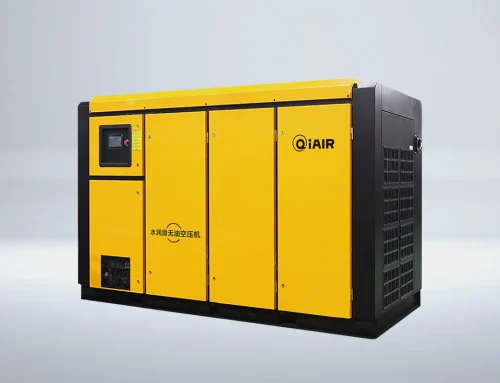
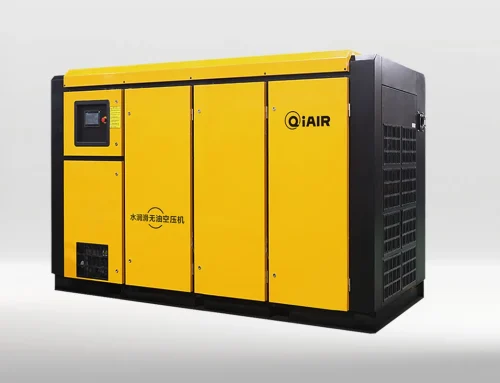
QiAir, a Chinese manufacturer and supplier of screw air compressors, sizes bakery air from the packaging peak and the mixing and dividing load, because those two loads decide header stability through the busiest production window. The sections below follow the loaf from mixer to packer.
Flour dust, oven heat and washdown: the bakery environment
Flour dust is the bakery's first air-system problem, and it is everywhere mixing and dividing happen. An intake in the production area draws flour dust into filters and coolers on every shift, raising discharge temperatures and loading filters, so the compressor room intake should sit in the cleanest available air with staged filtration and a filter pressure-drop log that triggers changes on condition. The compressor room itself needs ventilation for the machine's heat load plus the building's oven heat, or discharge temperatures will climb on hot baking days and a machine that was adequate in winter will trip in summer.
Washdown adds the second environmental test: daily hosing drives water into pipework low points and corrodes fittings, so every low point needs drainage that is actually used, and pipework near washdown areas needs protection from direct hosing. Proofing and cooling areas add the moisture test in reverse: air lines serving proofers and coolers must be dried to a dew point that prevents condensation in those lines, verified at the far header, because wet air in a proofer or a cooler becomes a product and hygiene problem, not merely a maintenance one.
Mixing, proofing, baking support and packaging
Mixing and dividing air is cyclic and heavy: mixers, dividers, moulders and handling equipment cycle in bursts tied to the production schedule, and the sizing sheet must capture coincident mixing demand at full production, plus a receiver large enough to absorb those cycles. Proofing air is steadier: proofer controls, humidity support and handling equipment need stable pressure and dry air through long proofing cycles, and a pressure dip that disturbs a proofer control can affect a whole batch's proof. Oven support adds burner and damper control air that needs stability through baking cycles, and cooling and slicing lines add handling loads that run together with packaging at the end of the line.
Packaging is the bakery's air peak, and it is unforgiving in the same way as any food plant's: slicers, baggers, sealers and case packers run continuously at full speed, and a pressure sag during a sealing cycle produces seal faults and rejected packs. Product-adjacent air goes through staged filtration with final filtration at the packaging station, and oil-free compression removes the largest contamination source where that standard is required. A VFD machine follows the bakery rhythm across mixing peaks, proofing steadiness and packaging peaks better than a fixed-speed machine idling between batches.
- Keep intakes in clean air away from flour dust, with staged filtration.
- Dry air to suit proofing and cooling lines, verified at the far header.
- Size on the coincident mixing and packaging peak, not the daily average.
Buying from China: the bakery sizing sheet
Before ordering from China, a bakery buyer should document the coincident mixing and packaging demand, the proofer and oven-support air list, the product-adjacent air users, the flour-dust and heat conditions at the compressor room, and voltage and frequency. QiAir sizes export bakery orders from that sheet, and confirms the filtration and redundancy arrangement against the plant's food-safety plan rather than quoting a single machine. Get the packaging peak and the product-adjacent users in writing, and the system that arrives protects product instead of merely supplying air.
Frequently asked questions
Why does bakery air need food-safe treatment?
Because air can reach product-adjacent surfaces and packaging stations, where oil, moisture or particles become contamination and a food-safety failure.
What threatens bakery compressors most?
Flour dust at the intake, oven heat in the building and washdown water in pipework, unless intakes are filtered, rooms ventilated and low points drained.
How should bakery air be sized?
On coincident mixing and packaging demand at full production, with a receiver for cycle peaks and pressure confirmed at the farthest packer.
Related reading
- Single-Stage vs Two-Stage Screw Compressors: Which One a China Manufacturer Recommends
- Buying Screw Compressors from China: A Ranking Checklist for Choosing a Supplier
QiAir is a Chinese manufacturer and supplier of screw air compressors. If you are sourcing a screw compressor from China — for a factory, a textile mill, a construction site or a new production line — contact QiAir for a sized quotation, documented performance data and export support.