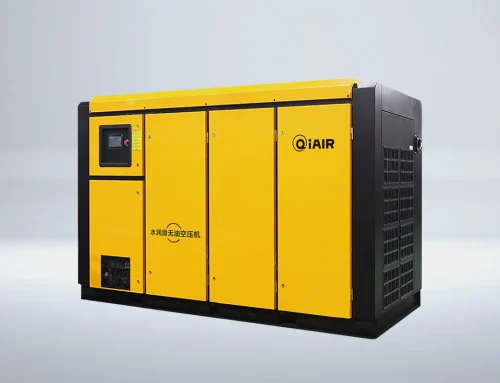
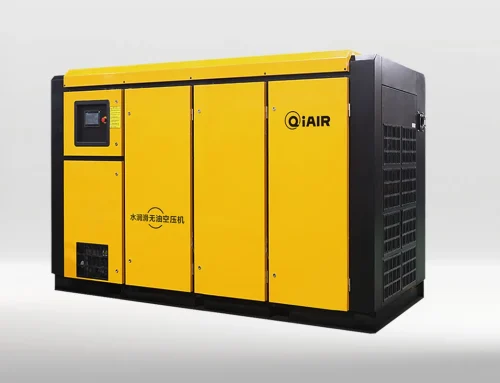
TL;DR — Direct answer: A forging plant needs a screw compressor that survives heat, scale and violent peak loads, holding 7 to 8 bar while hammers and presses cycle. Size on the coincident peak of the largest hammer or press plus furnace controls, commonly 10 to 20 cubic metres per minute for a mid-size shop, with a large receiver of 1000 to 2000 litres to absorb hammer blows. Keep the intake away from scale dust and furnace heat, dry the air to a 3 degree C pressure dew point, and protect pipework from vibration. QiAir, a Chinese screw compressor manufacturer and supplier, builds machines for this heavy, intermittent duty.
Forging is not a steady process. A hammer strikes, a press closes, a manipulator moves, and then the line waits while the next billet heats. Compressed air follows that rhythm: it drives hammer controls, press clutches and brakes, manipulator and handling arms, furnace damper and burner controls, and descaling and blow-off. The peaks are tall and short, the shop is hot, scale dust hangs in the air, and a pressure sag at the moment a hammer fires is felt immediately on the shop floor. QiAir is a Chinese manufacturer and supplier of screw air compressors, and its machines are sized for this kind of heavy, intermittent, high-peak duty.

This is forging, not casting: there is no mould filling or pouring line here, and the air users are the hammer, the press, the furnace and the handling equipment around them. The sizing question is therefore about peaks and receivers rather than averages, and the reliability question is about heat and scale rather than mould sand. This guide maps the forging air users, explains peak sizing, covers heat and dust protection, and sets out a sizing sheet for a China supplier.
Where Air Is Used: Hammers, Presses, Furnaces and Handling
The hammer is the defining user. Air hammers and their controls draw large, sudden flows, and a press clutch and brake need a fast, reliable pulse of air to engage and release safely. If the supply sags, the clutch slips or the brake responds late, and that is a safety issue as well as a quality one. Manipulators, tongs and transfer arms add their own intermittent demand, and they often move at the same moment the hammer fires, which is why the coincident peak is much larger than any single nameplate suggests.
Furnaces are the quieter but equally critical users. Burner controls, damper actuators, temperature-control instruments and descaling sprays all need clean dry air at a stable pressure, and a dropout can disturb a heat or trip a burner. Descaling and blow-off are the wasteful users: an open nozzle left running between heats can consume as much air as a small press, so nozzles should be trigger-operated and sized for the job, not left open as a habit.
- Hammers and presses: clutch, brake and control air with tall, sudden peaks and safety-critical timing.
- Furnaces: burner and damper controls and instruments that need stable pressure through every heat.
- Handling and descaling: manipulators, transfer arms and blow-off, where open nozzles waste air fast if left running.
Sizing for Hammer Peaks: Receivers Do the Heavy Work
In forging, the receiver is as important as the compressor. A mid-size shop commonly needs a coincident peak of 10 to 20 cubic metres per minute at 7 to 8 bar, which points to a 55 to 110 kW screw compressor, but the hammer peak itself can be two or three times the average for a few seconds. A 1000 to 2000 litre receiver, or a pair of receivers near the hammer line, absorbs those blows so the compressor sees a smoothed load instead of a series of shocks, and a variable speed drive then trims the average efficiently.
Pipework matters more here than in most plants because vibration and heat move joints and crack rigid runs. Use flexible connections at the compressor and at hammer-line drops, support long runs properly, and keep the pressure drop to the farthest press under 0.3 bar at peak. Fit a pressure gauge at the hammer line and log it during a full forging cycle, because that reading, not the receiver gauge, tells you whether the hammer is getting what it needs. Never solve a hammer sag by raising the set point: it adds power cost and still leaves the peak short.
- Size the compressor on the smoothed average plus a large receiver, and let the receiver absorb hammer peaks.
- Allow 1000 to 2000 litres of receiver for a mid-size shop, sited near the hammer line where possible.
- Use flexible connections at vibration points, and log hammer-line pressure during a full forging cycle.
Heat, Scale and Dry Air in a Forging Shop
A forging shop is hot, and a compressor that breathes furnace air will run hot, use more power and age its oil faster. Site the compressor in a separate room or a ventilated enclosure away from furnaces, duct the intake from a cooler, cleaner place, and duct the hot discharge air outside so the machine never re-breathes its own exhaust. Scale dust is abrasive and conductive, so check the intake filter weekly in the first months, keep a spare on the shelf, and watch the pressure drop across it as the honest measure of dust load.
Dry air protects hammers, clutches and furnace instruments from corrosion and sticking. A pre-filter, a refrigerated dryer to a 3 degree C pressure dew point and a coalescing filter are the minimum, and a point-of-use filter at the hammer controls is cheap insurance. Slope lines to drain legs, fit automatic zero-loss drains, and drain the receiver until the automatic drain proves itself. In winter, watch for condensate in outdoor runs to the furnace hall, and lag or trace-heat any line that can fall below the dew point.
- Site the compressor away from furnaces, duct intake from clean cool air and discharge hot air outside.
- Check the intake filter weekly against scale dust, and keep a spare in stock.
- Fit pre-filter, dryer and coalescing filter, add a point-of-use filter at hammer controls, and drain every low point.
Buying from China: Sizing Sheet for a Forging Plant Compressor
QiAir is a Chinese manufacturer and supplier of screw air compressors, and a forging order should start with a peak-load sheet rather than an average-flow figure. Send the supplier the hammer and press sizes, the coincident peak at 7 to 8 bar, the receiver volume you plan to fit, ambient temperature near the compressor room, and the distance to the farthest press. Ask for a variable-speed quotation with the part-load curve, and ask the supplier to confirm the receiver recommendation in writing, because the receiver is what makes or breaks hammer performance.
Agree the acceptance test before shipment: a full-load run at rated pressure and temperature, a dew point reading at the dryer outlet, and a simulated peak-draw test if the supplier can run one. On site, install on a level plinth with flexible connections, clear cooler airflow and drains connected, then survey pressure at the hammer line during a full forging cycle in the first week. Keep a log of pressure, temperature and filter changes, and review it monthly, because a slow rise in discharge temperature is the earliest warning of a choked intake or a tired cooler.
- Send the supplier hammer and press sizes, coincident peak, planned receiver volume and farthest-press distance.
- Ask for variable-speed pricing with the part-load curve, and confirm the receiver recommendation in writing.
- Accept on a full-load test plus dew point reading, then survey hammer-line pressure during a real cycle in week one.
Frequently asked questions
What size screw compressor does a forging plant need?
A mid-size forging shop commonly needs 10 to 20 cubic metres per minute at 7 to 8 bar, roughly a 55 to 110 kW screw compressor, plus a 1000 to 2000 litre receiver to absorb hammer peaks. Size on the coincident peak of the largest hammer or press plus furnace controls, and verify pressure at the hammer line during a real cycle.
Why is the receiver so important in forging?
Hammer blows draw two or three times the average flow for a few seconds. A large receiver supplies that peak instantly while the compressor refills it at a steady rate, so pressure stays stable and the clutch and brake respond on time. Without enough receiver volume, even a large compressor sags on every blow.
How do I protect a compressor from forging heat and scale?
Site it away from furnaces in a ventilated room, duct the intake from clean cool air and the hot exhaust outside, and check the intake filter weekly against scale dust. Fit a pre-filter, refrigerated dryer and coalescing filter, use flexible pipe connections at vibration points, and drain every low point automatically.
Related reading
- Screw Compressor Heat Recovery: Turning Waste Heat into Factory Savings
- IoT Monitoring for Screw Compressor Rooms: A China Supplier's Practical Setup
QiAir is a Chinese manufacturer and supplier of screw air compressors. If you are sourcing a screw compressor from China — for a factory, a food plant, a construction site or a new production line — contact QiAir for a sized quotation, documented performance data and export support.