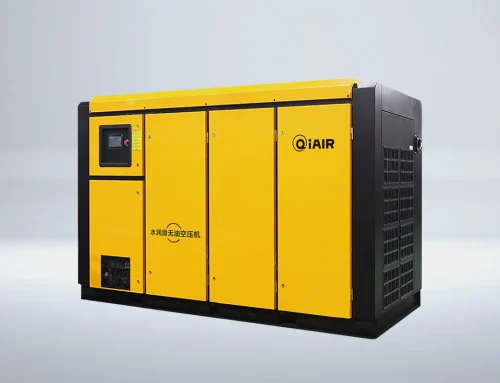
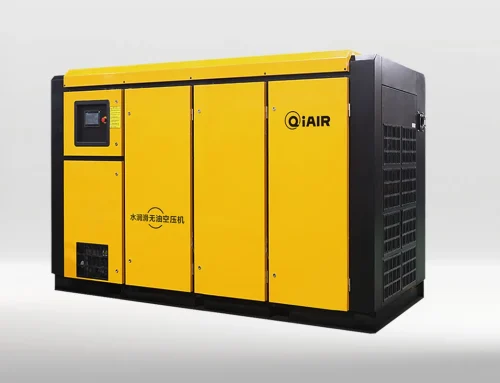
TL;DR — Direct answer: A cement plant needs a screw compressor that holds 7 to 8 bar through kiln, raw mill, pneumatic conveying and packing peaks, with a pressure dew point near 3 degrees C and filtration that survives cement dust. Size on the coincident peak of the largest conveying and packing loads, allow 1000 litres of receiver per 10 cubic metres per minute, and place the intake and dryer away from raw-mill dust. For a mid-size plant this is commonly a 75 to 160 kW machine, and a variable speed drive pays back fast where kiln and packing loads swing across the shift. QiAir, a Chinese screw compressor manufacturer and supplier, sizes machines for this duty.
Cement production is a continuous process that forgives very little. The kiln does not pause, the raw mill feeds it without a break, and packing lines run until the silo or the shift says stop. Compressed air sits behind all of it: it drives slide gates and diverter valves, pulses bag filters, feeds pneumatic conveying, operates kiln burner controls and packing-machine actuators, and cleans instruments that must stay accurate in a dusty hall. A pressure dip at the wrong moment can stall a conveying line, blind a filter or stop a packer, and restarting a choked line costs far more than the air that would have prevented it. QiAir is a Chinese manufacturer and supplier of screw air compressors, and its machines are built for the heat, dust and long hours of cement production.

This is about cement production, not mining: the kiln, the raw mill, the grinding and blending halls, and the packing and dispatch lines. Each area has its own air profile, and the plant-wide peak comes from two or three of them coinciding. This guide maps those users, shows how to size for the real peak, explains how to keep cement dust out of the air system, and sets out what to put on a sizing sheet for a China supplier.
Where Air Is Used: Kiln, Raw Mill, Conveying and Packing
The kiln area is the most critical user. Burner controls, kiln drive auxiliaries, slide gates and instrument air all need clean dry air at a stable pressure, and a dropout can trip a burner or blind an analyser. Raw mills add their own load: bag-filter pulse cleaning, gate and valve actuation, and conveying air for raw meal. Pulse cleaning is short and sharp, so it creates the tallest peaks in the plant, and a compressor that is sized only on average flow will sag every time a filter pulses across several compartments at once.
Pneumatic conveying and packing are the volume users. Dense-phase and dilute-phase conveying move raw meal, clinker and cement between silos and mills, and the air must arrive at a steady pressure or the line slugs and blocks. Packing machines, palletisers and truck-loading spouts use air for weighing, filling, sealing and dust extraction control. Dispatch peaks in the morning and late afternoon, so the compressor sees its hardest hours when the kiln is already at full load, which is exactly why the coincident peak, not the average, decides the size.
- Kiln and burner controls: instrument air and gate actuation where a pressure dip can trip equipment.
- Raw mill and bag filters: pulse cleaning with short sharp peaks, plus conveying air for raw meal.
- Conveying and packing: steady pressure for material transport, weighing, filling, sealing and dispatch.
Sizing for a Plant That Never Really Stops
Start with a user list per area, with flow, pressure and duty cycle for each, then add the users that genuinely coincide. In a mid-size cement plant the coincident peak is commonly 12 to 25 cubic metres per minute at 7 to 8 bar, which points to a 75 to 160 kW screw compressor, often with a variable speed drive to follow the packing and conveying swings. Keep a 15 to 20 percent margin for filter-pulse peaks and for a future packing line, and put the margin in the receiver and the header as well as in the compressor, because a large receiver is what absorbs a pulse peak without a pressure sag.
Pressure discipline matters in a long plant. Run a ring main where the layout allows, keep the drop to the farthest packer under 0.3 bar at peak, and fit a pressure gauge and a test point at each major area so a problem can be located in minutes. A 1000 litre receiver per 10 cubic metres per minute is a good starting point, and a second receiver near the packing hall often pays for itself by smoothing dispatch peaks locally. Do not solve a pressure problem by raising the compressor set point: every extra bar adds roughly 7 percent to power use and hides the real fault, which is usually a clogged filter or an undersized pipe.
- Size on the coincident peak of kiln, conveying and packing loads, with 15 to 20 percent margin for pulse peaks.
- Use a ring main and a receiver near the packing hall, and keep the far-end drop under 0.3 bar at peak flow.
- Do not raise the set point to mask a fault; find the clogged filter, leak or undersized pipe instead.
Cement Dust, Heat and Dry Air
Cement dust is fine, alkaline and abrasive, and it finds every gap in a compressor room. Site the compressor in a separate room with a clean intake, ducted from outside the raw-mill hall if possible, and keep the room under slight positive pressure with filtered air. Check the intake filter twice as often as the manual suggests in the first months, because actual dust load in a cement plant is almost always higher than the catalogue assumption, and a choked intake raises discharge temperature and shortens oil life.
Dry air protects the whole downstream system. A refrigerated dryer to a 3 degree C pressure dew point, a pre-filter and a coalescing filter are the minimum, and instrument air for kiln analysers deserves its own final filter and, where the analyser specifies it, a desiccant dryer. Slope air lines to drain legs, fit automatic drains at every low point, and drain the receiver daily until the automatic drain proves itself. Hot ambient air in the compressor room is the other enemy: keep the room ventilated, duct hot discharge air outside, and check that the compressor never breathes its own hot exhaust.
- Site the compressor in a separate room with a clean, ducted intake and filtered positive-pressure ventilation.
- Fit pre-filter, refrigerated dryer and coalescing filter, with a desiccant dryer for kiln instrument air if specified.
- Vent hot air outside, drain every low point automatically, and inspect intake filters more often than the manual says.
Buying from China: Sizing Sheet for a Cement Plant Compressor
QiAir is a Chinese manufacturer and supplier of screw air compressors, and a cement-plant order should begin with a one-page sizing sheet. List the coincident peak flow at 7 to 8 bar, the pulse-cleaning peaks, the highest-pressure user, ambient temperature and dust level in the compressor room, and the distance and pipe route to the packing hall. Ask for fixed-speed and variable-speed quotations with annual energy at your real load profile, and ask the supplier to state the receiver size, dryer duty and filter grades in the quotation rather than as an afterthought.
Agree the acceptance test before shipment: a full-load run at rated pressure and temperature, a dew point reading at the dryer outlet, and a documented pressure-drop check. On site, install with clear cooler airflow, a level plinth and drains connected before the first start, then survey pressure at the kiln instruments and the farthest packer during the first full production week. Keep a log of pressure, temperature, filter changes and dryer performance, and review it monthly, because a slow drift in any one of them is the earliest warning of a coming failure.
- Send the supplier coincident peak flow, pulse-cleaning peaks, ambient dust and temperature, and far-end distance.
- Compare fixed and variable speed on annual energy at the real load profile, and confirm receiver and dryer duty in writing.
- Accept on a full-load test plus dew point reading, then survey kiln and packer pressure in the first production week.
Frequently asked questions
What size screw compressor does a cement plant need?
A mid-size cement plant commonly needs 12 to 25 cubic metres per minute at 7 to 8 bar, roughly a 75 to 160 kW screw compressor. Size on the coincident peak of kiln, conveying and packing loads, allow 1000 litres of receiver per 10 cubic metres per minute, and verify pressure at the farthest packer under full load.
Why does pressure sag when bag filters pulse?
Pulse cleaning draws short, sharp peaks, and if several compartments pulse together the instantaneous demand can exceed the compressor output. A larger receiver, a ring main and a 15 to 20 percent sizing margin absorb those peaks, while a variable speed drive recovers faster than a fixed-speed machine.
How do I protect a compressor from cement dust?
Site it in a separate room with a clean ducted intake and filtered ventilation, check intake filters far more often than the manual suggests, and keep the room from breathing its own hot exhaust. Fit a pre-filter, refrigerated dryer and coalescing filter, with a desiccant dryer for sensitive kiln instrument air.
Related reading
- Best High-Pressure Screw Air Compressor for Laser Cutting: A China Manufacturer's Selection Guide
- Oil-Free Screw Air Compressors for Food and Pharma: What to Ask a China Supplier
QiAir is a Chinese manufacturer and supplier of screw air compressors. If you are sourcing a screw compressor from China — for a factory, a food plant, a construction site or a new production line — contact QiAir for a sized quotation, documented performance data and export support.