TL;DR — Direct answer: A paint and coatings plant runs on process air, not spray air: mixers, dispersers and bead mills, let-down and tinting stations, and filling lines for cans, pails and drums all draw on one header, and a pressure dip during a dispersing run or a filling cycle produces an off-spec batch or a filling fault that stops the line. This article covers process air for manufacturing only, not spray-booth application, which is a separate system with its own design. The working system delivers dry, clean, stable air at 7 to 8 bar, sized on the coincident dispersing and filling peak, with solvent-aware ventilation and housekeeping built into the compressor room.
Paint and coatings manufacturing moves from raw pigment and resin to a filled, labelled can in stages that all use air: high-speed dispersers and bead mills, mixing and let-down vessels, tinting and quality-control stations, and filling lines that handle everything from small cans to bulk drums. The plant handles solvents and fine pigment dust, so the air system must be reliable and the compressor room must be ventilated and kept clear of solvent vapour and dust accumulation. A disperser that loses air mid-run leaves a batch half-dispersed, and a filler that starves at full speed produces short fills across a whole run.

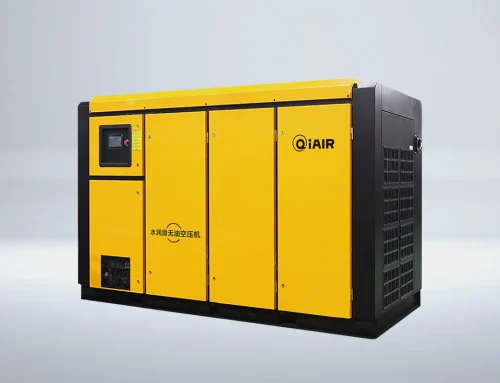
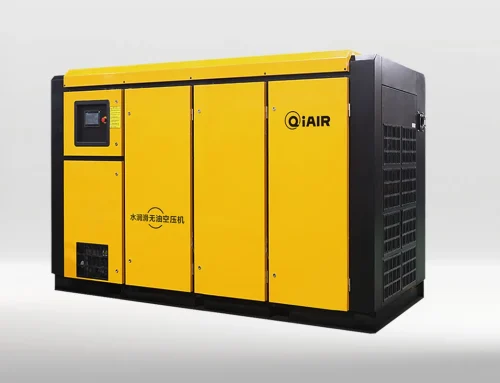
QiAir, a Chinese manufacturer and supplier of screw air compressors, sizes coatings-plant air from the coincident dispersing and filling peak, because those two loads decide whether the header holds pressure through the busiest production hour. The sections below follow the paint from disperser to drum.
Mixing, dispersing and milling: the steady heavy load
Dispersing is the coatings plant's defining air load: high-speed dispersers, bead mills and mixers run for hours per batch, cycling valves, actuators and vessel controls, and several dispersers running together produce a coincident demand far above any single machine's average. The load is steady rather than bursty, but it is long, and a pressure dip that slows a disperser control or a vessel valve during a run disturbs a batch that cannot be recovered by simply restarting the disperser. A VFD screw compressor follows that mixed rhythm across dispersing runs, let-down and tinting better than a fixed-speed machine idling between batches.
Pigment dust and resin handling add the environmental test. Fine pigment dust loads intake filters and point-of-use filters, and it finds its way into any unprotected opening, so intake placement in the cleanest available air, staged intake filtration and a filter pressure-drop log are the baseline. Moisture matters too: water in process air contaminates water-based coatings and disturbs solvent-based formulations alike, so the pressure dew point must suit the coldest line in the plant and be verified at the farthest filling station.
Filling lines and the solvent-aware compressor room
Filling is the plant's air peak: can, pail and drum filling lines, capping and labelling equipment and palletisers run together at full speed, and a pressure sag during a filling cycle produces short fills, cap faults and rejected containers. The sizing sheet must list every filling user, its flow at working pressure and which lines truly run together at full production, plus a receiver of 1,500 to 3,000 litres on a mid-size plant to absorb filling-cycle peaks, with header pressure confirmed at the farthest filler.
The compressor room needs solvent awareness. Solvent vapours must be kept out of the compressor intake, the room needs ventilation that follows the plant's local solvent-handling rules, and electrical and ventilation arrangements around solvent areas must meet the plant's own safety assessment rather than being assumed from a standard compressor installation. This article covers manufacturing process air only: spray-booth application air, with its own atomisation, filtration and safety requirements, is a separate system and must be specified separately. A plant that confuses the two buys the wrong system for both jobs.
- Size on coincident dispersing and filling demand at full production.
- Keep solvent vapour and pigment dust out of the compressor intake.
- Keep process air and spray-booth application air as separate systems.
Tinting, quality control and the small-batch peak
Tinting and quality control add a different rhythm to a coatings plant: small batches, frequent colour changes and short runs that cycle valves, dosing pumps and sampling equipment in bursts throughout the shift. Each tinting station draws air in short, sharp patterns, and several stations tinting at once produce a coincident peak that a sizing sheet built only on large dispersing runs will miss. The sheet must list every tinting and dosing user, its flow at working pressure and which stations truly run together during a colour-change window, because a header that sags during tinting produces dosing errors and off-colour batches.
Quality-control stations add precision loads of their own: viscosity testing, drawdown and sample preparation equipment need clean, dry, stable air, and a test result must be repeatable, so a test station fed by a sagging header produces measurements the laboratory cannot trust. A receiver near the tinting and laboratory area absorbs dosing peaks, and header pressure logging during a busy colour-change window proves whether the system holds where colour accuracy is decided.
Buying from China: the coatings sizing sheet
Before ordering from China, a coatings buyer should document the coincident dispersing and filling demand, the process-air user list, the required pressure at the farthest filler, the solvent and dust conditions at the compressor room, and voltage and frequency, while confirming separately whether any spray-booth scope exists outside this process-air order. QiAir sizes export coatings orders from that sheet, and confirms the intake and ventilation arrangement against the plant's safety assessment rather than quoting a single machine. Get the filling peak and the solvent conditions in writing, and the system that arrives supports manufacturing without crossing into a duty it was never designed for.
Frequently asked questions
Is this the same air system as a spray booth?
No. This article covers manufacturing process air for mixing, dispersing and filling; spray-booth application air is a separate system with its own atomisation, filtration and safety design.
Why does coatings air need to be so dry?
Because moisture contaminates both water-based and solvent-based formulations and disturbs filling, so dew point must suit the coldest line and be verified at the farthest filler.
How should coatings air be sized?
On coincident dispersing and filling demand at full production, with a receiver for filling cycles and pressure confirmed at the farthest filler.
Related reading
- How to Choose the Best Screw Air Compressor Manufacturer in China for Your Factory
- Two-Stage PM VFD Screw Compressors: How a Top China Supplier Cuts Factory Energy Costs
QiAir is a Chinese manufacturer and supplier of screw air compressors. If you are sourcing a screw compressor from China — for a factory, a textile mill, a construction site or a new production line — contact QiAir for a sized quotation, documented performance data and export support.