TL;DR — Direct answer: A combined-cycle power plant treats compressed air as safety and revenue infrastructure, not as a workshop service: instrument air keeps gas and steam turbine controls, valves and safety systems alive, starting air or starting support gets gas turbines turning, and utility air serves maintenance across a plant that earns money only while it generates. The failure that matters is not a slow tool but a turbine that cannot start or a control valve that loses air mid-load, and both argue for the same design: duty-and-standby instrument air with tested changeover, dryers delivering a dew point below the coldest line temperature, and a compressor system sized for turbine-start peaks on top of continuous instrument demand. In a power plant, air reliability is measured in megawatts, not in workshop convenience.
A combined-cycle plant runs a precise choreography — gas turbines, heat recovery steam generators, steam turbines, all balanced against grid demand — and compressed air is woven through every part of it. Control valves modulate on instrument air, turbine auxiliaries depend on utility air, and a gas turbine start sequence has air-dependent steps that must complete in order and on time. When air fails in a power plant, the consequence is not a delayed job but a lost start, a forced outage, or a unit that trips off the grid.

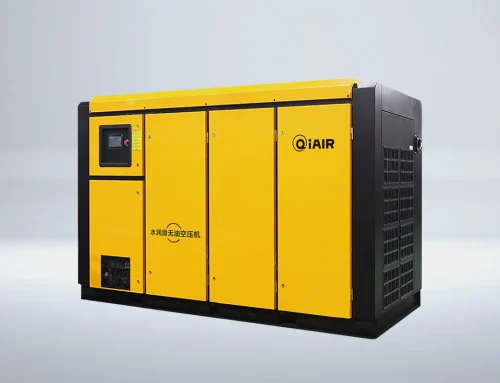
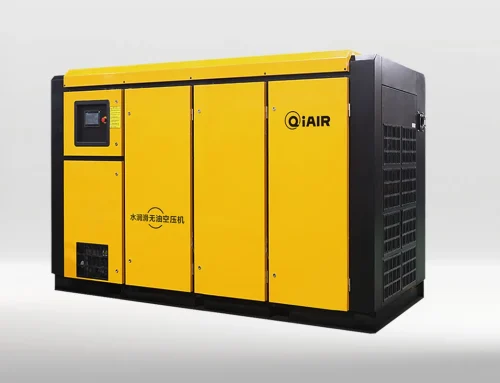
QiAir, a Chinese manufacturer and supplier of screw air compressors, sizes power-plant air from the turbine start sequence and the instrument load together, because a system sized for instrument air alone will sag when a turbine start stacks its air users on top. The sections below keep those two loads in view throughout.
Instrument air: the plant nervous system, with no single point of failure
Instrument air in a combined-cycle plant drives control valves, actuators, analysers and safety systems across gas turbines, steam systems and balance-of-plant equipment, and its quality and continuity requirements are the strictest in the plant. Air must be oil-free or carbon-filtered, dry to a dew point below the coldest temperature any instrument line will see, and particle-filtered to protect delicate valve positioners. A single oil or moisture excursion can stick a control valve or distort an analyser reading, and in a power plant that kind of fault shows up as a load or emissions problem, not as a compressor alarm.
Redundancy is not optional for instrument air: duty-and-standby machines, each able to carry the full instrument load, with automatic changeover and duplex dryer and filter trains so one train can be serviced while the other runs. Changeover must be tested regularly under load, because a standby machine that has sat idle through a long base-load run may have a flat battery, a seized drain or a stale controller fault. The receiver should bridge a changeover without a pressure dip at the farthest control valve, and instrument air pressure should be monitored at the farthest user, not just at the compressor outlet, with alarms that reach the control room before operators notice a valve behaving strangely.
Gas turbine starts: peak air on top of continuous load
Gas turbine starting is the peak that separates power-plant air design from ordinary industrial design. A start sequence draws air for cranking support, fuel-gas valve operation, auxiliaries and purge steps in a timed order, and the air system must deliver that peak while continuous instrument air keeps running without a dip. Sizing on instrument load alone guarantees a sag during a start, and a sag during a start can abort the sequence, waste a start attempt, and delay synchronisation to the grid — a costly failure measured in lost generation, not in maintenance hours.
The honest sizing method lists the start-sequence air users, their flow and timing, on top of the continuous instrument and utility load, and sizes the compressor and receiver for the combined peak. A receiver of 3,000 litres or more is common on mid-size combined-cycle instrument systems, because it absorbs start peaks and bridges changeover, and a VFD or staged multi-machine system follows the plant from base load through start peaks without idling wastefully between starts. Where a turbine needs a specific starting-air pressure above the instrument header, a dedicated circuit or booster beats pressurising the whole instrument system for one user.
- Size instrument air plus the full turbine-start peak together, never instrument air alone.
- Test duty-to-standby changeover regularly under real load.
- Monitor instrument pressure at the farthest control valve, with control-room alarms.
Reliability, maintenance and the export checklist
Power-plant maintenance is planned around availability, and the air system should be maintained on the same logic: condition monitoring on discharge temperature, vibration and oil condition, trending that catches a fouled cooler or a tired separator weeks before a trip, and service intervals tied to running hours and start counts rather than to the calendar alone. Spares on site should cover the items that stop an instrument system — filters, separators, drains, service kits, control components — and the service arrangement should be measured in hours, because a power plant without instrument air cannot generate, and every hour offline is grid revenue lost.
Before ordering from China, a power-plant buyer should document the turbine types and start sequences, the instrument air load with the farthest user, required pressure and dew point, ambient conditions, and voltage and frequency. QiAir sizes export power-plant orders from that sheet, and confirms redundancy, dryer and filtration scope in writing, because a compressor quoted as a general industrial machine will not meet a power plant instrument specification. Get the start sequence and the instrument load in writing, and the system that arrives protects the megawatts it serves.
Frequently asked questions
Why is instrument air redundancy standard in power plants?
Because instrument air drives control and safety valves; losing it can trip a unit off the grid, so duty-standby machines with tested changeover are the norm.
How should turbine-start air be sized?
On the full start-sequence peak stacked on top of continuous instrument and utility load, with a receiver large enough to absorb the start without a pressure dip.
What air quality do power-plant instruments need?
Oil-free or carbon-filtered, dry to a dew point below the coldest line temperature, and particle-filtered to protect valve positioners and analysers.
Related reading
- Single-Stage vs Two-Stage Screw Compressors: Which One a China Manufacturer Recommends
- Buying Screw Compressors from China: A Ranking Checklist for Choosing a Supplier
QiAir is a Chinese manufacturer and supplier of screw air compressors. If you are sourcing a screw compressor from China — for a factory, a textile mill, a construction site or a new production line — contact QiAir for a sized quotation, documented performance data and export support.