TL;DR — Direct answer: A modern logistics warehouse runs on compressed air in ways that are easy to overlook until they stop: sortation diverters firing thousands of times a shift, dock doors and levellers cycling with every truck, pallet wrappers and carton sealers running at pack-out, and automated storage systems whose pneumatic actuators must respond in milliseconds. The air demand is bursty, distributed across a very large building, and unforgiving of pressure sag, because a sorter that misses a divert sends a parcel to the wrong lane. The right system is sized on simultaneous sorter and dock demand, delivered through a ring main that holds pressure at the farthest aisle, and buffered by a receiver that rides through dispatch peaks.
A distribution centre at peak dispatch looks quiet from the compressor room, but the air system is working harder than in many factories: hundreds of pneumatic actuators across sorters, conveyors, doors and packaging lines, spread over tens of thousands of square metres, all drawing in short bursts tied to parcel flow. The failure mode is distinctive: pressure holds at the compressor outlet while the farthest sorter sags, and the symptom appears as mis-sorts and slow doors, not as a compressor alarm.

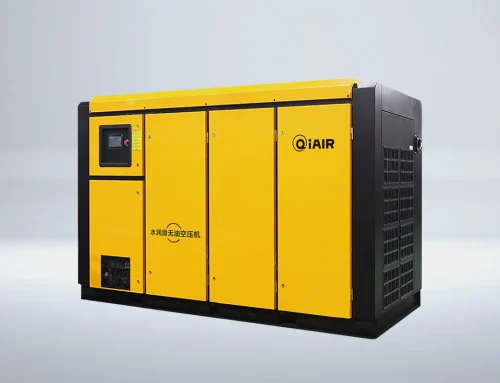
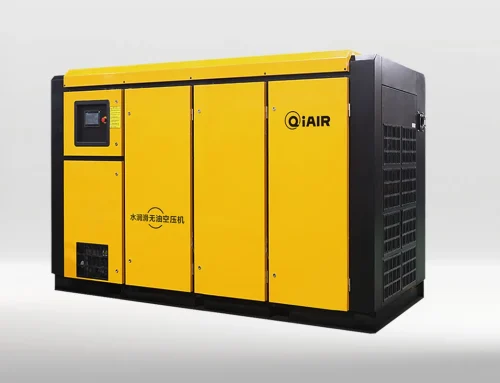
QiAir, a Chinese manufacturer and supplier of screw air compressors, sizes warehouse systems from the building's layout and its dispatch peak, because a warehouse is a distribution problem before it is a compressor problem. The sections below follow the air across that distance.
Sortation and automation: bursty demand across a large building
Sortation demand is bursty by nature: diverters, pushers and tilt trays fire in clusters as parcels arrive, then idle between waves, and the coincident peak during a dispatch wave dwarfs the average across a shift. Sizing must therefore start from the sorter supplier's air consumption at peak throughput — actuators per sorter, cycles per minute, and how many sorters run together — plus conveyor and automated storage demand, then add 15 to 20 percent for leaks and future lanes. A system sized on average sorter demand will sag on every peak wave.
Pressure loss across a large warehouse is the second sizing factor. A header that is adequate for a compact factory loses measurable pressure over 100 metres or more, so warehouse mains should be sized as ring mains with adequate bore, drops sized for the actuator at the end of each run, and pressure verified at the farthest sorter during a peak wave, not at the compressor room. Where a warehouse adds a new sortation zone, the main should be rechecked, because a zone added to an undersized main starves every zone on it.
- Size sortation air on peak-wave simultaneous actuators, not shift average.
- Use a ring main sized for the farthest sorter at peak throughput.
- Verify pressure at the farthest aisle during a dispatch peak.
Dock doors, levellers and packaging: the dispatch-peak load
Dock equipment is the warehouse's other coincident load: doors, levellers, vehicle restraints and dock seals cycle together when trucks arrive in a batch, and a dispatch peak can stack door cycles, sorter waves and packaging lines at the same hour. Packaging air — carton sealers, pallet wrappers, labellers and strapping machines — adds a steady load at pack-out that should be in the same calculation, because pack-out and dispatch peaks overlap by design.
A receiver of 2,000 litres or more on a mid-size distribution centre absorbs the combined dock and sorter surge, and a VFD machine follows the warehouse's daily rhythm — quiet nights, intense dispatch windows — better than a fixed-speed machine idling through the night. Dry, filtered air matters for dock and packaging equipment too: moisture in a dock-door valve in winter causes sluggish operation, and oil in packaging air contaminates cartons and film, so coalescing filtration and drying to a dew point suited to the building's conditions belong in the base design, not as an upgrade.
Layout, growth and the export buying check
Warehouse air systems should be designed for growth, because a distribution centre that adds sortation lanes or dock doors every year will outgrow a system sized exactly for opening day. Leave header capacity and receiver headroom for the next zone, document the air balance per zone so a new zone's demand can be added without guessing, and site the compressor room centrally where possible to shorten the longest run. A central plant room with a well-sized ring main beats a corner plant room with a long, lossy main, even where the corner looks convenient on a floor plan.
Before ordering from China, a warehouse operator should document sorter and actuator counts, peak-wave throughput, dock door and leveller counts, packaging-line demand, building dimensions and the farthest drop distance, and required pressure at that drop. QiAir sizes export warehouse orders from that sheet, because a compressor quoted without the building's length and its dispatch peak in the calculation will hold pressure in the plant room and lose it in the farthest aisle. Get the layout in writing, and the system that arrives holds pressure where parcels actually move.
Frequently asked questions
Why do sorters mis-sort when air pressure sags?
Sortation actuators need full pressure to fire on time. A sag delays or weakens a divert, sending a parcel to the wrong lane, even while pressure at the compressor looks normal.
How should a warehouse air system be sized?
On peak-wave simultaneous sorter actuators plus dock and packaging demand, with a ring main sized for the farthest aisle and a receiver to absorb dispatch peaks.
Should warehouse air systems allow for growth?
Yes. Leave header and receiver headroom for new sortation lanes and dock doors, and document air demand per zone so growth can be added without guessing.
Related reading
- Single-Stage vs Two-Stage Screw Compressors: Which One a China Manufacturer Recommends
- Buying Screw Compressors from China: A Ranking Checklist for Choosing a Supplier
QiAir is a Chinese manufacturer and supplier of screw air compressors. If you are sourcing a screw compressor from China — for a factory, a textile mill, a construction site or a new production line — contact QiAir for a sized quotation, documented performance data and export support.