
TL;DR — Direct answer: A soft drink and juice plant needs oil-free, food-grade air at 6 to 7 bar for filling, capping and packaging, plus high-pressure air at 30 to 40 bar for PET bottle blowing, with a minus 20 degree C pressure dew point and 0.01 micron filtration. Size on the coincident peak of the blowing machines and the filling lines, 6 to 12 cubic metres per minute, roughly a 45 to 90 kW screw compressor. QiAir, a Chinese screw compressor manufacturer and supplier, builds oil-free machines for beverage plants.
A soft drink or juice bottle starts as a small PET preform and ends as a sealed, labelled bottle on a pallet, and every step in between depends on air that cannot carry oil, moisture or particles. Preforms are heated and blown into bottles, juice and carbonated drinks are filled, caps are applied and sealed, labels are fixed, and finished cases are packed and palletised. Compressed air drives bottle blowing machines, filling valves, capping heads, labellers and packaging lines. QiAir is a Chinese manufacturer and supplier of screw air compressors, and its machines for beverage plants are specified around oil-free, food-grade air first.
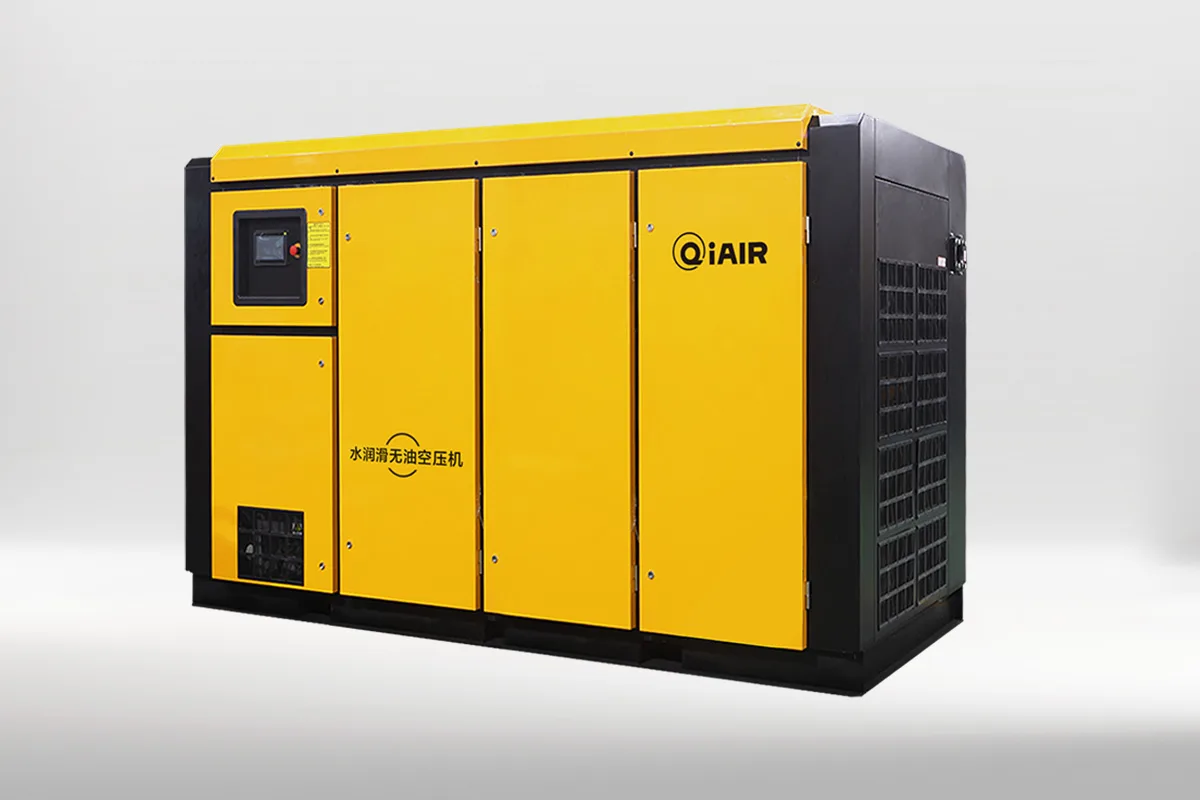
The common sizing mistake is counting the filling lines alone and forgetting bottle blowing. Filling lines draw air steadily, PET blowing machines need a large volume of high-pressure air at every blow, capping heads pulse at every bottle, and packaging lines use air for case handling and palletising. This guide maps where the air goes, explains how to size for blowing and filling peaks, sets the oil-free air standard that protects drinks and consumers, and shows what to put on a sizing sheet for a China supplier.
Where Air Is Used: PET Blowing, Filling, Capping and Packaging
PET bottle blowing is the heaviest user, and it works at a different pressure from the rest of the plant. Preforms are heated and stretched into bottles by high-pressure air at 30 to 40 bar, using a large volume at every blow, while low-pressure air at 6 to 7 bar runs the stretch rods, mould clamping and bottle handling. A pressure dip at a blowing machine changes bottle wall thickness, and a thin-walled bottle collapses on the filling line or leaks at the cap.
Filling, capping, labelling and packaging take the rest. Juice and carbonated drinks are filled through valves, caps are applied and torqued, labels are fixed and checked, and finished bottles are packed into cases and palletised. Filling air must stay free of oil and particles, because air that contacts the drink or the inside of the bottle becomes part of the product itself.
- PET bottle blowing: high-pressure air at 30 to 40 bar for blowing, plus 6 to 7 bar air for stretch rods and moulds.
- Filling and capping: filling valves, cap application, torqueing and seal checks.
- Labelling and packaging: labellers, date coders, case packers and palletisers.
Sizing for Blowing Machines and Filling Line Peaks
List every machine and line with its flow at peak and at steady running, keeping high-pressure and low-pressure demand separate. A mid-size plant with two to four PET blowing machines and two to four filling lines typically peaks at 6 to 12 cubic metres per minute of low-pressure air at 6 to 7 bar, roughly a 45 to 90 kW screw compressor, plus a high-pressure booster for the 30 to 40 bar blowing air. Size the booster on the blowing peak alone, since blowing air cannot be borrowed from the filling supply.
Keep the pressure drop to the farthest filling line under 0.2 bar at peak flow, tighter than general industry, because filling valves and capping heads are sensitive to pressure change, and fit a receiver of 500 to 1000 litres per 10 cubic metres per minute on the low-pressure side to absorb filling spikes. Log pressure at the farthest filling line for a week of full production: that log is the honest record of whether the compressor is big enough.
The high-pressure booster deserves its own sizing note, because PET blowing is the most energy-hungry part of a beverage plant. A booster fed by a dry, filtered low-pressure supply lasts longer and uses less power than one fed by wet air, so place the dryer and filters before the booster inlet, not after it. Ask the supplier for the booster power at the blowing peak in writing, and check that the low-pressure compressor still has enough capacity left for the filling lines when the booster draws its full inlet flow.
- Size low-pressure air on the coincident peak of the filling lines, and size the blowing booster on the blowing peak alone.
- Keep far-end pressure drop under 0.2 bar at the filling lines, with a variable speed drive for mixed loads.
- Log farthest-line pressure during production for a week to prove the sizing in real use.
Oil-Free, Food-Grade Air: Protecting Drinks and Consumers
Oil and moisture are the two contaminants that ruin a beverage batch, and both are invisible until a bottle fails testing. A trace of oil in filling air changes the taste of a juice, moisture in a blowing machine leaves spots inside a bottle, and damp air in a capper corrodes the capping heads. The fix is oil-free air at source: an oil-free screw compressor, a desiccant dryer to a minus 20 degree C pressure dew point, filtration to 0.01 micron with an activated-carbon filter for oil vapour, and a final point-of-use filter at each filling line.
Food-grade discipline applies to the whole air system. Site the compressor in a clean, ventilated room away from syrup and sugar dust, use stainless steel pipework downstream of the final filter so rust cannot reach the lines, and test line air regularly for oil, moisture and particles. Keep the test results with the batch records for each product, since auditors will ask for them during a food safety inspection.
- Use an oil-free screw compressor for beverage production, where air contacts bottles, caps and the drink itself.
- Fit a desiccant dryer to minus 20 degrees C and 0.01 micron filtration, with a final filter at each filling line.
- Use stainless pipework after the final filter, and test line air regularly for oil, moisture and particles.
Buying from China: Sizing Sheet for a Beverage Plant Compressor
QiAir is a Chinese manufacturer and supplier of screw air compressors, and a beverage order should start with a sizing sheet that names the line count. Send the supplier the number of PET blowing machines, filling lines, capping heads and packaging lines, the low-pressure peak at 6 to 7 bar and the high-pressure blowing demand at 30 to 40 bar, the air-quality class the filling lines require, ambient temperature and humidity, and the distance to the farthest filling line.
Agree the acceptance test before shipment: a full-load run at rated pressure, a dew point reading at the dryer outlet, a particle count at the final filter outlet, and an oil-aerosol check, with the ISO 8573-1 class confirmed in writing. On arrival, install on a level plinth with clear cooler airflow, connect drains before the first run, and survey pressure and dew point at the farthest filling line during the first full production week.
- Send the supplier blowing machine, filling line and capping head counts, both pressure levels and farthest-line distance.
- Ask for an oil-free machine quotation with dryer type, filtration grades and ISO 8573-1 class in writing.
- Accept on a full-load test plus dew point, particle count and oil-aerosol checks, then survey the farthest line in week one.
Frequently asked questions
What pressure does a soft drink and juice plant need?
A soft drink and juice plant needs oil-free, food-grade air at 6 to 7 bar for filling, capping and packaging, plus high-pressure air at 30 to 40 bar for PET bottle blowing. Keep far-end pressure drop under 0.2 bar at the filling lines, because a pressure dip changes filling volume, and size the blowing booster on the blowing peak alone.
Why must beverage manufacturing air be oil-free?
A trace of oil in filling air changes the taste of a juice, moisture in a blowing machine leaves spots inside a bottle, and damp air in a capper corrodes the capping heads. An oil-free screw compressor removes the oil risk at source, with a desiccant dryer to minus 20 degrees C and 0.01 micron filtration downstream.
What size screw compressor does a beverage plant need?
A mid-size soft drink and juice plant with two to four PET blowing machines and two to four filling lines typically needs 6 to 12 cubic metres per minute of low-pressure air at 6 to 7 bar, roughly a 45 to 90 kW screw compressor with a variable speed drive, plus a high-pressure booster for 30 to 40 bar blowing air. Add a 500 to 1000 litre receiver per 10 cubic metres per minute, and verify pressure and dew point at the farthest filling line under full load.
Related reading
- Screw Air Compressor Maintenance Checklist from a China Manufacturer
- How to Size a Screw Compressor: Air Demand Calculation Before You Buy from China
QiAir is a Chinese manufacturer and supplier of screw air compressors. If you are sourcing a screw compressor from China — for a factory, a food plant, a construction site or a new production line — contact QiAir for a sized quotation, documented performance data and export support.