
TL;DR — Direct answer: A smartphone plant typically runs 7 to 8 bar, 5 to 15 m3/min, on 37 to 110 kW rotary screw compressors, with a 3°C pressure dew point dryer and 0.01 micron filtration protecting SMT lines, camera modules and test rigs from moisture and oil. QiAir, a Chinese screw compressor manufacturer and supplier, sizes systems with clean, stable air so precision assembly never suffers a pressure dip.
Smartphone manufacturing packs more precision into one building than almost any other industry. SMT lines place thousands of components per hour, robotic arms assemble glass and frames to hairline tolerances, and camera modules are aligned under microscopes. Nearly every one of those machines uses compressed air for clamping, pick-and-place, blowing and testing.
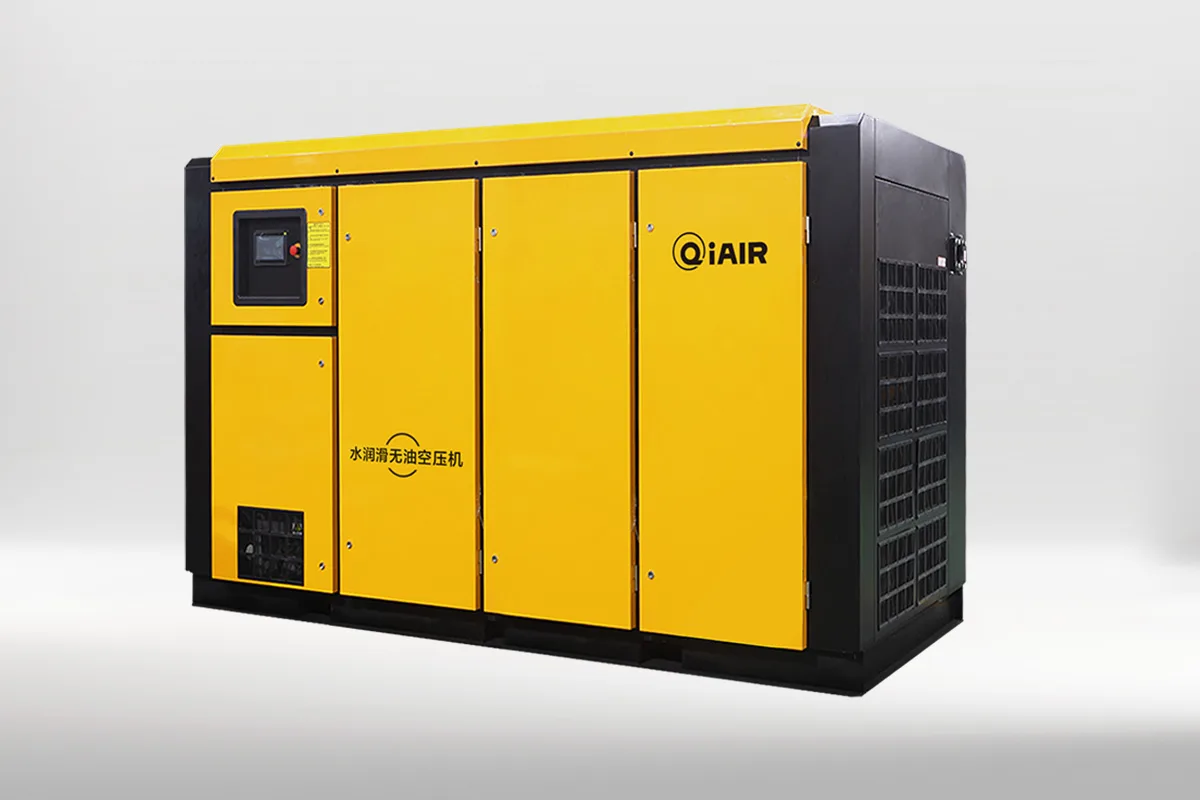
The volumes are modest but the quality demands are extreme. Smartphone plants therefore treat compressed air as a process input, with filtration and drying specified as carefully as the solder paste and the cleanroom itself.
SMT Lines and Precision Assembly Air Demand
An SMT line with four placement machines and two reflow ovens will usually draw 1.5 to 3 m3/min, mostly in short bursts from nozzle changers, feeder advances and board handling. Each burst is small, but dozens of machines cycling together create a pulsing load that a fixed-speed compressor chases all day. A variable-speed drive machine follows the pulses smoothly and holds the header within 0.3 bar.
Robotic assembly cells add a steadier demand. Grippers, vacuum generators and air bearings run continuously while phones move between stations, and a pressure sag slows the whole cell because every robot waits for the same vacuum signal. Size the header for the simultaneous operation of all cells, and put a pressure regulator at each cell so a distant station cannot steal air from its neighbour.
Board handling and cleaning use air in a different way. Ionised air blowers remove dust from PCBs before placement, and a weak blower leaves particles that become solder defects. Keep the blower branch filtered to 0.01 micron and dried to a 3°C pressure dew point, and check the ioniser balance weekly so static never builds up on sensitive components.
- Size for simultaneous nozzle changes across SMT lines
- Regulate pressure at each robotic assembly cell
- Filter ionised blower air to 0.01 micron
Camera Modules, Displays and Cleanroom Air
Camera module assembly is the cleanest corner of a smartphone plant. Lens alignment, sensor bonding and module testing happen in cleanrooms where even a speck of oil vapour can fog a lens or coat a sensor. The compressed air here must be oil-free at the point of use, filtered to 0.01 micron, and dried to a low dew point.
Display bonding uses pneumatic pressure to laminate glass, polarisers and touch panels without bubbles or dust. A pressure fluctuation during lamination leaves a visible defect in the finished screen, and a moisture spot under the glass cannot be repaired. Give the bonding line its own dryer and filtration branch, separate from general plant air, and monitor its dew point continuously.
Cleanroom air systems and process air are not the same thing, but they share the compressor room. Keep the compressor intake away from cleanroom exhaust and chemical storage, and use stainless or coated pipework on clean branches so corrosion never sheds particles into the air. A carbon filter stage removes the last traces of oil vapour before the air reaches the cleanroom.
- Use oil-free point-of-use air for camera modules
- Give display bonding its own dryer and filtration branch
- Use coated pipework on all cleanroom air branches
Testing, Packaging and Pneumatic Handling
End-of-line testing is where air quality becomes a pass-or-fail issue. Phones are pressure-tested for water resistance, speakers and microphones are tested with air-coupled signals, and connectors are checked under pneumatic load. Test air carrying moisture or oil contaminates seals and skews results, so test benches need their own fine filtration and a small local dryer.
Packaging lines run fast and use air everywhere. Carton erectors, labelling heads and case packers cycle hundreds of times per hour, and a slow pneumatic cylinder is enough to jam the line. The load is steady rather than spiky, so a fixed-speed compressor can serve packaging well, but keep it on the same variable-speed system and the plant gains redundancy for free.
Vacuum handling deserves its own note. Suction cups and vacuum generators consume large volumes of air for every phone they lift, and a plant moving thousands of units per hour can spend more air on handling than on assembly.
- Give test benches their own fine filtration and dryer
- Keep packaging air steady with a dedicated regulator
- Use central vacuum for high-volume phone handling
Buying from China: Sizing Sheet for Smartphone Plants
Before requesting a quotation, gather four numbers: the SMT line count and simultaneous nozzle-change demand, the cleanroom and camera module flow, the test-bench air quality specification, and the distance from the compressor room to the furthest cleanroom. A supplier that quotes from total installed power alone will miss the filtration specification entirely.
For most smartphone plants the practical range is a 37 to 90 kW variable-speed drive screw compressor at 7.5 or 8 bar, with a refrigerated dryer, 0.01 micron filtration, carbon adsorption and a 2,000 to 3,000 litre receiver. Larger plants with several SMT halls usually run a duty-plus-standby pair so maintenance never stops a production line.
When comparing Chinese suppliers, ask for the full package price including dryer, filters, receiver and commissioning spares, and confirm the export packing, voltage and documentation for your country. Check the filter element life, the service interval and the availability of filters and airends through the supplier's export channel. QiAir, a Chinese screw compressor manufacturer and supplier, quotes the complete package so buyers compare real installed cost.
- Collect a 15 minute peak load profile before quoting
- Budget 37 to 90 kW VSD plus dryer and carbon filtration
- Confirm spares, voltage and export packing in writing
Frequently asked questions
What pressure do smartphone plants normally run?
Most run 7 to 8 bar at the header, regulated down to 6 bar at SMT lines and 5 to 6 bar at cleanroom tools, so placement machines and robots see stable pressure all shift.
Do camera modules need oil-free air?
Yes, at the point of use. Oil vapour can fog lenses and coat sensors, so camera module lines need oil-free filtration to 0.01 micron plus a carbon adsorption stage.
Why does SMT need such stable pressure?
Nozzle changers and feeders cycle hundreds of times per hour, and a 0.5 bar sag changes placement timing enough to cause missed picks and solder defects. A variable-speed drive compressor holds the header steady.
Can packaging share air with cleanroom tools?
They can share a compressor room, but give cleanroom and bonding lines their own dryer and filtration branch, so packaging dust and moisture never reach precision tools.
Related reading
- Screw Air Compressor Maintenance Checklist from a China Manufacturer
- How to Size a Screw Compressor: Air Demand Calculation Before You Buy from China
QiAir is a Chinese manufacturer and supplier of screw air compressors. If you are sourcing a screw compressor from China — for a factory, a food plant, a construction site or a new production line — contact QiAir for a sized quotation, documented performance data and export support.