
TL;DR — Direct answer: Underground mining asks compressed air to do heavy work in the worst place on the mine: drilling and bolting machines that demand high flow at the face, ventilation and dust-suppression support, and refuge and workshop air, all delivered through kilometres of pipe in dust, heat, humidity and vibration. The failure mode is not subtle: pressure loss down a long decline leaves a drill starved at the face, and a compressor failure underground stops production across every heading it feeds. Size on face demand at the farthest heading, protect intakes against mine dust, and build redundancy into the surface plant, because the mine cannot wait for a repair crew to reach a machine.
A working face underground runs on air in a way surface visitors rarely appreciate. Rock drills, bolters, loaders and shotcrete equipment all draw on it, ventilation doors and dust suppression depend on it, and the workshop and refuge chambers need it as a safety utility. The compressor plant usually sits on surface, and the air travels down shafts and declines through pipework that loses pressure with every metre, every bend and every leak. The drill at the face feels all of that loss, and it feels it as slow penetration and stalled production.
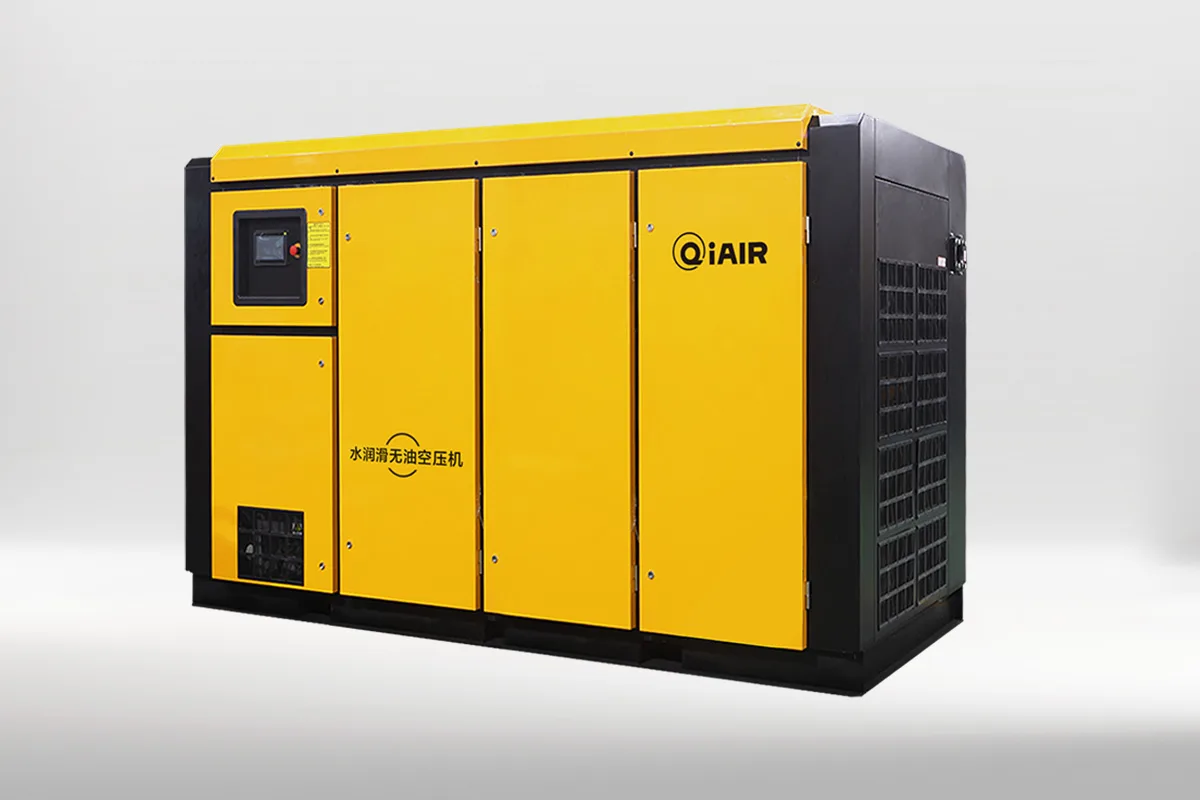
QiAir, a Chinese manufacturer and supplier of screw air compressors, sizes mining air from the face equipment list and the decline layout, because a machine quoted for a surface workshop will not hold pressure at a face two kilometres down a decline. The sections below start at the face and work back to the surface plant.
Drilling and face air: flow at the farthest heading
Drilling air is the governing load, and it is high-flow and bursty. A single rock drill can draw several cubic metres per minute at 7 bar or more at the drill itself, and a heading with two drills, a bolter and a loader running together stacks those flows into a coincident peak that dwarfs the mine average. The sizing sheet must list every face machine, its rated air consumption at working pressure, and which headings run together on the same shift, because a mine that sizes on average face demand will starve the farthest heading whenever two headings drill at once. Pressure must be confirmed at the face, not at the surface outlet, and that test should be repeated as headings advance and pipe runs lengthen.
Distribution underground is the harder half of the design. Long declines, shaft piping, moisture and leaks all cut pressure, and a leak underground is harder to find and fix than the same leak on surface. Ring mains where the layout allows, drops sized for the largest drill at peak, receivers near active headings to absorb drill-cycle peaks, and a disciplined leak survey are worth more than a larger surface machine. Wet air is a second problem: moisture in face air accelerates drill wear and freezes in cold sections, so drying and drainage at the surface plant and at underground receivers must handle the real water load, not a catalogue figure.
Ventilation support, dust and the underground environment
Ventilation support air is a different duty from drilling air, and it must not be allowed to compete with it. Ventilation doors, regulators, dust-suppression sprays and monitoring equipment need stable, lower-flow air that arrives even when drilling peaks, so the design should separate or prioritise ventilation and safety air from production drilling air. A ventilation door that fails to close because a drill burst starved the header is a ventilation failure, not a minor pressure event, and the mine ventilation plan should name which air users are safety-critical and what pressure they must hold during a drilling peak.
Dust, heat and humidity underground punish equipment that would last years on surface. Mine dust is abrasive and coats cooler fins and intake filters, heat and humidity load dryers and raise discharge temperatures, and vibration from nearby operations loosens fittings. Surface compressor rooms need intake air drawn from the cleanest available location, pre-filtration where dust levels are high, and cooler cleaning tied to production rather than to the calendar. Underground receivers and drops need drainage, corrosion protection and inspection access, because a receiver that cannot be drained or inspected will corrode quietly until it becomes a safety finding.
- Confirm pressure at the farthest face during a full drilling shift.
- Separate or prioritise ventilation and safety air from drilling peaks.
- Survey underground leaks regularly: long pipe runs hide the losses.
Reliability, redundancy and the export buying check
Reliability underground is measured in production hours, because a surface compressor failure stops every heading on its header at once. That argues for duty-and-standby capacity at the surface plant with automatic changeover, a service arrangement measured in hours, and spares on site covering filters, separators, drains and service kits. Changeover should be tested monthly under load, and the mine should hold a written plan for which headings keep running and which pause if one machine is lost, so a failure becomes a managed reduction rather than a site-wide stop.
Before ordering from China, a mining buyer should document the face equipment list with coincident demand, heading depths and pipe lengths, the ventilation and safety air list, required pressure at the farthest face, dust and humidity conditions, and voltage and frequency. QiAir sizes export mining orders from that sheet, and confirms whether any equipment sited underground or near hazardous areas needs special certification for the mine. Get the face list and the decline layout in writing, and the plant that arrives holds pressure where the drills actually work.
Frequently asked questions
Why does drilling air sag at the face?
Long declines and shaft pipework lose pressure with distance, bends and leaks, so a system sized at the surface outlet without a face-pressure check starves the farthest heading.
What pressure do underground drills need?
Typically 7 bar or more at the drill itself. Size on coincident drills and bolters at peak, with pressure confirmed at the face during a full shift.
Should ventilation air share the drilling header?
Only with separation or priority: ventilation and safety air must hold pressure even during drilling peaks, or a drill burst becomes a ventilation failure.
Related reading
- Screw Air Compressor Maintenance Checklist from a China Manufacturer
- How to Size a Screw Compressor: Air Demand Calculation Before You Buy from China
QiAir is a Chinese manufacturer and supplier of screw air compressors. If you are sourcing a screw compressor from China — for a factory, a textile mill, a construction site or a new production line — contact QiAir for a sized quotation, documented performance data and export support.