
TL;DR — Direct answer: A plastic injection moulding plant needs clean, dry air at 6 to 8 bar for mould clamping, ejectors, core pulls, robots and resin drying, with a pressure dew point of 3 degrees C and filtration to 0.01 micron so no oil or moisture reaches a mould cavity, a robot gripper or a resin hopper. Size on the coincident peak of the moulding machines and robots, 4 to 10 cubic metres per minute for a mid-size plant, roughly a 30 to 75 kW screw compressor with a variable speed drive. QiAir, a Chinese screw compressor manufacturer and supplier, builds fixed and variable speed machines with dry-air treatment for injection moulding plants.
An injection moulding plant is a cycle of short, sharp air demands. Moulds clamp shut, plastic is injected, cores pull, ejectors push the part out, robots lift it away, and the cycle repeats every few seconds. Compressed air drives the ejectors, core pulls, mould safety interlocks, robots and part-handling grippers, and it feeds the desiccant dryers that dry hygroscopic resin before moulding. A pressure dip at the ejector leaves a part stuck in the mould, moisture in the drying air leaves splay marks and bubbles in the part, and oil on a mould cavity shows up as a stain on every part until the mould is cleaned. The air system is part of the moulding quality, not just a utility. QiAir is a Chinese manufacturer and supplier of screw air compressors, and its machines for moulding plants are specified around dry air and cycle stability first and flow second.
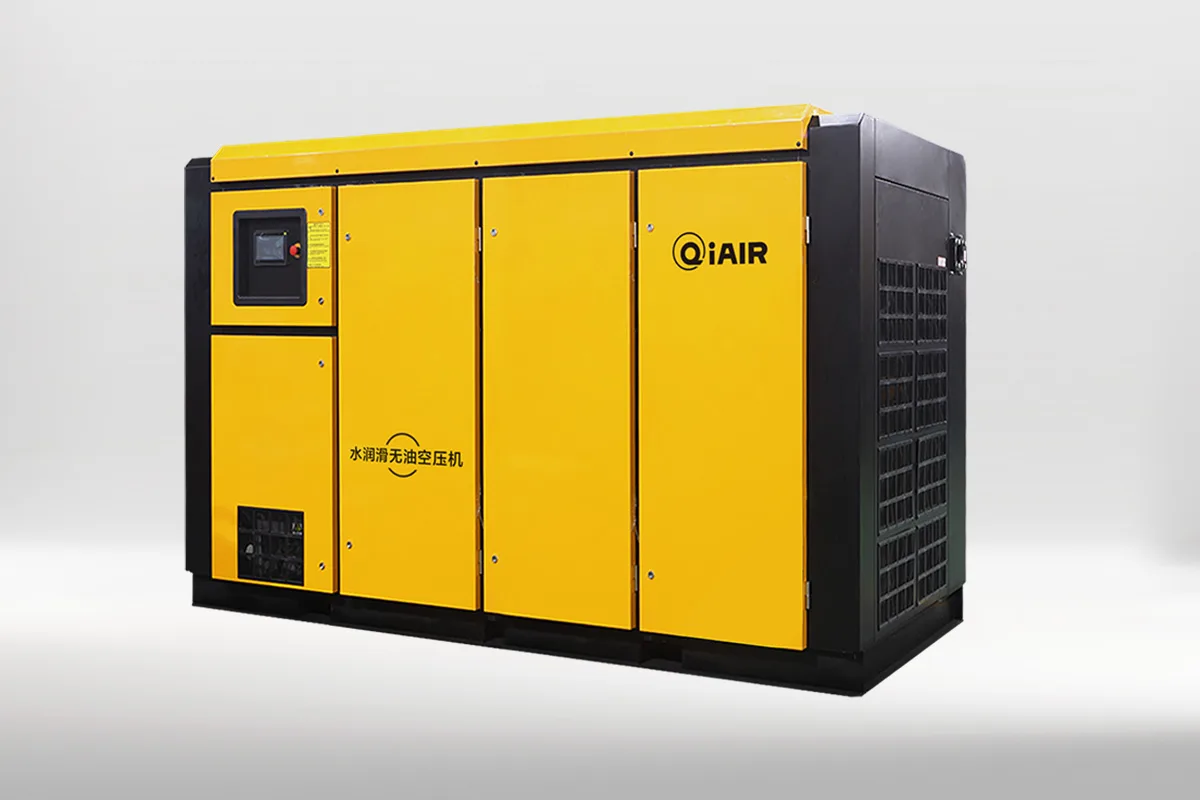
The mistake buyers make most often is sizing air on the moulding machines alone and forgetting the robots, the resin dryers and the auxiliary equipment. Each machine draws air in pulses tied to its cycle, robots draw air at every pick and place, and a desiccant dryer for PET or nylon consumes a steady purge flow all day. Add them together at peak and the real demand is typically 20 to 30 percent higher than the first estimate. This guide maps where the air goes in an injection moulding plant, explains how to size for moulding cycles and robot peaks, sets the dry-air standard that protects resin and moulds, and shows what to put on a sizing sheet for a China supplier.
Where Air Is Used: Mould Clamping, Ejectors, Robots and Resin Drying
Moulding machines are the steadiest users. Each machine uses air for mould clamping safety, ejector plates, core pulls, mould protection sensors and pneumatic valves, and the demand follows the machine cycle, pulsing every few seconds. A plant with ten to thirty machines sees those pulses add up at the header, and the peak lands when many machines eject at the same moment. Keep the pressure at the machine within a narrow band, because a dip at the ejector leaves a part in the mould and stops the cycle, and a dip at a core pull can bend a core pin and damage a mould worth far more than the air system.
Robots, resin dryers and auxiliaries take the rest of the air. Take-out robots use it for grippers, vacuum cups and wrist rotation, desiccant dryers for hygroscopic resins such as PET, nylon and PC use a steady purge flow, and granulators, conveyors and mould temperature controllers use it for valves, blow-offs and cleaning. PET preform blowing is a special case: stretch blow moulding needs high-pressure air at 30 to 40 bar, which a standard 7 to 8 bar screw compressor cannot supply alone, so a booster compressor is added downstream. A plant that maps every user, including the cleaning lances used between mould changes, usually finds 15 to 25 percent more demand than the original estimate.
- Moulding machines: ejectors, core pulls, clamping safety and valves pulsing with every moulding cycle.
- Robots and handling: grippers, vacuum cups and wrist rotation at every pick and place.
- Resin drying: desiccant dryer purge flow for PET, nylon and PC, plus high-pressure boosters for PET blow moulding.
Sizing for Moulding Cycles and Robot Peaks
List every machine with its flow at peak and at steady running, because the two differ sharply in moulding work. A mid-size plant with ten to thirty injection moulding machines, six to twelve robots and two to four resin dryers typically peaks at 4 to 10 cubic metres per minute at 6 to 8 bar, which is roughly a 30 to 75 kW screw compressor, and the peak usually lands when several machines eject together and the robots are at full pace. A variable speed drive earns its keep here: it follows the cycle pattern of the moulding hall instead of loading and unloading a fixed-speed machine hundreds of times a shift, and it holds pressure within the narrow band that ejectors and robots prefer.
Keep the pressure drop to the farthest moulding machine under 0.3 bar at peak flow, and fit a receiver of 500 to 1000 litres per 10 cubic metres per minute to absorb ejector and robot spikes. A ring main helps when the moulding hall and the drying area sit in different parts of the building. Log pressure at the farthest machine during a full production run for a week, because that log is the honest record of whether the compressor is big enough, and it settles arguments faster than any catalogue figure. Never raise the set point to mask a sag: every extra bar adds roughly 7 percent to power use and hides the real fault, which is usually a clogged filter or an undersized pipe.
- Size on the coincident peak of mould ejection and robot cycles, not on steady-state average flow.
- Use a variable speed drive for cyclic moulding loads, and keep far-end pressure drop under 0.3 bar.
- Log farthest-machine pressure during production for a week to prove the sizing in real use.
Dry Air for Resin, Moulds and Part Quality
Moisture is the main enemy in injection moulding. Hygroscopic resins such as PET, nylon and PC absorb moisture from the air, and moulding damp resin leaves splay marks, silver streaks and bubbles in the part, while weak, brittle parts fail in the customer's hands. The drying air must be dry: a desiccant dryer takes the dew point to minus 20 to minus 40 degrees C, and the compressed air feeding it must be clean and dry first, or the dryer cannot do its job. Oil is the second risk: oil on a mould cavity stains every part until the mould is stopped and cleaned, and oil in a robot gripper leaves marks on a finished part.
Mould sweating is the other moisture problem. When a mould runs cold for fast cycles, humid plant air condenses on the mould steel, and that condensation drips into the cavity or rusts the mould. Keep the plant air dry with a refrigerated dryer to a 3 degree C pressure dew point, filter to 0.01 micron with a carbon filter for oil vapour, and fit a final point-of-use filter at each machine group. Drain condensate with automatic zero-loss drains, slope lines to drain legs, and test the air at the farthest machine quarterly for oil, moisture and particles. Change coalescing elements on pressure drop, not on a calendar guess.
- Feed resin desiccant dryers with clean, dry air at a 3 degree C pressure dew point, so the dryer can reach minus 20 to minus 40 degrees C.
- Fit pre-filter, refrigerated dryer, 0.01 micron coalescing filter and carbon filter, with a final filter at each machine group.
- Prevent mould sweating with dry plant air, and test air at the farthest machine quarterly.
Buying from China: Sizing Sheet for an Injection Moulding Plant Compressor
QiAir is a Chinese manufacturer and supplier of screw air compressors, and an injection moulding order should start with a sizing sheet that names the machine count. Send the supplier the number of moulding machines, robots and resin dryers, the coincident peak at 6 to 8 bar, whether PET blow moulding needs a high-pressure booster, the air-quality standard the moulds require, ambient temperature and humidity, and the distance to the farthest machine. Ask for a quotation that states the dryer type and filtration grades explicitly, and ask whether an oil-free machine or a filtered oil-injected machine fits the moulding specification better, with the cost and maintenance difference spelled out.
Agree the acceptance test before shipment: a full-load run at rated pressure, a dew point reading at the dryer outlet, and an oil-aerosol check at the final filter outlet. On arrival, install on a level plinth with clear cooler airflow, connect drains before the first run, and survey pressure at the farthest moulding machine during the first full production week. Keep a log of pressure, dew point and filter changes, and review it monthly, because a slow rise in dew point is the earliest sign that a dryer needs attention before moulded parts start failing inspection.
- Send the supplier machine, robot and dryer counts, coincident peak, booster need and farthest-machine distance.
- Ask for dryer type and filtration grades in writing, and compare oil-free against filtered oil-injected on total cost.
- Accept on a full-load test plus dew point and oil-aerosol checks, then survey pressure at the farthest machine in week one.
Frequently asked questions
What pressure does an injection moulding plant need?
A plastic injection moulding plant needs clean, dry air at 6 to 8 bar for mould clamping, ejectors, core pulls, robots and resin drying. Keep far-end pressure drop under 0.3 bar, because a pressure dip at the ejector leaves a part stuck in the mould, and size on the coincident peak of mould ejection and robot cycles.
How dry must air be for injection moulding?
General moulding air needs a refrigerated dryer to a 3 degree C pressure dew point with 0.01 micron filtration. Hygroscopic resins such as PET, nylon and PC need desiccant drying to minus 20 to minus 40 degrees C, and the compressed air feeding the dryer must be clean and dry first, or the dryer cannot reach its target and parts show splay marks and bubbles.
What size screw compressor does an injection moulding plant need?
A mid-size plant with ten to thirty moulding machines, six to twelve robots and two to four resin dryers typically needs 4 to 10 cubic metres per minute at 6 to 8 bar, roughly a 30 to 75 kW screw compressor with a variable speed drive. PET stretch blow moulding needs a high-pressure booster to 30 to 40 bar on top of the standard supply.
Related reading
- Screw Air Compressor Maintenance Checklist from a China Manufacturer
- How to Size a Screw Compressor: Air Demand Calculation Before You Buy from China
QiAir is a Chinese manufacturer and supplier of screw air compressors. If you are sourcing a screw compressor from China — for a factory, a food plant, a construction site or a new production line — contact QiAir for a sized quotation, documented performance data and export support.