
TL;DR — Direct answer: A central kitchen or ready-meal plant needs food-safe compressed air at 7 to 8 bar for cooking vessels, chilling tunnels, portioning and packing, with a pressure dew point of 3 degrees C and filtration to 0.01 micron so no oil or water reaches food, trays or sealing heads. Size on the coincident peak of cooking, chilling and packing, commonly 5 to 11 cubic metres per minute for a mid-size plant, and use a variable speed drive because cooking and packing run in distinct shifts. QiAir, a Chinese screw compressor manufacturer and supplier, builds machines with food-grade air treatment for ready-meal production.
A central kitchen runs on timing. Rice cookers, steam kettles and combi ovens finish in batches, chilling tunnels pull product temperature down fast, portioning lines fill trays, and packing lines seal, label and palletise before the delivery trucks leave. Compressed air sits behind most of it: it drives steam and water valves on cooking vessels, controls dampers and conveyors in chilling tunnels, powers portioning and filling heads, and runs the sealers and labellers that close every tray. When the air falters, a batch waits, a chilling tunnel warms, or a sealer misfires, and in ready meals a delay is a shelf-life problem, not just a schedule problem. QiAir is a Chinese manufacturer and supplier of screw air compressors, and its machines for central kitchens are specified around food-safe air first and flow second.
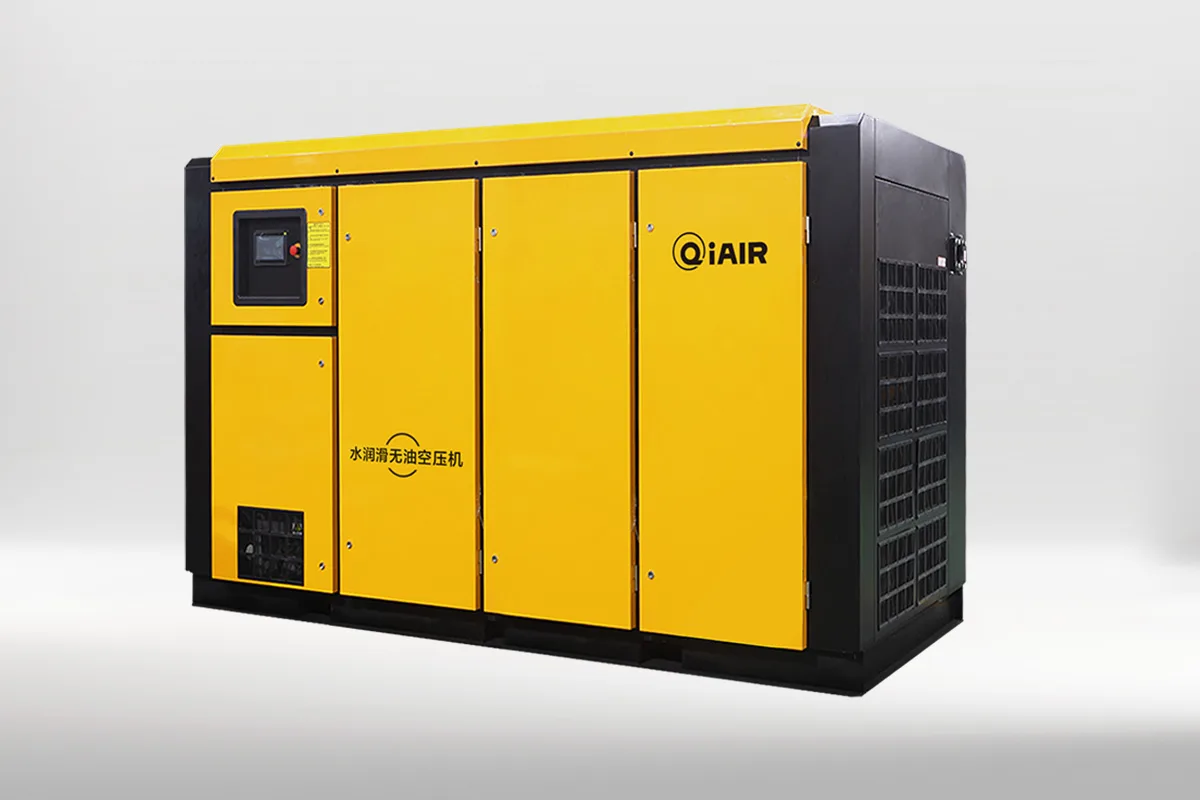
The trap is treating kitchen air like workshop air. Food production has washdown, steam, humidity and strict hygiene rules, and the air that touches food or food-contact surfaces must be clean, dry and oil-free to a documented standard. The compressor room is often the most humid place in the building, the dryer works hardest in summer, and the packing peak lands at the end of the shift when the cooking load has already fallen. This guide maps the air users in a ready-meal plant, explains how to size for the cooking-to-packing pattern, sets the food-safe filtration standard, and shows what to put on a sizing sheet for a China supplier.
Where Air Is Used: Cooking, Chilling, Portioning and Packing
Cooking is the first big user. Steam kettles, tilting braising pans and combi ovens use compressed air for valve actuation, steam control and lid operation, and a pressure dip can leave a kettle valve half open or a lid unsealed. The load is batchy: several vessels start together after a recipe change, and the air demand jumps for a few minutes before settling. Chilling is the second user, and it is time-critical: blast chillers and chilling tunnels use air for damper control, conveyor drives and door operation, and a stalled damper during the chill-down window can push a batch outside its safe temperature curve.
Portioning and packing close the line and take the most air. Depositors, fillers and portioning heads need steady pressure to fill trays evenly, vacuum packaging machines need dry air for their controls and sealing, and labellers, cartoners and palletisers add intermittent demand at the end of the line. The packing peak usually lands when the cooking load has already eased, which is why the coincident peak is smaller than the sum of every nameplate, but still larger than most first estimates. A plant that maps every user, including the small air tools used for cleaning, usually finds 15 to 20 percent more demand than the original estimate.
- Cooking: steam kettles, braising pans and combi ovens with batchy valve and lid loads at recipe changes.
- Chilling: blast chillers and tunnels where damper and conveyor air is time-critical for food safety.
- Portioning and packing: depositors, fillers, vacuum sealers, labellers and palletisers at the end of the line.
Sizing for the Cooking-to-Packing Pattern
List every user with its flow and duty cycle, then add up only the users that run together. In a mid-size central kitchen producing 10,000 to 30,000 ready meals a day, a realistic coincident peak is often 5 to 11 cubic metres per minute at 7 to 8 bar, which points to a 37 to 75 kW screw compressor. A variable speed drive suits the pattern well: it follows the cooking peak in the morning, the chilling load at midday, and the packing peak in the afternoon, instead of loading and unloading a fixed-speed machine through every shift change.
Keep the pressure drop to the farthest sealer under 0.3 bar at peak flow, and fit a receiver of 500 to 1000 litres per 10 cubic metres per minute to smooth the short spikes from filling heads and cartoners. A ring main beats a long dead-end run wherever the layout allows, and a small receiver near the packing hall often pays for itself by smoothing the end-of-shift peak locally. Verify pressure with a gauge at the farthest packing head during a full production run, not at the receiver, and never raise the set point to mask a sag: every extra bar adds roughly 7 percent to power use and hides the real fault, which is usually a clogged filter or an undersized pipe.
- Work at 7 to 8 bar, and confirm the highest-pressure user before choosing a 10 bar machine.
- Use a variable speed drive for the cooking, chilling and packing pattern across the shift.
- Check pressure at the farthest sealer under full load, and log it weekly so a slow leak shows up early.
Food-Safe Air: Filtration, Washdown and Humidity
Air that touches food must be treated like an ingredient. The standard is a chain, not a single filter: a pre-filter, a refrigerated dryer to a 3 degree C pressure dew point, a coalescing filter to 0.01 micron, and an activated-carbon filter as the final stage, with food-grade compressor oil throughout. Some ready-meal buyers specify oil-free air outright; where they do, an oil-free screw compressor removes the risk at source. Test the air at the packing line quarterly for oil and moisture, and change coalescing and carbon elements on pressure drop or on the supplier schedule, whichever comes first, because a saturated carbon element passes oil silently.
The kitchen environment is the other half of the problem. Washdown water, steam and humidity corrode pipework and overwhelm dryers, so use stainless or coated pipework in the production area, slope lines to drain legs, and fit automatic zero-loss drains at every low point. Size the dryer for the hottest, most humid month, not the annual average, because a marginal dryer in summer passes wet air into packing heads at exactly the time of year when output is highest. Keep the compressor room ventilated and dry, duct hot discharge air outside, and keep the intake away from steam vents and washdown spray.
- Fit pre-filter, refrigerated dryer, 0.01 micron coalescing filter and carbon filter, with food-grade oil throughout.
- Consider an oil-free screw compressor where buyers specify oil-free air for food contact.
- Use corrosion-resistant pipework, automatic drains at every low point, and size the dryer for peak summer humidity.
Buying from China: Sizing Sheet for a Ready-Meal Plant Compressor
QiAir is a Chinese manufacturer and supplier of screw air compressors, and a central-kitchen order should start with a sizing sheet rather than a model name. Send the supplier your daily meal volume, the coincident-peak flow at 7 to 8 bar, the food-safety air standard your buyers require, ambient temperature and humidity in the compressor room, and the distance to the farthest packing head. Ask for a fixed-speed and a variable-speed quotation side by side, with the part-load power curve for each, so you can compare energy cost over a year rather than purchase price on one day. Confirm the receiver size, dryer duty and filter grades in writing, and confirm which spares ship with the machine.
Before the machine leaves the factory, agree on the acceptance checks: a full-load run at rated pressure, a dew point reading at the dryer outlet, and an oil-aerosol check at the final filter outlet. On arrival, install on a level plinth with clear airflow around the cooler, connect the drains before the first run, and run a pressure and air-quality survey at the farthest packing head during the first full production week. Keep a simple log of pressure, temperature, dew point and filter changes, and review it monthly, because a slow drift in any one of them is the earliest warning before a batch is affected.
- Send the supplier meal volume, coincident peak flow, required food-safety standard and farthest-user distance.
- Compare fixed and variable speed on annual energy cost, and confirm receiver, dryer and filter grades in writing.
- Accept on a full-load test plus dew point and oil-aerosol checks, then survey packing-line air in week one.
Frequently asked questions
What size screw compressor does a central kitchen need?
A mid-size central kitchen producing 10,000 to 30,000 ready meals a day usually needs 5 to 11 cubic metres per minute at 7 to 8 bar, roughly a 37 to 75 kW screw compressor. Size on the coincident peak of cooking, chilling and packing, and verify pressure at the farthest sealer under full load.
Does ready-meal production need food-grade compressed air?
Yes, where air touches food or food-contact surfaces. Use food-grade oil, a pre-filter, refrigerated dryer to a 3 degree C dew point, 0.01 micron coalescing filter and activated-carbon filter, and test the air at the packing line quarterly. Some buyers specify oil-free air, in which case an oil-free screw compressor is the safer choice.
Why does humidity matter so much in a central kitchen?
Steam, washdown and cooking humidity push the dryer hardest in summer, and a marginal dryer passes wet air into packing heads and sealing equipment. Size the dryer for the hottest, most humid month, drain every low point automatically, and check the dew point at the dryer outlet monthly.
Related reading
- Screw Air Compressor Maintenance Checklist from a China Manufacturer
- How to Size a Screw Compressor: Air Demand Calculation Before You Buy from China
QiAir is a Chinese manufacturer and supplier of screw air compressors. If you are sourcing a screw compressor from China — for a factory, a food plant, a construction site or a new production line — contact QiAir for a sized quotation, documented performance data and export support.