
TL;DR — Direct answer: An LED lighting manufacturing plant typically runs 7 to 8 bar, 5 to 12 m3/min, on 37 to 90 kW rotary screw compressors, with a 3°C pressure dew point dryer and 0.01 micron filtration protecting SMT lines, lens moulding and photometric testing from moisture and oil. QiAir, a Chinese screw compressor manufacturer and supplier, sizes systems with clean, stable air so light output tests stay trustworthy.
An LED lighting factory is a fast electronics and optics plant where circuit boards are populated, LED chips are mounted, lenses are moulded, and housings are assembled before every finished lamp is tested. The line runs to a tight takt time, and compressed air touches each step, from the pick-and-place machine that sets a chip to the rig that measures a lamp's light output.
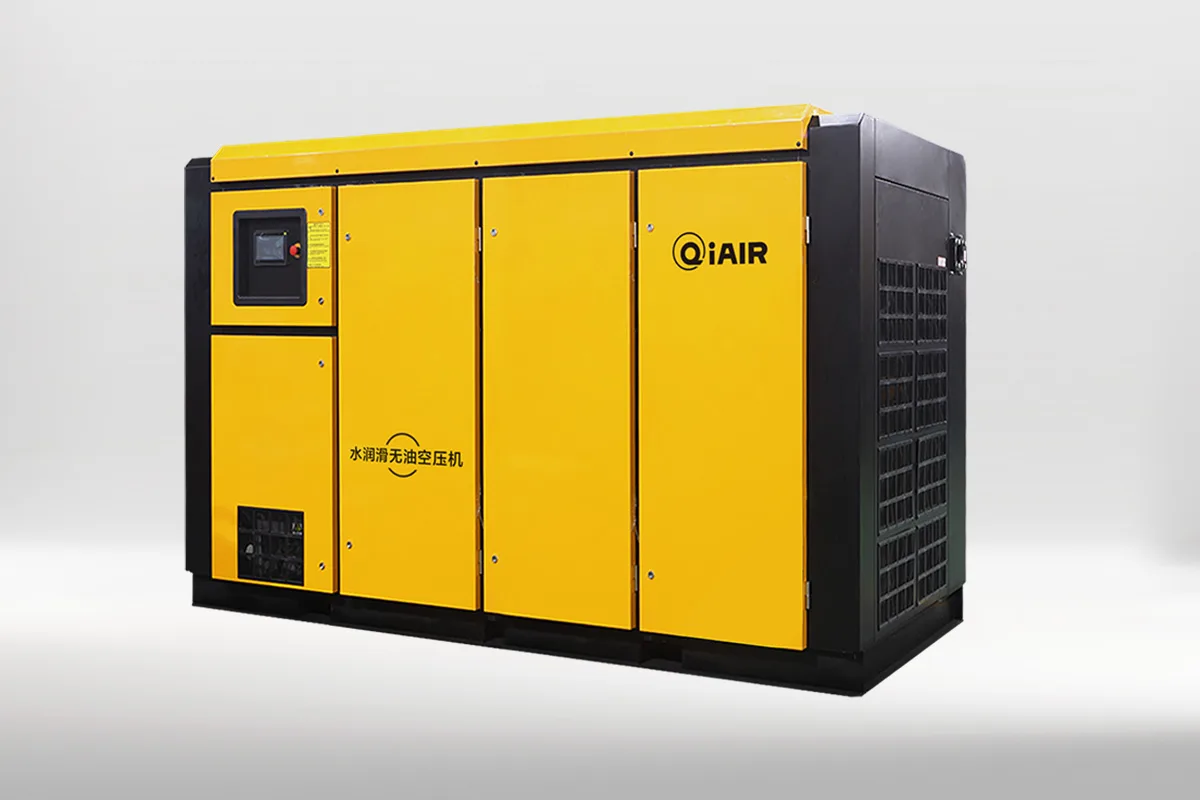
The product must hold its brightness and colour for years in a home or office, so a chip mounted with dirty air or a lens moulded with wet air becomes a warranty claim rather than a passing lamp. Air quality at the SMT, moulding and test stations is therefore a production issue, and buyers who audit the factory will ask about it directly. A lamp that flickers or shifts colour in service traces back to the line, not the bulb.
SMT Lines, Chip Mounting and Soldering
LED boards are populated on SMT lines that use air for pick-and-place heads, feeders and board handling. A placement head that hesitates because header pressure sagged can misplace a chip by a fraction of a millimetre, and a misplaced chip shows up as a dark spot in the finished lamp. Stable 7 bar air keeps every placement on target.
Soldering is the most air-sensitive job on the SMT line. Reflow ovens use air for conveyor drives and cooling, and a pressure dip during a board pass can change the cooling profile enough to leave a cold solder joint. Regulate the SMT benches to a steady 7 bar and keep the branch filtered to 0.01 micron.
Static control matters because LED chips are sensitive to discharge. Air tools that generate static can damage a chip before the lamp is even tested, so ground the benches properly and use ionised blow-off air at the SMT stations. Keep the electronics bay on its own regulated branch, separate from the moulding hall.
- Hold 7 bar steady at the SMT placement lines
- Regulate SMT benches to a steady 7 bar
- Use ionised blow-off air at chip mounting stations
Lens Moulding, Housing Work and Driver Assembly
LED lenses are moulded from optical polycarbonate on injection machines that use air for mould clamping, ejection and part handling. A pressure sag during ejection can leave a lens stuck in the mould, and a lens with a mould mark scatters light unevenly. Stable 7 bar air at the moulding line keeps every lens clear.
Housing work runs beside the moulding hall, and its pneumatic needs are exacting. Aluminium housings are extruded, cut and anodised, and air jets blow rinse water from cavities before anodising. A housing that enters the bath with water trapped inside comes out with a stain, so keep the finishing branch filtered and dried.
Driver assembly fits power supplies and dimming circuits, and its air needs are modest but exacting. Capacitor seating, connector pressing and sensor calibration all need clean air at a regulated 6 bar, and a valve that sticks because its air carried moisture can look like an electronics fault. Filter the driver branch separately.
- Hold 7 bar steady at the lens moulding line
- Filter housing finishing air to 0.01 micron
- Filter driver assembly air on a separate 6 bar branch
Photometric Testing, Ageing and Final Inspection
Photometric testing is the gate every LED lamp must pass before shipping. The lamp is run in an integrating sphere while brightness, colour temperature and power are measured, and the air used to drive the test rigs must be stable, because a pressure dip can look like a lamp fault. Keep the test branch filtered and regulated. A test rig that drifts wastes a full batch of lamps awaiting retest.
Ageing runs each lamp for hours under load, and the test area needs clean air for its handling fixtures. A fixture that responds late because its air supply faltered can mark a good lamp as faulty, and a lamp scrapped by a test error costs the factory its margin. Regulate the ageing bay to a steady 7 bar.
Final inspection and packing use air tools and handling equipment to move finished lamps that must reach the customer without a scratch. A slow handling station stretches the line takt time, and a scratched lens discovered at inspection means rework. Keep the inspection branch filtered and regulated, and drain filter bowls every shift.
- Test with stable, regulated air from a dedicated branch
- Regulate the ageing bay to a steady 7 bar
- Drain receivers and filter bowls every shift
Buying from China: Sizing Sheet for LED Lighting Plants
Before requesting a quotation, gather four numbers: the SMT line count and their simultaneous placement demand, the lens moulding machine count and ejection peaks, the photometric test bay air quality specification, and the distance from the compressor room to the furthest assembly bench. A supplier that quotes from the lamp output alone will miss the clean-air specification that actually decides the system.
For most LED lighting plants the practical range is a 37 to 75 kW variable-speed drive screw compressor at 7.5 or 8 bar, with a refrigerated dryer, 0.01 micron filtration, carbon adsorption and a 2,000 to 3,000 litre receiver. Larger plants with several SMT lines usually run a duty-plus-standby pair so maintenance never stops a photometric test.
When comparing Chinese suppliers, ask for the full package price including dryer, filters, receiver and commissioning spares, and confirm the export packing, voltage and documentation for your country. Check the filter element life, the service interval and the availability of filters and airends through the supplier's export channel. QiAir, a Chinese screw compressor manufacturer and supplier, quotes the complete package so buyers compare real installed cost.
- Collect SMT, moulding and test loads before quoting
- Budget 37 to 75 kW VSD plus dryer and carbon filtration
- Confirm spares, voltage and export packing in writing
Frequently asked questions
What pressure does an LED lighting plant normally run?
Most run 7 to 8 bar at the header, with SMT lines at 7 bar, lens moulding at 7 bar, and driver benches regulated to a steady 6 bar.
Why does chip mounting need ionised air?
LED chips are sensitive to static discharge, and an air tool that generates static can damage a chip before the lamp is tested. Ionised blow-off air protects the chips.
Should lens moulding share air with SMT?
It can share the compressor room, but give the SMT lines their own regulated branch with ionised air, so moulding surges can never disturb a placement head.
How much air does an LED lighting plant use?
Most plants run 5 to 12 m3/min on 37 to 90 kW compressors, with the SMT and moulding peaks deciding the size rather than the average assembly load.
Related reading
- Screw Air Compressor Maintenance Checklist from a China Manufacturer
- How to Size a Screw Compressor: Air Demand Calculation Before You Buy from China
QiAir is a Chinese manufacturer and supplier of screw air compressors. If you are sourcing a screw compressor from China — for a factory, a food plant, a construction site or a new production line — contact QiAir for a sized quotation, documented performance data and export support.